GBP/USD gains ground as risk appetite takes a step up
- GBP/USD rose nearly a full percent on Thursday.
- UK GDP came in firmer than expected, and US PPI figures firmed post-revision.
- US Retail Sales still in the pipe for Friday, but tariff threats have again eased.

GBP/USD rallied on Thursday, climbing over nine-tenths of one percent and tapping the 1.2560 region after economic data came in broadly better-than-expected on both sides of the Atlantic. UK Gross Domestic Product (GDP) beat median market forecasts, and US Producer Price Index (PPI) inflation figures assuaged investor concerns after an uptick in consumer-level inflation this week.
US President Donald Trump: Plan for reciprocal tariffs in the works
US President Donald Trump made a big reveal of his latest idea for drumming up tax revenues in the face of steep administrative tax cuts. “Reciprocal tariffs”, plans to levy fees against countries who have tariffs on US goods, are set to take shape over the coming months, with US Commerce Secretary Howard Lutnick tapped to work out the details.
The timeline on further tariff threats remains elusive, and investors are pricing the fresh tariff threats in as something that is not going to happen, much like President Trump’s “day one tariffs”, and tariffs on Canada and Mexico, and specific tariffs on automobiles, microchips, and pharmaceuticals. Taken in totality, there are a lot of concepts of a plan to impose stiff import taxes on US consumers and businesses, but very little real progress, and investors are betting that the trend will continue.
Forex Today: Markets now look at tariffs and US fundamentals
UK Q4 GDP clocked in at 1.4% YoY, well above the forecast 1.1%, and rising even further from the previous period’s revised 1.0%. QoQ GDP also beat the street, rising to 0.1% versus the forecast -0.1% contraction.
On the US side, PPI business-level inflation came in above expectations, but sharp revisions to previous figures gave investors the opportunity to interpret the latest batch of price data as showing easing inflation pressures. Core PPI inflation for the year ended in January came in at 3.6% YoY, well above the forecast 3.3% but a tick below the revised figure of 3.7%, which initially printed at 3.5%.
US Retail Sales are all that remains in the barrel for the remainder of the week’s key data. Markets will be hoping for another firm print, with the monthly Retail Sales figure forecast to come in at a slight contraction of -0.1% compared to the previous 0.4%.
GBP/USD price forecast
After weeks of bullish effort, GBP/USD is finally back above the 50-day Exponential Moving Average (EMA) near the 1.2500 handle. There is still plenty of room to the downside that bulls can fall after several weeks of congestion, but the next immediate technical barrier to the upside sits at the 200-day EMA parked just below 1.2700.
GBP/USD daily chart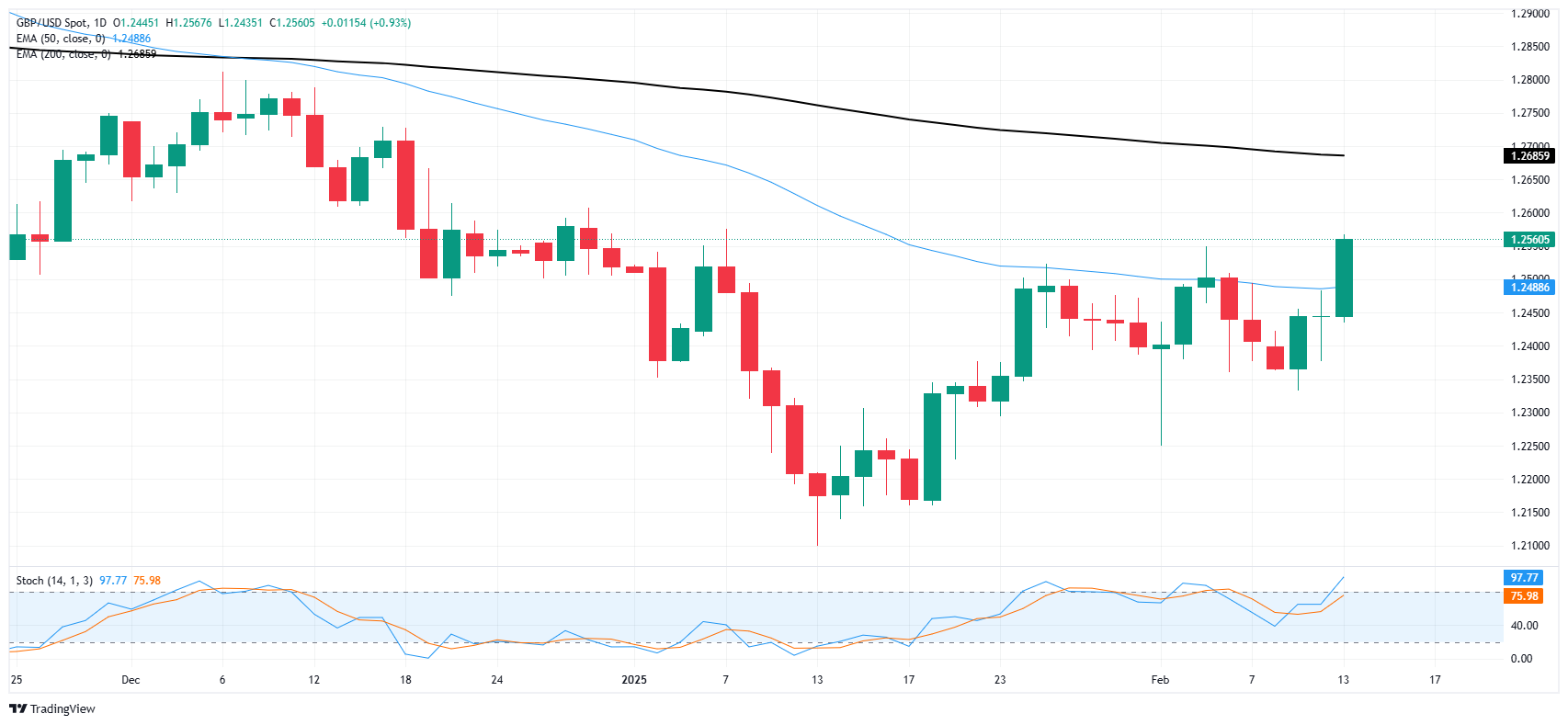
Pound Sterling FAQs
The Pound Sterling (GBP) is the oldest currency in the world (886 AD) and the official currency of the United Kingdom. It is the fourth most traded unit for foreign exchange (FX) in the world, accounting for 12% of all transactions, averaging $630 billion a day, according to 2022 data. Its key trading pairs are GBP/USD, also known as ‘Cable’, which accounts for 11% of FX, GBP/JPY, or the ‘Dragon’ as it is known by traders (3%), and EUR/GBP (2%). The Pound Sterling is issued by the Bank of England (BoE).
The single most important factor influencing the value of the Pound Sterling is monetary policy decided by the Bank of England. The BoE bases its decisions on whether it has achieved its primary goal of “price stability” – a steady inflation rate of around 2%. Its primary tool for achieving this is the adjustment of interest rates. When inflation is too high, the BoE will try to rein it in by raising interest rates, making it more expensive for people and businesses to access credit. This is generally positive for GBP, as higher interest rates make the UK a more attractive place for global investors to park their money. When inflation falls too low it is a sign economic growth is slowing. In this scenario, the BoE will consider lowering interest rates to cheapen credit so businesses will borrow more to invest in growth-generating projects.
Data releases gauge the health of the economy and can impact the value of the Pound Sterling. Indicators such as GDP, Manufacturing and Services PMIs, and employment can all influence the direction of the GBP. A strong economy is good for Sterling. Not only does it attract more foreign investment but it may encourage the BoE to put up interest rates, which will directly strengthen GBP. Otherwise, if economic data is weak, the Pound Sterling is likely to fall.
Another significant data release for the Pound Sterling is the Trade Balance. This indicator measures the difference between what a country earns from its exports and what it spends on imports over a given period. If a country produces highly sought-after exports, its currency will benefit purely from the extra demand created from foreign buyers seeking to purchase these goods. Therefore, a positive net Trade Balance strengthens a currency and vice versa for a negative balance.
Author

Joshua Gibson
FXStreet
Joshua joins the FXStreet team as an Economics and Finance double major from Vancouver Island University with twelve years' experience as an independent trader focusing on technical analysis.