GBP/USD flat as US shutdown drags into sixth day
- Traders brace for a prolonged shutdown with White House warning of mass federal layoffs if no deal is reached.
- Deutsche Bank warns UoM Consumer Sentiment could hit record lows as confidence erodes during fiscal gridlock.
- UK data sparse; Construction PMI improves slightly while ONS revisions deepen concerns over slowing household savings.

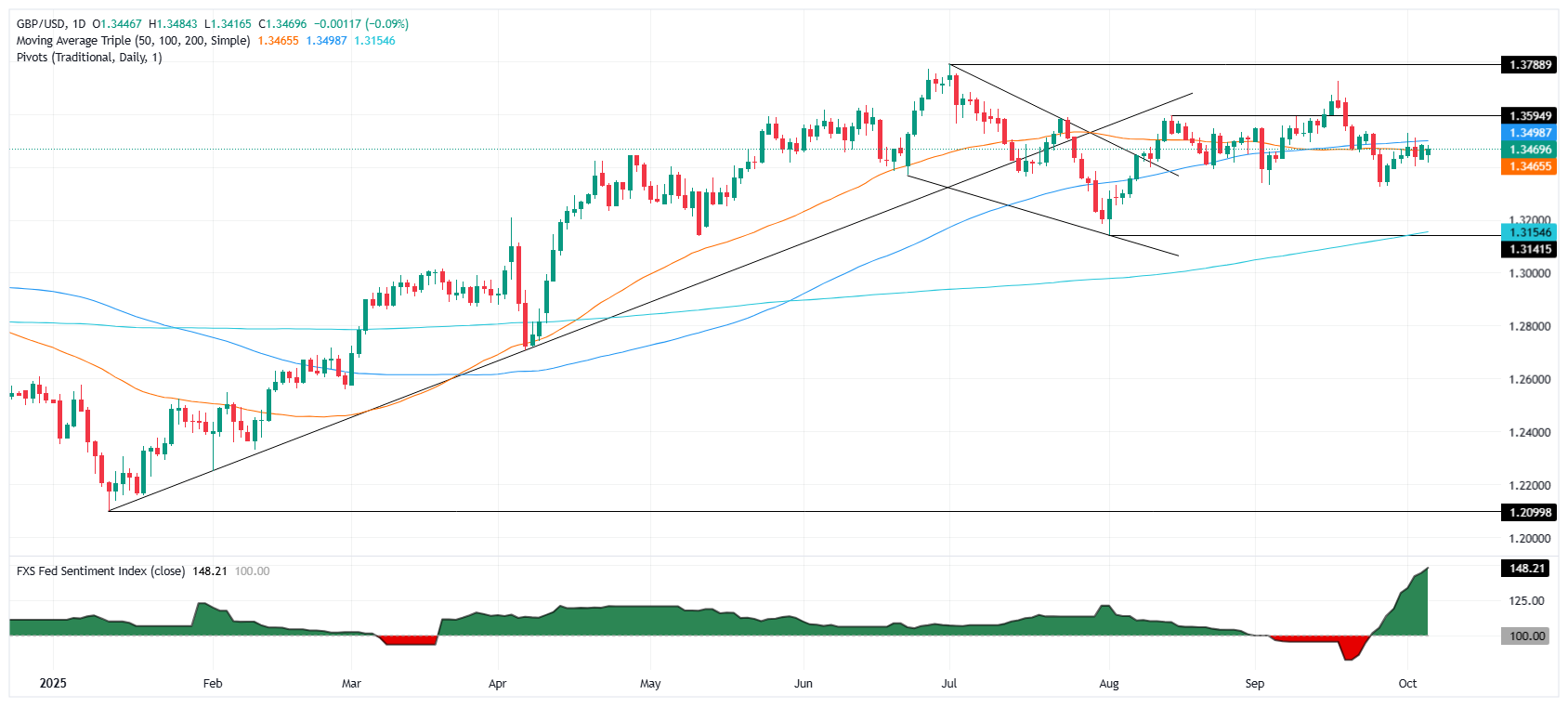
The Pound Sterling (GBP) remains flat during the North American session on Monday as the US government shutdown reaches its sixth day, which has kept financial markets trading blind due to the lack of economic data. GBP/USD trades at around 1.3474, virtually unchanged.
Sterling steadies near 1.3470 as markets trade without data; Senate vote and Fed speakers dominate week ahead
The US Senate is set to vote late Monday on a House bill that would temporarily fund the government, according to Bloomberg. The White House continued to exert pressure on Democrats, giving them another chance to pass the spending bill before initiating mass firings of federal workers. The US docket will feature Federal Reserve (Fed) speakers throughout the week, along with the Federal Open Market Committee (FOMC) last meeting minutes.
The economic data release is expected to be anemic, with traders waiting for the University of Michigan (UoM) Consumer Sentiment due Friday, which is forecast to worsen, according to Deutsche Bank analysts. They wrote that “historically confidence has fallen during shutdowns, so we'll see if that creeps into the data. It's possible we'll see a record low below the 50.0 reading seen in June 2022. Our economists expect 50.1 against 55 the previous month.”
In the UK, economic data is thin, with S&P Global revealing the Construction PMI in September, which improved from 45.5 to 46.2.
The Times reported that the UK economy is dwindling, amid the ongoing revision of the Office for National Statistics (ONS) data, which increased doubts about how much households have been saving.
The divergence between the US and UK central banks could favor further upside on the pair. Nevertheless, a stagflationary scenario developing in the UK and a prolonged extension of the US government shutdown could boost the US Dollar, due to its safety status.
GBP/USD Price Forecast: Technical outlook
The technical picture indicates GBP/USD is poised to remain subdued amid the lack of catalysts. On the upside, it is limited by the 100-day SMA at 1.3495, followed by the 20-day SMA at 1.3500. If those levels are cleared, the next resistance would be the September 17 high at 1.3726.
Conversely, a break below 1.3400 will expose the September 25 swing low of 1.3324, ahead of the 1.3300 figure.
Pound Sterling Price This Month
The table below shows the percentage change of British Pound (GBP) against listed major currencies this month. British Pound was the strongest against the Japanese Yen.
| USD | EUR | GBP | JPY | CAD | AUD | NZD | CHF | |
|---|---|---|---|---|---|---|---|---|
| USD | 0.24% | -0.21% | 1.46% | 0.22% | -0.06% | -0.73% | -0.10% | |
| EUR | -0.24% | -0.44% | 1.19% | -0.03% | -0.28% | -0.95% | -0.35% | |
| GBP | 0.21% | 0.44% | 1.68% | 0.41% | 0.16% | -0.51% | 0.10% | |
| JPY | -1.46% | -1.19% | -1.68% | -1.22% | -1.53% | -1.95% | -1.46% | |
| CAD | -0.22% | 0.03% | -0.41% | 1.22% | -0.28% | -0.93% | -0.32% | |
| AUD | 0.06% | 0.28% | -0.16% | 1.53% | 0.28% | -0.67% | -0.06% | |
| NZD | 0.73% | 0.95% | 0.51% | 1.95% | 0.93% | 0.67% | 0.62% | |
| CHF | 0.10% | 0.35% | -0.10% | 1.46% | 0.32% | 0.06% | -0.62% |
The heat map shows percentage changes of major currencies against each other. The base currency is picked from the left column, while the quote currency is picked from the top row. For example, if you pick the British Pound from the left column and move along the horizontal line to the US Dollar, the percentage change displayed in the box will represent GBP (base)/USD (quote).
Author

Christian Borjon Valencia
FXStreet
Markets analyst, news editor, and trading instructor with over 14 years of experience across FX, commodities, US equity indices, and global macro markets.

















