GBP/USD flat as UK unemployment rise boosts BoE rate cut expectations
- GBP/USD remains flat as UK unemployment rises to 5%, fueling speculation of a December BoE rate cut.
- Private wage growth slows to 4.2% YoY, signaling a cooling labor market and easing inflation pressures.
- US Senate passes funding bill to reopen government, lifting risk appetite ahead of House approval.

The Pound Sterling (GBP) recovers some ground and trims some earlier losses on Tuesday following the release of softer-than-expected labor market figures in the UK, increasing speculation that the Bank of England (BoE) could cut rates at its December meeting. At the time of writing, GBP/USD trades at 1.3172, virtually unchanged.
Sterling trims losses as weak labor figures boost BoE rate-cut expectations
Risk appetite improved after the US Senate approved the stopgap funding bill in a 60-40 vote during the overnight session. Now the bill is headed to the House of Representatives, where the leader of the Republicans and House Speaker Mike Johnson commented that he has the votes to approve it and reopen the government.
Meanwhile, the lack of economic data keeps traders leaning into other data. The NFIB Small Business Optimism Index fell in October to 98.2 but stood above the 52-year average of 98. The Uncertainty Index fell 12 points from September to 88, the lowest reading of this year.
The NFIB Small Business Optimism Index declined 0.6 points in October to 98.2 but remained above its 52-year average of 98. The Uncertainty Index fell 12 points from September to 88, the lowest reading of this year.
“Optimism among small businesses declined slightly in October as owners report lower sales and reduced profits,” said NFIB Chief Economist Bill Dunkelberg. He added, “Many firms are still navigating a labor shortage and want to hire but are having difficulty doing so.”
Data from ADP showed that the United States lost an average of 11,250 private-sector jobs in the four weeks ending October 25, compared with 14,250 previously.
In the UK, the latest jobs report showed that the Unemployment Rate rose by 5% in September, exceeding the Bank of England (BoE) estimates for the second straight month. The data has increased the chances for the BoE to reduce interest rates at the December meeting, as private sector wages also moderated to 4.2% YoY, meaning that the jobs market continued to soften.
Traders had priced 21 bps of BoE rate cuts for December, up from 17 bps before the jobs data, and 65 bps of easing by December 2026 versus 58 bps before.
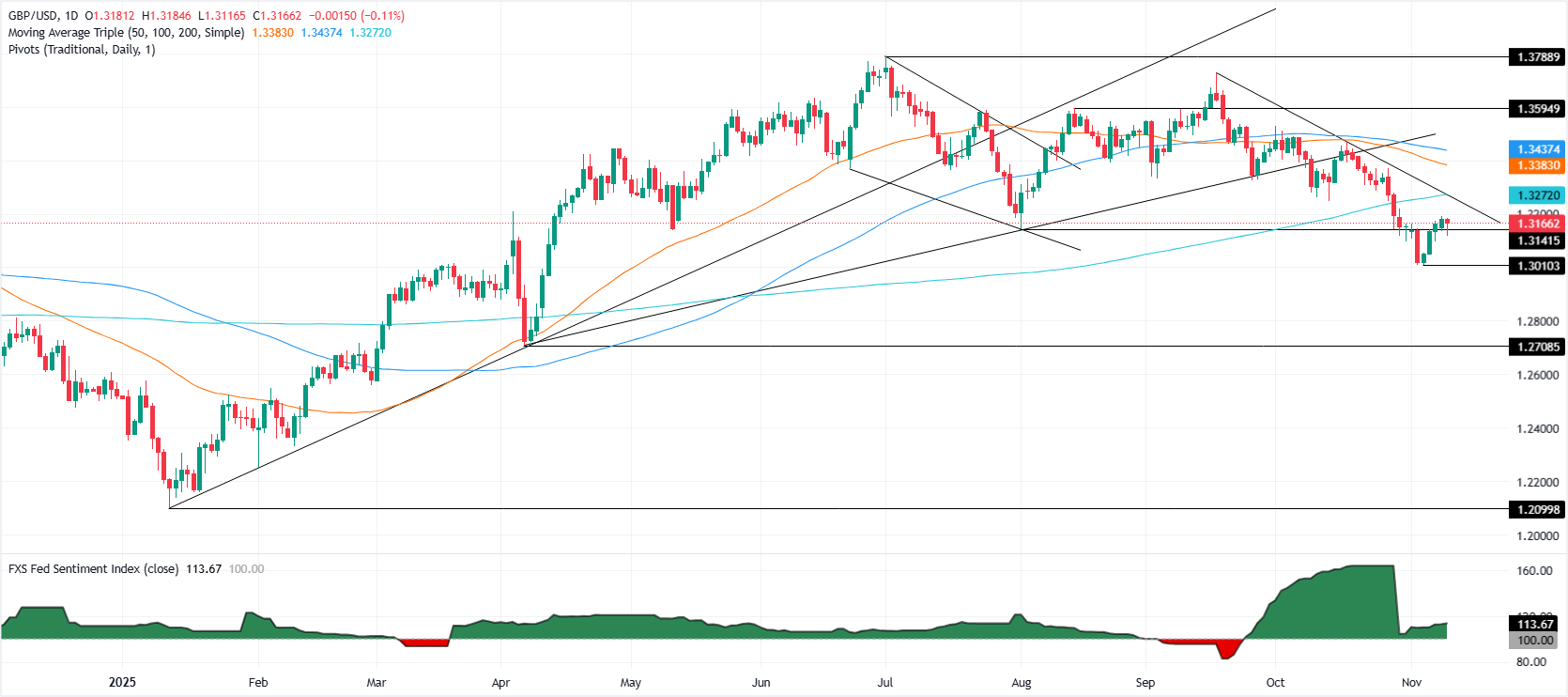
GBP/USD Price Forecast: Technical outlook
The technical picture suggests that GBP/USD appears to have peaked at around 1.3180 in the short term, with buyers remaining unable to crack 1.3200. A breach of the latter will expose the confluence of the 20 and 200-day SMAs at around 1.3248/68.
A decisive break or daily close below 1.3150 exposes the 1.3100 milestone, ahead of sellers driving the exchange rate towards the November 4 cycle low of 1.3010.
Pound Sterling FAQs
The Pound Sterling (GBP) is the oldest currency in the world (886 AD) and the official currency of the United Kingdom. It is the fourth most traded unit for foreign exchange (FX) in the world, accounting for 12% of all transactions, averaging $630 billion a day, according to 2022 data. Its key trading pairs are GBP/USD, also known as ‘Cable’, which accounts for 11% of FX, GBP/JPY, or the ‘Dragon’ as it is known by traders (3%), and EUR/GBP (2%). The Pound Sterling is issued by the Bank of England (BoE).
The single most important factor influencing the value of the Pound Sterling is monetary policy decided by the Bank of England. The BoE bases its decisions on whether it has achieved its primary goal of “price stability” – a steady inflation rate of around 2%. Its primary tool for achieving this is the adjustment of interest rates. When inflation is too high, the BoE will try to rein it in by raising interest rates, making it more expensive for people and businesses to access credit. This is generally positive for GBP, as higher interest rates make the UK a more attractive place for global investors to park their money. When inflation falls too low it is a sign economic growth is slowing. In this scenario, the BoE will consider lowering interest rates to cheapen credit so businesses will borrow more to invest in growth-generating projects.
Data releases gauge the health of the economy and can impact the value of the Pound Sterling. Indicators such as GDP, Manufacturing and Services PMIs, and employment can all influence the direction of the GBP. A strong economy is good for Sterling. Not only does it attract more foreign investment but it may encourage the BoE to put up interest rates, which will directly strengthen GBP. Otherwise, if economic data is weak, the Pound Sterling is likely to fall.
Another significant data release for the Pound Sterling is the Trade Balance. This indicator measures the difference between what a country earns from its exports and what it spends on imports over a given period. If a country produces highly sought-after exports, its currency will benefit purely from the extra demand created from foreign buyers seeking to purchase these goods. Therefore, a positive net Trade Balance strengthens a currency and vice versa for a negative balance.
Author

Christian Borjon Valencia
FXStreet
Markets analyst, news editor, and trading instructor with over 14 years of experience across FX, commodities, US equity indices, and global macro markets.

















