GBP/USD firm as Fed easing bets outweigh soft US PMI signals
- GBP/USD climbs to 1.3092 as traders raise odds of a December Fed cut following upbeat US sentiment data.
- US PMIs show resilient business activity, while Michigan survey reveals improving confidence and easing inflation expectations.
- Fed officials remain divided, with Logan and Collins urging caution as Williams and Miran signal support for near-term easing.

The Pound Sterling turns positive in the day as traders increase their bets that the Federal Reserve could cut rates at the December meeting. The GBP/USD trades at 1.3082 up 0.08%.
Sterling turns positive as improved US sentiment and dovish Fed voices lift December rate-cut expectations
The US economic docket revealed that business activity in the US remained solid according to S&P Global. The Manufacturing PMI dipped from 52.5 to 51.9, slightly below the 52 estimates Conversely, the Services PMI improved from 54.6 to 54.8, above forecasts of 54.5. Comments of the survey showed that business confidence has improved, and that hopes for additional rate cuts and the government reopening “improved economic optimism.”
At the same time, the University of Michigan revealed that Consumer Sentiment in November, improved to 51 from 50.3, above forecasts. Inflation expectations edged lower, for one year from 4.7% to 4.5%, and for five years, from 3.6% to 3.4%.
Federal Reserve officials split between cutting or no cutting
On Friday, Dallas Fed Lorie Logan said that rates need to be on hold “for a time” while they assess the impact of current policy over inflation. She said she finds “difficult” to cut in December. Boston Fed Susan Collins coincided with Logan’s adding that “restrictive policy is very appropriate right now.”
On the other hand, the New York Fed John Williams said they can still cut rates in the “near-term”, which boosted odds for a December move. Echoing some of his words was Governor Stephen Miran, who said that Thursday’s data favors a December rate cut, and that if his vote was the marginal one, he “would vote for a 25 bps cut.”
In the UK, Retail Sales were weaker than expected in October, and flash PMIs for November were mixed, with the Manufacturing PMI improving, while the Services PMI approached the 50 neutral threshold.
GBP/USD Price Forecast: Technical outlook
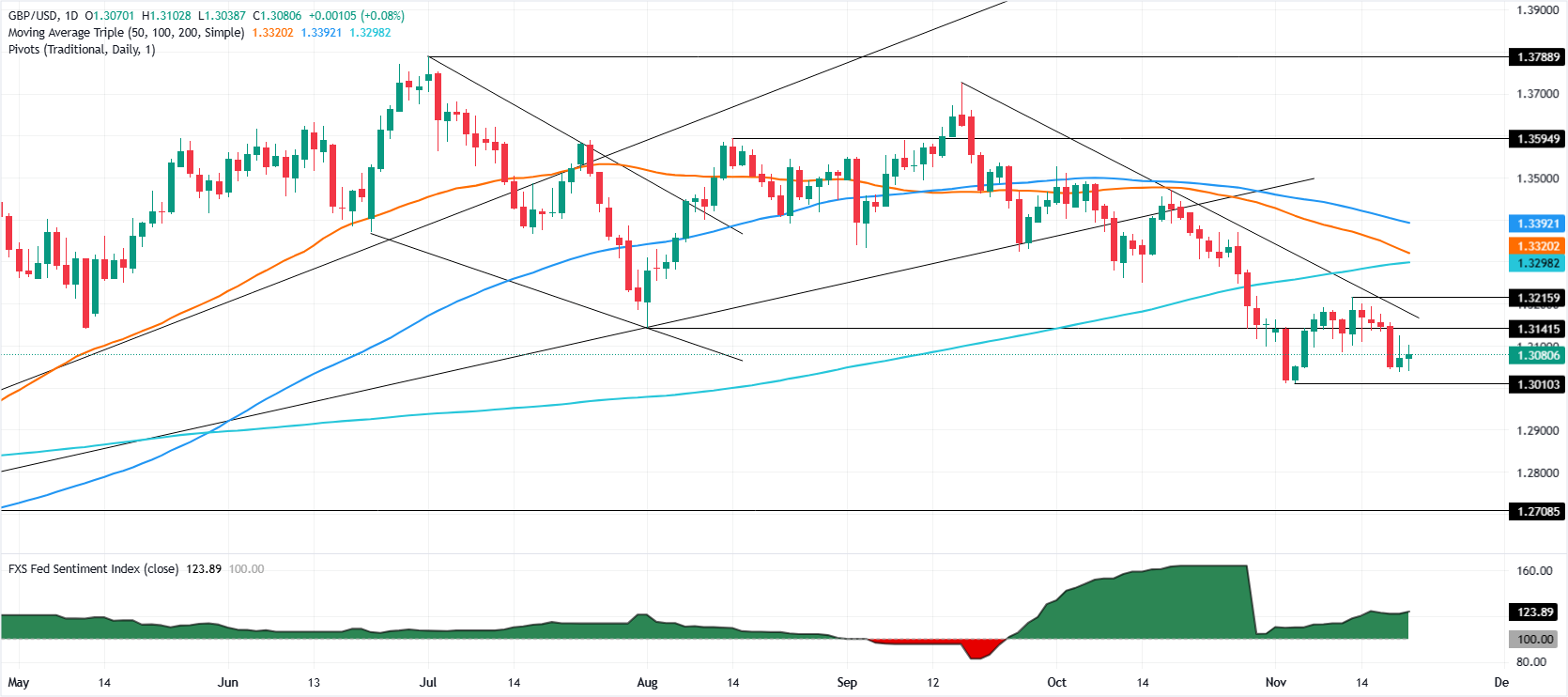
The GBP/USD remains biased, technically speaking. After hitting a weekly high of 1.3193, the pair continued its downtrend and if buyers would like to regain control, the pair must clear key resistance levels like the 1.3100 mark, the 20-day SMA at 1.3146 and 1.3200.
Conversely, the GBP/USD first support would be 1.3050. Once breached, the next support would be the 1.3000 mark, followed by the April 8 swing low of 1.2764.
Pound Sterling Price This week
The table below shows the percentage change of British Pound (GBP) against listed major currencies this week. British Pound was the strongest against the Swiss Franc.
| USD | EUR | GBP | JPY | CAD | AUD | NZD | CHF | |
|---|---|---|---|---|---|---|---|---|
| USD | 1.07% | 0.63% | 1.20% | 0.71% | 1.59% | 1.52% | 1.81% | |
| EUR | -1.07% | -0.33% | 0.49% | -0.34% | 0.51% | 0.47% | 0.75% | |
| GBP | -0.63% | 0.33% | 0.57% | -0.01% | 0.84% | 0.80% | 1.09% | |
| JPY | -1.20% | -0.49% | -0.57% | -0.47% | 0.40% | 0.32% | 0.57% | |
| CAD | -0.71% | 0.34% | 0.00% | 0.47% | 0.87% | 0.80% | 1.10% | |
| AUD | -1.59% | -0.51% | -0.84% | -0.40% | -0.87% | -0.03% | 0.25% | |
| NZD | -1.52% | -0.47% | -0.80% | -0.32% | -0.80% | 0.03% | 0.29% | |
| CHF | -1.81% | -0.75% | -1.09% | -0.57% | -1.10% | -0.25% | -0.29% |
The heat map shows percentage changes of major currencies against each other. The base currency is picked from the left column, while the quote currency is picked from the top row. For example, if you pick the British Pound from the left column and move along the horizontal line to the US Dollar, the percentage change displayed in the box will represent GBP (base)/USD (quote).
Author

Christian Borjon Valencia
FXStreet
Markets analyst, news editor, and trading instructor with over 14 years of experience across FX, commodities, US equity indices, and global macro markets.