GBP/USD finds uneasy gains ahead of US government shutdown
- GBP/USD gained a slight edge on Tuesday, creeping into a third straight bullish session.
- Market reactions remain limited for the time being, but investors are keenly watching as the US government heads into a shutdown.
- This week's NFP jobs report is set to be canceled or delayed.

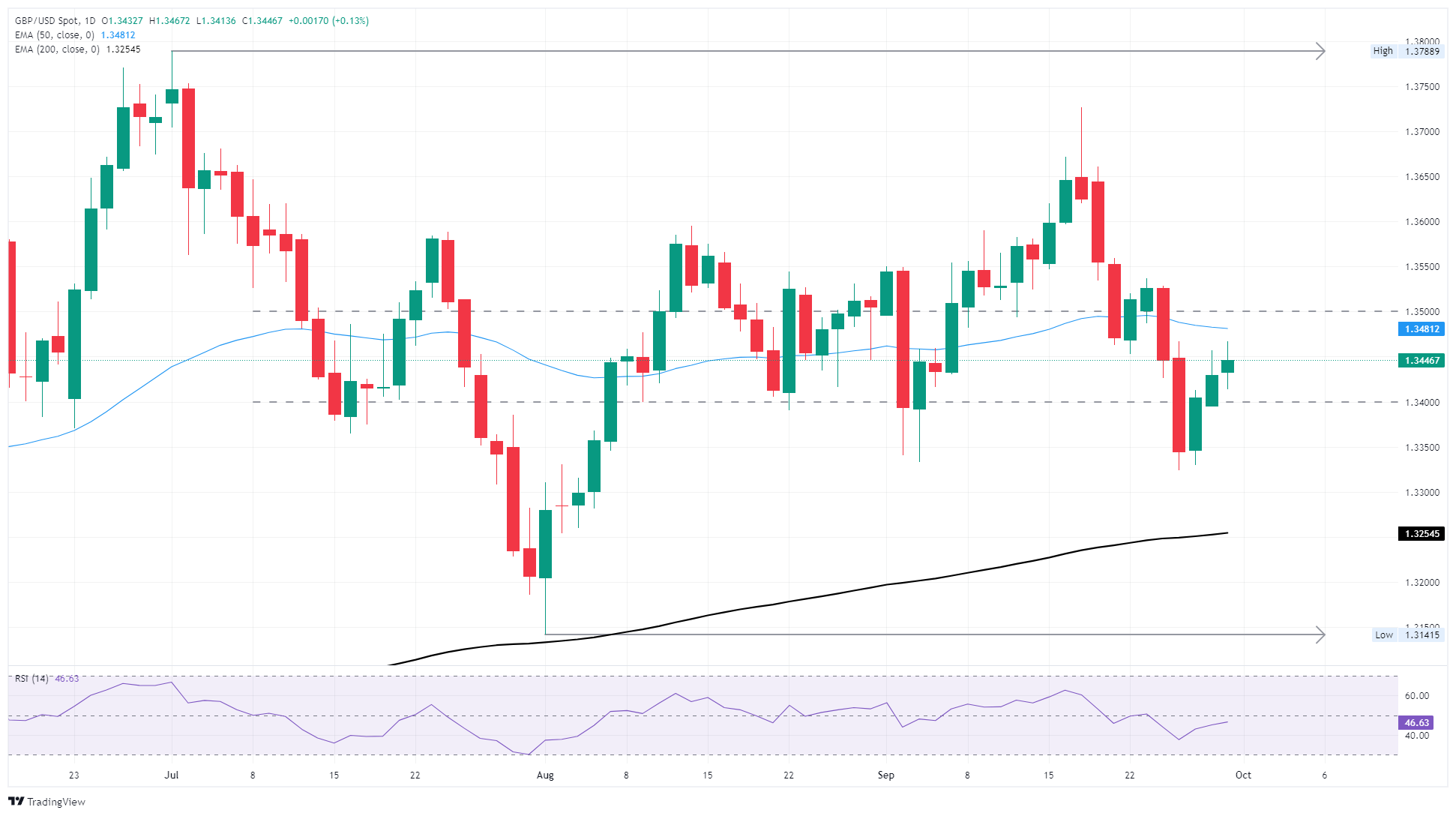
GBP/USD caught a slight lift on Tuesday, creeping into the 1.3450 region and tilting into a third straight bullish session. United Kingdom (UK) Gross Domestic Product (GDP) growth figures beat expectations, bolstering the Pound Sterling (GBP), while US Dollar (USD) flows hunkered in place as investors brace for the US government's latest funding crisis shutdown.
UK GDP accelerated to 1.4% YoY in Q2, rising above the expected hold at 1.2%. GBP flows tilted bullish afterward, but FX market flows have broadly drawn down ahead of the US government shutdown, which was confirmed after Congress retired early on Tuesday, forcing the US federal government to cross the fiscal year rollover on October 1 without a functioning government budget plan.
Institute of Supply Management (ISM) Purchasing Managers Index (PMI) figures from the US are due on Wednesday, as well as the latest ADP Employment Change data for September. The Chicago Advance PMI contracted sharply, casting fresh doubt on the median market forecast for Wednesday's ISM PMI print, which is expected to tick up to 49.0 from 48.7.
ADP Employment Change is expected to shift slightly lower, falling to 50K from the previous 54K. ADP jobs data has a tenuous-at-best relationship with Nonfarm Payrolls (NFP) data, but investors lacking access to trustworthy government data will have little choice but to tilt further into the ADP figures this week.
The US Bureau of Labor Statistics (BLS) has already announced that they will be canceling or delaying the latest NFP jobs numbers if the US government shuts down. NFP, which was scheduled to release this Friday, has become a large question mark for markets.
GBP/USD price forecast
A third straight bullish day on the Cable chart has pushed GBP/USD bidsa into an uneasy middle ground between key moving averages. Bullish price action is facing a sharp slowing in momentum just below the 50-day Exponential Moving Average (EMA) near 1.3480. On the bottom end, the 200-day EMA is providing a firm technical floor from the 1.3250 region.
GBP/USD daily chart
Pound Sterling FAQs
The Pound Sterling (GBP) is the oldest currency in the world (886 AD) and the official currency of the United Kingdom. It is the fourth most traded unit for foreign exchange (FX) in the world, accounting for 12% of all transactions, averaging $630 billion a day, according to 2022 data. Its key trading pairs are GBP/USD, also known as ‘Cable’, which accounts for 11% of FX, GBP/JPY, or the ‘Dragon’ as it is known by traders (3%), and EUR/GBP (2%). The Pound Sterling is issued by the Bank of England (BoE).
The single most important factor influencing the value of the Pound Sterling is monetary policy decided by the Bank of England. The BoE bases its decisions on whether it has achieved its primary goal of “price stability” – a steady inflation rate of around 2%. Its primary tool for achieving this is the adjustment of interest rates. When inflation is too high, the BoE will try to rein it in by raising interest rates, making it more expensive for people and businesses to access credit. This is generally positive for GBP, as higher interest rates make the UK a more attractive place for global investors to park their money. When inflation falls too low it is a sign economic growth is slowing. In this scenario, the BoE will consider lowering interest rates to cheapen credit so businesses will borrow more to invest in growth-generating projects.
Data releases gauge the health of the economy and can impact the value of the Pound Sterling. Indicators such as GDP, Manufacturing and Services PMIs, and employment can all influence the direction of the GBP. A strong economy is good for Sterling. Not only does it attract more foreign investment but it may encourage the BoE to put up interest rates, which will directly strengthen GBP. Otherwise, if economic data is weak, the Pound Sterling is likely to fall.
Another significant data release for the Pound Sterling is the Trade Balance. This indicator measures the difference between what a country earns from its exports and what it spends on imports over a given period. If a country produces highly sought-after exports, its currency will benefit purely from the extra demand created from foreign buyers seeking to purchase these goods. Therefore, a positive net Trade Balance strengthens a currency and vice versa for a negative balance.
Author

Joshua Gibson
FXStreet
Joshua joins the FXStreet team as an Economics and Finance double major from Vancouver Island University with twelve years' experience as an independent trader focusing on technical analysis.

















