GBP/USD slips as BoE holds rates, scales back QT and signals future cuts
- GBP/USD retreats after BoE 7–2 vote leaves rates unchanged and trims Quantitative Tightening program to £70B.
- UK inflation nearly doubles the target; Bailey signals more cuts ahead, though timing remains uncertain.
- US Jobless Claims ease to 231K, while Powell cites immigration as labor headwinds.

The British Pound (GBP) reversed its course, dropping over 0.51% on Thursday following the Bank of England’s (BoE) decision to hold rates unchanged, after the Federal Reserve (Fed) began its 2025 easing cycle. The GBP/USD pair trades at 1.3551 after hitting a daily high of 1.3660.
Pound slides after BoE keeps Bank Rate at 4% and scales back QT, diverging from Fed’s easing cycle
The economic schedule on both sides of the Atlantic has been busy. US Initial Jobless Claims for the week ending September 13 came at 231K, below forecasts of 240K and the previous week upward revised 264K. Continuing Claims dipped from 1.939 million to 1.920 million
Although the data was positive, hiring has slowed as most economists blamed tariffs. The Fed Chair Jerome Powell mentioned that the lack of immigration is another reason weighing on the labor market.
Earlier, the Bank of England maintained the Bank Rate at 4% as expected, on a 7-2 vote split, and reduced the Quantitative Tightening (QT) from £100 billion to £70 billion. Worth noting, in the previous meeting, the BoE reduced rates even though inflation in the UK is almost twice the bank’s 2% target.
BoE Governor Andrew Bailey said that there will be more rate cuts, though added that the timing and scale are uncertain.
Ahead, the UK economic docket will feature Retail Sales data. In the US, the calendar is empty, though traders should be aware that the Fed blackout period ended and that some officials could cross the newswires.
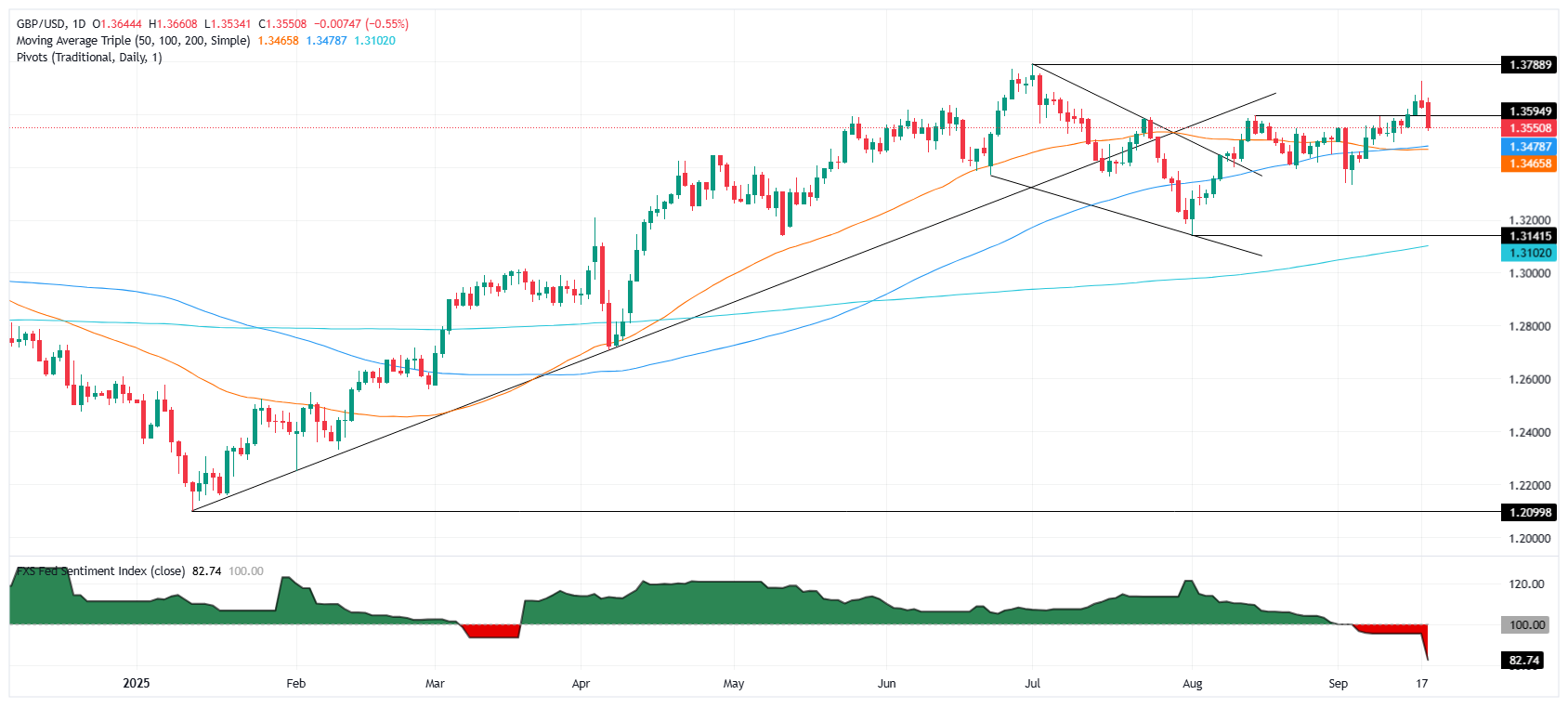
GBP/USD Price Forecast: Mild-bearish as evening star emerges
GBP/USD shifted from being upward biased to consolidate within the 1.3500 – 1.3650 area as an 'evening star' emerges. If bears would like to push the exchange rate lower, they must clear the 20-day SMA at 1.3521, followed by the September 11 swing low of 1.3491. Once cleared, the next area of interest would be the confluence of the 100 and 50-day SMAs at around 1.3475/62.
On the flip side, a GBP/USD daily close above 1.3600 could cement the case for another attempt to challenge the yearly peak at 1.3788.
Pound Sterling FAQs
The Pound Sterling (GBP) is the oldest currency in the world (886 AD) and the official currency of the United Kingdom. It is the fourth most traded unit for foreign exchange (FX) in the world, accounting for 12% of all transactions, averaging $630 billion a day, according to 2022 data. Its key trading pairs are GBP/USD, also known as ‘Cable’, which accounts for 11% of FX, GBP/JPY, or the ‘Dragon’ as it is known by traders (3%), and EUR/GBP (2%). The Pound Sterling is issued by the Bank of England (BoE).
The single most important factor influencing the value of the Pound Sterling is monetary policy decided by the Bank of England. The BoE bases its decisions on whether it has achieved its primary goal of “price stability” – a steady inflation rate of around 2%. Its primary tool for achieving this is the adjustment of interest rates. When inflation is too high, the BoE will try to rein it in by raising interest rates, making it more expensive for people and businesses to access credit. This is generally positive for GBP, as higher interest rates make the UK a more attractive place for global investors to park their money. When inflation falls too low it is a sign economic growth is slowing. In this scenario, the BoE will consider lowering interest rates to cheapen credit so businesses will borrow more to invest in growth-generating projects.
Data releases gauge the health of the economy and can impact the value of the Pound Sterling. Indicators such as GDP, Manufacturing and Services PMIs, and employment can all influence the direction of the GBP. A strong economy is good for Sterling. Not only does it attract more foreign investment but it may encourage the BoE to put up interest rates, which will directly strengthen GBP. Otherwise, if economic data is weak, the Pound Sterling is likely to fall.
Another significant data release for the Pound Sterling is the Trade Balance. This indicator measures the difference between what a country earns from its exports and what it spends on imports over a given period. If a country produces highly sought-after exports, its currency will benefit purely from the extra demand created from foreign buyers seeking to purchase these goods. Therefore, a positive net Trade Balance strengthens a currency and vice versa for a negative balance.
Author

Christian Borjon Valencia
FXStreet
Markets analyst, news editor, and trading instructor with over 14 years of experience across FX, commodities, US equity indices, and global macro markets.

















