GBP/USD crosses 1.34 for the first time since March of 2023
- GBP/USD continues Pound rally on Greenback weakness.
- US consumer sentiment data shows US consumer still fear inflation.
- Markets have leaned into higher expectations of further outsized Fed cuts.

GBP/USD extended the ongoing Pound Sterling rally for another consecutive day, crossing the 1.3400 handle and chalking in fresh 30-month highs after the US Dollar broadly weakened on Tuesday. The Greenback’s market-wide withering gave Cable exactly what it needed to keep the current Pound Sterling bull run on-balance.
Wednesday will be a quiet showing for the Pound Sterling on the data docket, although GBP traders will be keeping one eye out for statements from Bank of England (BoE) Monetary Policy Committee (MPC) member Megan Greene. MPC Member Greene will be speaking at the North East Chamber of Commerce in England.
The American side of Tuesday’s economic data docket is similarly under-weighted for the midweek market session. August’s New Homes Sales MoM figure is unlikely to drive much momentum in either direction, and will be followed by a speech from Federal Reserve (Fed) Board of Governors member Adriana Kugler, who will be speaking at the Harvard Kennedy School in Cambridge.
Consumer confidence deteriorated across the board on Tuesday, and consumer expectations of 12-month inflation accelerated to 5.2%. Consumers also reported a general weakening of their six-month family financial situation outlook, and consumer assessments of overall business conditions have turned negative.
Backsliding consumer confidence results sparked a renewed bid in rate markets for a follow-up jumbo cut in November. According to the CME’s FedWatch Tool, rate markets are pricing in nearly 60% odds of a second 50 bps rate cut on November 7, and only 40% odds of a more reasonable 25 bps follow-up rate trim. Rate traders were pricing in roughly even odds of a 50 or 25 bps rate cut at the beginning of the week.
GBP/USD price forecast
CAble buyers continue to shrug off all near-term warning signs, pushing GBP/USD deeper into overbought territory. The pair has gained over 3% over the last two weeks, rallying from the last swing low on daily candlesticks into the 1.3000 handle.
With price action trading north of 1.3400, short sellers are faced with difficult choices; while Cable looks increasingly appetizing for a snap play to the low side, a lack of technical resistance means timing a short entry carries excessive risks to bid directly against still-healthy bullish momentum.
GBP/USD daily chart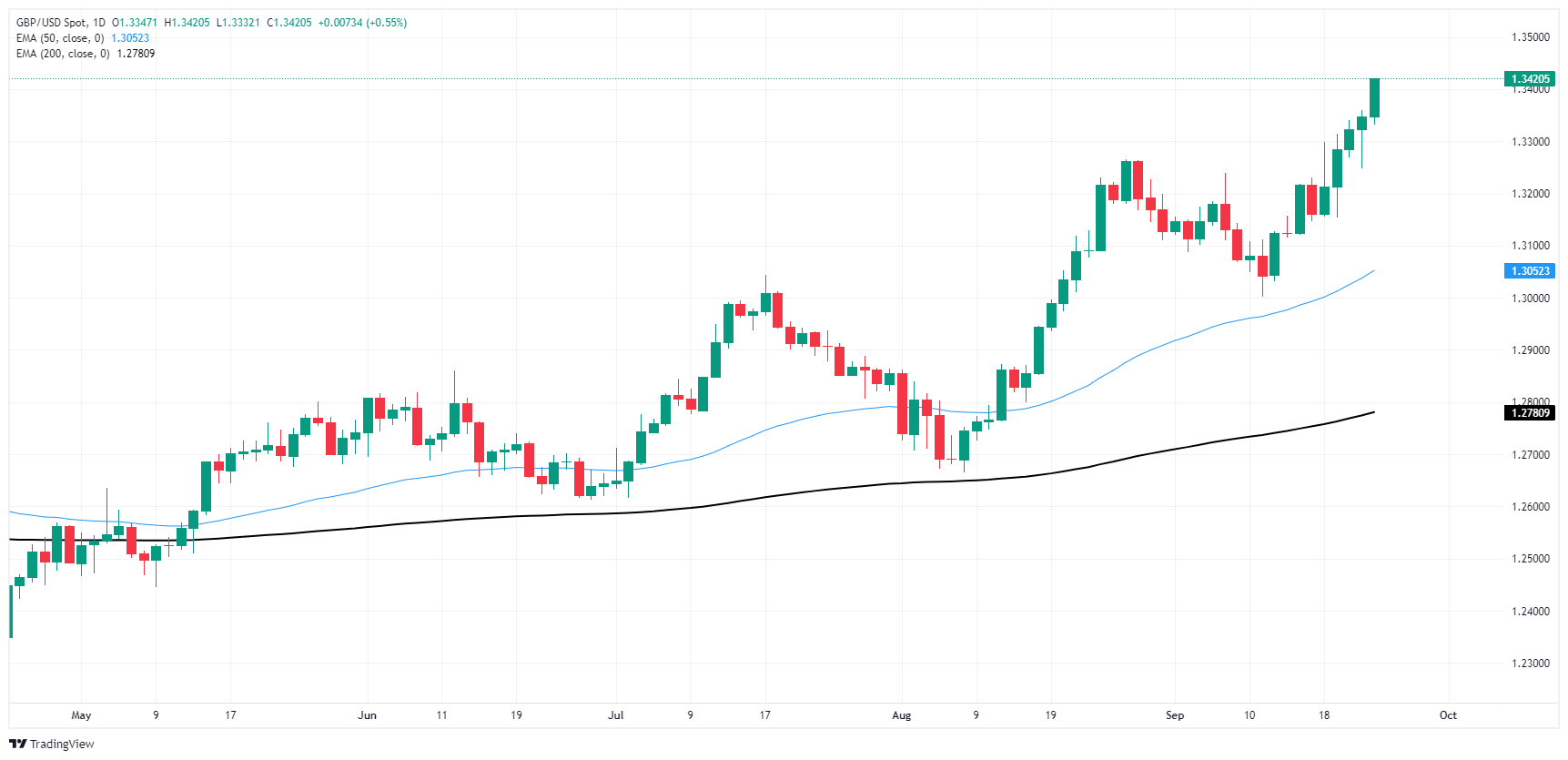
Pound Sterling FAQs
The Pound Sterling (GBP) is the oldest currency in the world (886 AD) and the official currency of the United Kingdom. It is the fourth most traded unit for foreign exchange (FX) in the world, accounting for 12% of all transactions, averaging $630 billion a day, according to 2022 data. Its key trading pairs are GBP/USD, aka ‘Cable’, which accounts for 11% of FX, GBP/JPY, or the ‘Dragon’ as it is known by traders (3%), and EUR/GBP (2%). The Pound Sterling is issued by the Bank of England (BoE).
The single most important factor influencing the value of the Pound Sterling is monetary policy decided by the Bank of England. The BoE bases its decisions on whether it has achieved its primary goal of “price stability” – a steady inflation rate of around 2%. Its primary tool for achieving this is the adjustment of interest rates. When inflation is too high, the BoE will try to rein it in by raising interest rates, making it more expensive for people and businesses to access credit. This is generally positive for GBP, as higher interest rates make the UK a more attractive place for global investors to park their money. When inflation falls too low it is a sign economic growth is slowing. In this scenario, the BoE will consider lowering interest rates to cheapen credit so businesses will borrow more to invest in growth-generating projects.
Data releases gauge the health of the economy and can impact the value of the Pound Sterling. Indicators such as GDP, Manufacturing and Services PMIs, and employment can all influence the direction of the GBP. A strong economy is good for Sterling. Not only does it attract more foreign investment but it may encourage the BoE to put up interest rates, which will directly strengthen GBP. Otherwise, if economic data is weak, the Pound Sterling is likely to fall.
Another significant data release for the Pound Sterling is the Trade Balance. This indicator measures the difference between what a country earns from its exports and what it spends on imports over a given period. If a country produces highly sought-after exports, its currency will benefit purely from the extra demand created from foreign buyers seeking to purchase these goods. Therefore, a positive net Trade Balance strengthens a currency and vice versa for a negative balance.
Author

Joshua Gibson
FXStreet
Joshua joins the FXStreet team as an Economics and Finance double major from Vancouver Island University with twelve years' experience as an independent trader focusing on technical analysis.