GBP/USD crashes to 1.3300 as risk-off sentiment drives Greenback gains
- GBP/USD crashed into the 1.3300 handle on Thursday.
- Risk-off sentiment is bolstering the safe haven US Dollar.
- The ongoing US government shutdown is beginning to shake out markets.

GBP/USD accelerated into the bearish side on Thursday, falling nearly eight-tenths of one percent and sending Cable bids into the 1.3300 handle for the first time since early August. Broad-market investor sentiment is beginning to crumble amid the ongoing US government shutdown, which shows no signs of slowing.
The US government’s ongoing shutdown has officially extended past the one-week mark, reaching its ninth day on Thursday. Investors initially showed little to no reaction to the shuttering of federal services, but market apprehension is slowly on the rise as the US Senate shows no signs of progress. Senate Republicans have rejected multiple budget bridging proposals from Democrats, as the two sides of the US government vote down party lines.
The government shutdown has also clamped down on the release of official datasets, leaving markets to grapple with newly added emphasis on private datasets. This week’s key release will be the University of Michigan’s (UoM) Consumer Sentiment Index for October, slated for Friday. Aggregated consumer survey results are expected to ease slightly as ongoing trade war headlines and rising inflation pressures eat away at consumer confidence.
GBP/USD price forecast
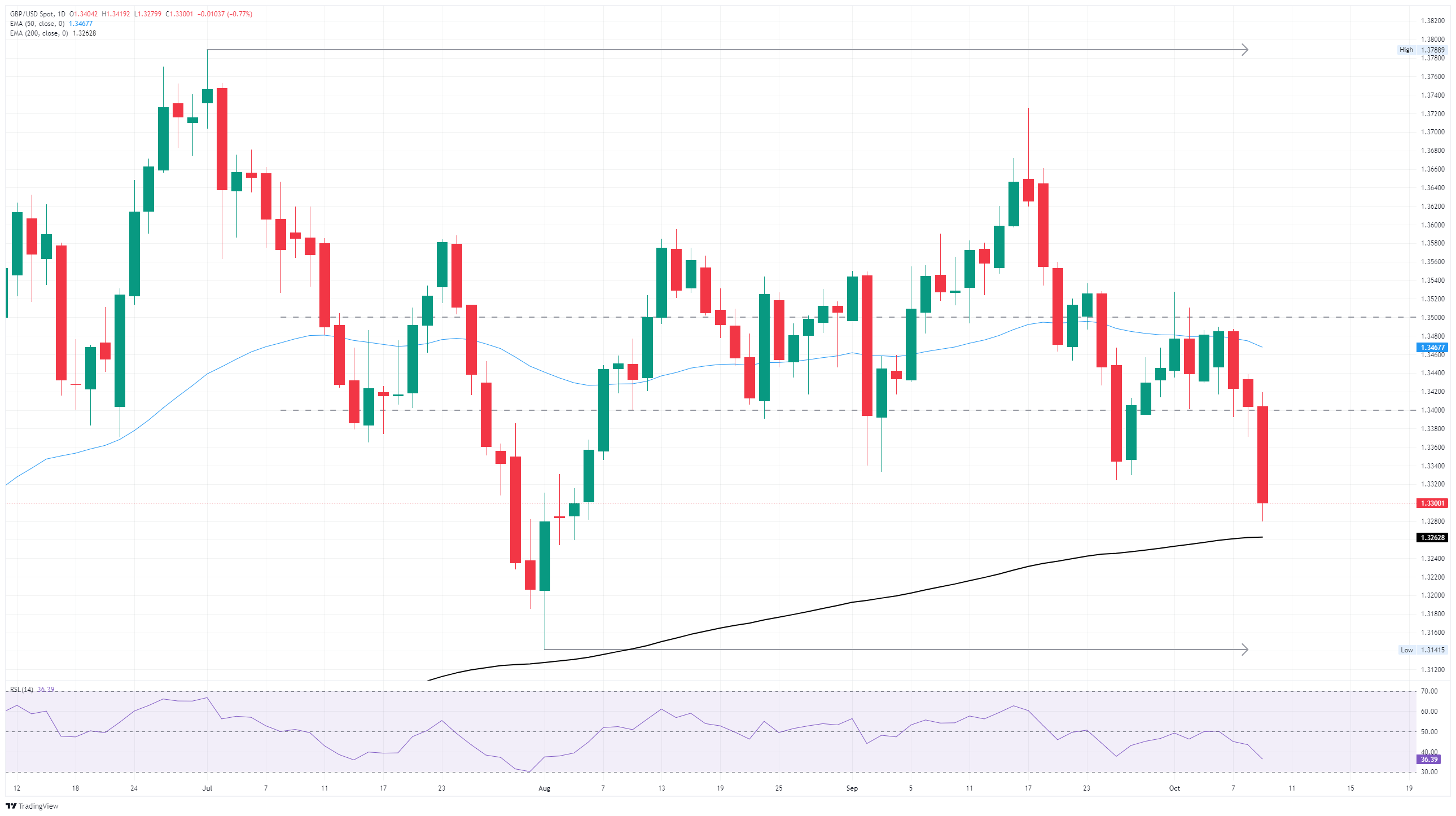
GBP/USD extended its decline this week, breaking beneath recent consolidation near 1.3400 and now testing the 200-day Exponential Moving Average (EMA) around 1.3280. The pair has been under steady selling pressure as the dollar regained strength, and the daily close below the 50-day EMA at 1.3467 confirms a shift in short-term momentum toward the bears.
From a price action standpoint, sellers have taken control after a failed attempt to reclaim mid-September highs. The long-bodied red candles reflect strong participation from the downside, while the Relative Strength Index (RSI) at 36 suggests growing bearish momentum but not yet oversold conditions. The 200-day EMA now serves as the last major technical support before the summer lows near 1.3140. If buyers fail to defend this level, the broader uptrend from early August could give way to a deeper retracement phase.
GBP/USD daily chart
Pound Sterling FAQs
The Pound Sterling (GBP) is the oldest currency in the world (886 AD) and the official currency of the United Kingdom. It is the fourth most traded unit for foreign exchange (FX) in the world, accounting for 12% of all transactions, averaging $630 billion a day, according to 2022 data. Its key trading pairs are GBP/USD, also known as ‘Cable’, which accounts for 11% of FX, GBP/JPY, or the ‘Dragon’ as it is known by traders (3%), and EUR/GBP (2%). The Pound Sterling is issued by the Bank of England (BoE).
The single most important factor influencing the value of the Pound Sterling is monetary policy decided by the Bank of England. The BoE bases its decisions on whether it has achieved its primary goal of “price stability” – a steady inflation rate of around 2%. Its primary tool for achieving this is the adjustment of interest rates. When inflation is too high, the BoE will try to rein it in by raising interest rates, making it more expensive for people and businesses to access credit. This is generally positive for GBP, as higher interest rates make the UK a more attractive place for global investors to park their money. When inflation falls too low it is a sign economic growth is slowing. In this scenario, the BoE will consider lowering interest rates to cheapen credit so businesses will borrow more to invest in growth-generating projects.
Data releases gauge the health of the economy and can impact the value of the Pound Sterling. Indicators such as GDP, Manufacturing and Services PMIs, and employment can all influence the direction of the GBP. A strong economy is good for Sterling. Not only does it attract more foreign investment but it may encourage the BoE to put up interest rates, which will directly strengthen GBP. Otherwise, if economic data is weak, the Pound Sterling is likely to fall.
Another significant data release for the Pound Sterling is the Trade Balance. This indicator measures the difference between what a country earns from its exports and what it spends on imports over a given period. If a country produces highly sought-after exports, its currency will benefit purely from the extra demand created from foreign buyers seeking to purchase these goods. Therefore, a positive net Trade Balance strengthens a currency and vice versa for a negative balance.
Author

Joshua Gibson
FXStreet
Joshua joins the FXStreet team as an Economics and Finance double major from Vancouver Island University with twelve years' experience as an independent trader focusing on technical analysis.