GBP/USD climbs above 1.2900 following US NFP data
- US Nonfarm Payrolls rise to 151K, but unemployment ticks up to 4.1%.
- Markets price in three Fed rate cuts in 2025 amid economic uncertainty.
- UK traders eye GDP data next week, while US focuses on inflation and UoM sentiment.

The Pound Sterling (GBP) registered solid gains versus the US Dollar (USD) in early trading on Friday during the North American session, even though the latest jobs report in the United States (US) depicts the economy remains solid. Nevertheless, fears of a recession in the US keep the Greenback on the back foot, and GBP/USD is trading at 1.2920, up over 0.30%.
Sterling gains 0.30% despite NFP beat as rising US unemployment weighs on sentiment
February’s Nonfarm Payroll figures were 151K, up from January’s 125K but missing estimates of 160K. Although the print is solid, the GBP/USD pair rose as the Unemployment Rate ticked up to 4.1%, above forecasts of 4%.
The data doesn’t suggest that the Federal Reserve (Fed) needs to cut rates at the upcoming meeting. Nevertheless, it didn’t improve the economic outlook due to US President Donald Trump's controversial policies, which keep businesses uncertain of planning ahead.
March’s Nonfarm Payrolls data is expected to be worse due to Elon Musk’s Department of Government Efficiency (DOGE) laying off probationary federal government workers. Investors seem to be pricing a jobs market slowdown, which could exert pressure on the Fed to lower borrowing costs to fulfill its dual mandate.
A Reuters poll showed that 70 out of 74 economists say the risk of recession has risen in the US, Canada and Mexico. Money market players continued to price in three 25 basis points of rate cuts by the Fed, according to the December 2025 fed funds rate futures contract.
Across the pond, the Sterling has been supported by the weakness of the US Dollar. Traders are awaiting forecasts of the Office for Budget Responsibility (OBR) on March 26, at a time when Finance Minister Rachel Reeves is pressured to clarify how she would balance the books without breaking her own fiscal rules.
Ahead next week, the UK economic docket will feature Gross Domestic Product (GDP) figures. In the US, traders are eyeing inflation data, alongside Consumer Sentiment by the University of Michigan (UoM).
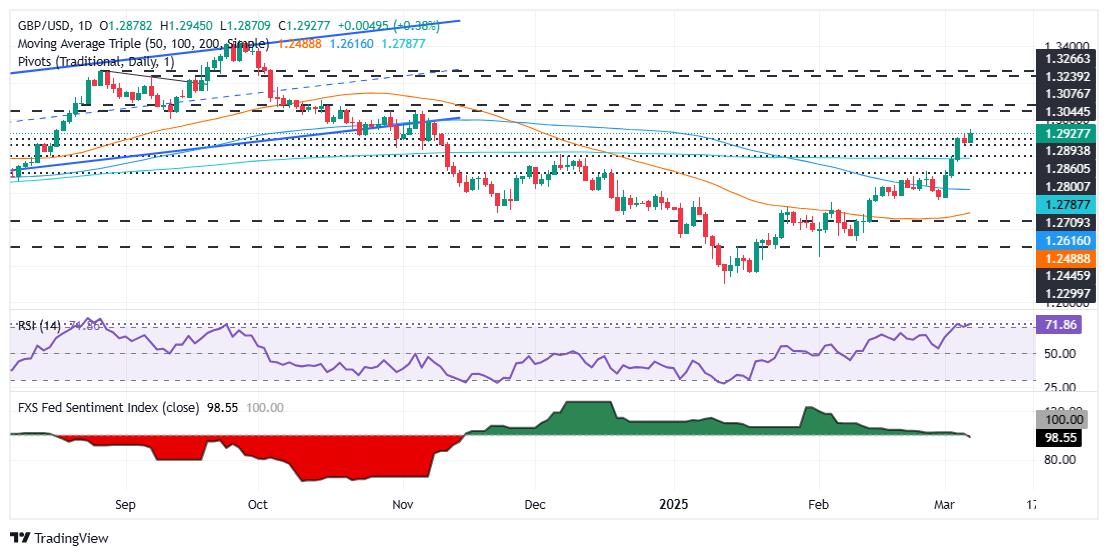
GBP/USD Price Forecast: Technical outlook
GBP/USD is set to extend its gains once it clears the 1.2900 figure. Momentum favors further upside, although the Relative Strength Index (RSI) turned overbought. Nonetheless, traders must be aware that in strong trends, such as a bullish move, the RSI would reach overbought levels at 80. Hence, further upside is seen.
The next key resistance would be 1.2950 and the 1.3000 mark. On the downside, if GBP/USD falls beneath 1.2900, a test of the December 2024 cycle high at 1.2811 is on the cards.
British Pound PRICE Today
The table below shows the percentage change of British Pound (GBP) against listed major currencies today. British Pound was the strongest against the Australian Dollar.
| USD | EUR | GBP | JPY | CAD | AUD | NZD | CHF | |
|---|---|---|---|---|---|---|---|---|
| USD | -0.65% | -0.38% | -0.24% | 0.26% | 0.29% | 0.26% | -0.51% | |
| EUR | 0.65% | 0.27% | 0.43% | 0.92% | 0.95% | 0.92% | 0.14% | |
| GBP | 0.38% | -0.27% | 0.17% | 0.64% | 0.67% | 0.65% | -0.10% | |
| JPY | 0.24% | -0.43% | -0.17% | 0.50% | 0.54% | 0.50% | -0.24% | |
| CAD | -0.26% | -0.92% | -0.64% | -0.50% | 0.03% | 0.00% | -0.74% | |
| AUD | -0.29% | -0.95% | -0.67% | -0.54% | -0.03% | -0.03% | -0.77% | |
| NZD | -0.26% | -0.92% | -0.65% | -0.50% | -0.00% | 0.03% | -0.74% | |
| CHF | 0.51% | -0.14% | 0.10% | 0.24% | 0.74% | 0.77% | 0.74% |
The heat map shows percentage changes of major currencies against each other. The base currency is picked from the left column, while the quote currency is picked from the top row. For example, if you pick the British Pound from the left column and move along the horizontal line to the US Dollar, the percentage change displayed in the box will represent GBP (base)/USD (quote).
Author

Christian Borjon Valencia
FXStreet
Markets analyst, news editor, and trading instructor with over 14 years of experience across FX, commodities, US equity indices, and global macro markets.