GBP/USD churns chart paper near key figures ahead of quiet session
- GBP/USD remains bolstered above 1.3450 and the 50-day EMA.
- A midweek lull will give Cable traders some breathing room on Wednesday.
- US growth and inflation data to dominate the scope heading into the end of the week.

GBP/USD rebounded from early-week losses on Tuesday, bouncing back up from a fresh technical floor near the 1.3450 level. Cable has been drifting within familiar technical levels as broad-market investor sentiment grinds to a halt ahead of key US economic figures.
It’ll be a quiet market session on Wednesday; meaningful economic data is functionally absent on both sides of the Atlantic. Investors will be on the lookout for further political headlines from the Trump administration as traders await results from President Donald Trump’s attempt to directly “fire” Dr. Lisa Cook from the Federal Reserve (Fed) Board of Governors on Monday.
US numbers to dominate the data docket later this week
The midweek data peace will end on Thursday, when the latest US Gross Domestic Product (GDP) growth figures will be released. Quarterly US GDP growth is expected to tick up to 3.1% on an annualized basis, but the key data print this week will be Friday’s US Personal Consumption Expenditures Price Index (PCE) inflation print. PCE inflation is expected to rise slightly once again, and rising inflation pressures will make it difficult for the Fed to continue its march toward a fresh interest rate cut on September 17.
GBP/USD price forecast
On the hourly chart, GBP/USD has been hovering just above the 1.3500 level, a spot that felt more like a soft landing than a hang-tight zone. After reversing sharply from a recent dip, the pair found traction above key moving averages, sweeping past the 100-period and barely poking over the 200-period simple moving average. Those who tick at the market’s pulse will notice support stacking up between 1.3500 and 1.3510, acting like mooring lines, while overhead resistance starts to firm around 1.3540, the Fibonacci 61.8% retracement of the latest slide. The RSI readings may not be screaming overbought yet, but price action suggests tentative optimism and a market that’s quietly betting on further upside.
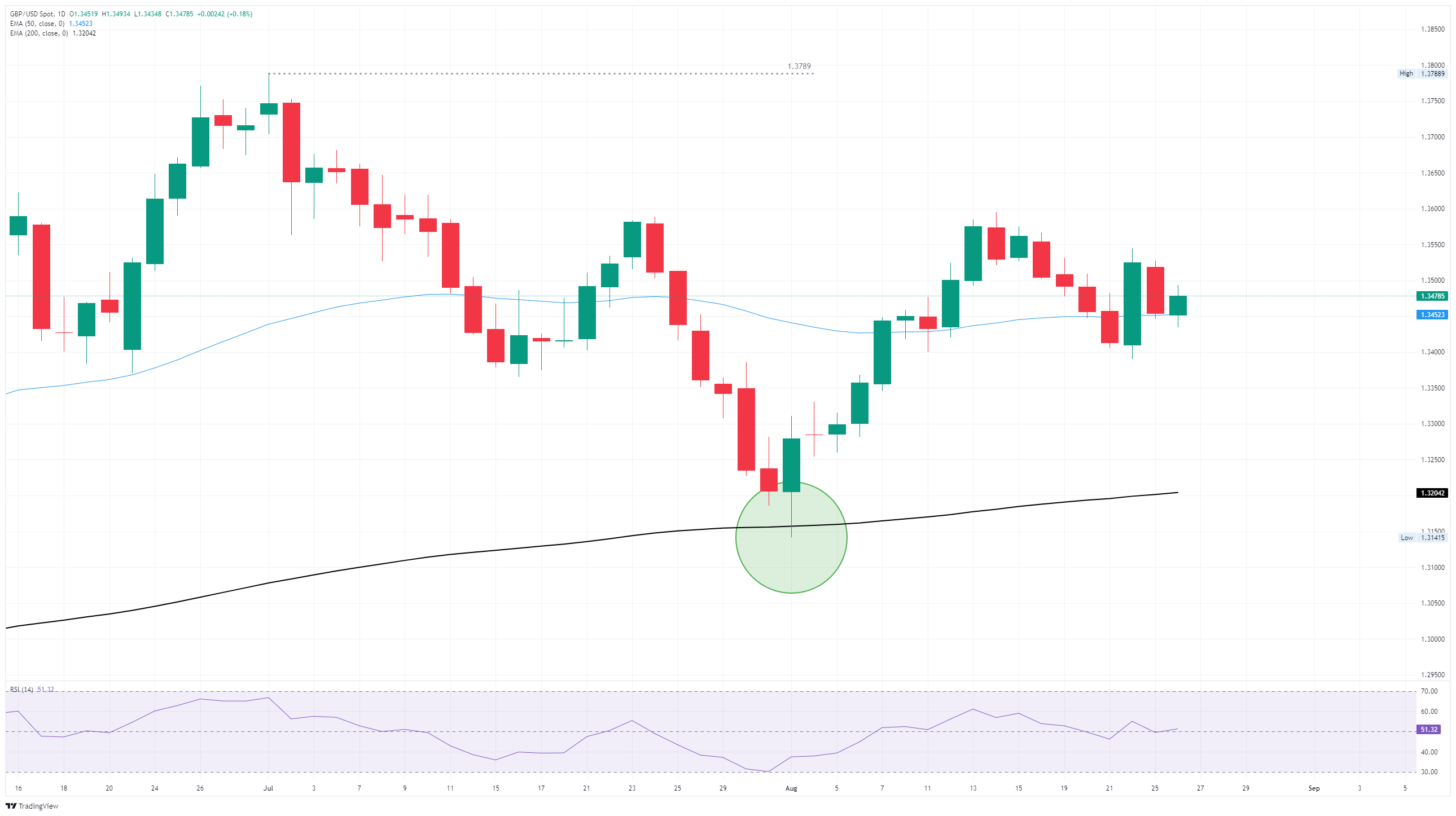
On the daily chart, GBP/USD is in a choreography of consolidation between roughly 1.3400 on the downside and the 1.3600 zone above. Technicals remain constructive so long as the move above 1.3400 holds, and a breach above 1.3400 could re-ignite the longer-term uptrend sustained since 1.3050 in 2022, potentially targeting the projection up near 1.3800. For now, traders appear to be in a “wait for clear direction” mode, with markets digesting dovish tones from the Fed and a weaker US Dollar backdrop lending support to Cable’s consolidation.
GBP/USD daily chart
Pound Sterling FAQs
The Pound Sterling (GBP) is the oldest currency in the world (886 AD) and the official currency of the United Kingdom. It is the fourth most traded unit for foreign exchange (FX) in the world, accounting for 12% of all transactions, averaging $630 billion a day, according to 2022 data. Its key trading pairs are GBP/USD, also known as ‘Cable’, which accounts for 11% of FX, GBP/JPY, or the ‘Dragon’ as it is known by traders (3%), and EUR/GBP (2%). The Pound Sterling is issued by the Bank of England (BoE).
The single most important factor influencing the value of the Pound Sterling is monetary policy decided by the Bank of England. The BoE bases its decisions on whether it has achieved its primary goal of “price stability” – a steady inflation rate of around 2%. Its primary tool for achieving this is the adjustment of interest rates. When inflation is too high, the BoE will try to rein it in by raising interest rates, making it more expensive for people and businesses to access credit. This is generally positive for GBP, as higher interest rates make the UK a more attractive place for global investors to park their money. When inflation falls too low it is a sign economic growth is slowing. In this scenario, the BoE will consider lowering interest rates to cheapen credit so businesses will borrow more to invest in growth-generating projects.
Data releases gauge the health of the economy and can impact the value of the Pound Sterling. Indicators such as GDP, Manufacturing and Services PMIs, and employment can all influence the direction of the GBP. A strong economy is good for Sterling. Not only does it attract more foreign investment but it may encourage the BoE to put up interest rates, which will directly strengthen GBP. Otherwise, if economic data is weak, the Pound Sterling is likely to fall.
Another significant data release for the Pound Sterling is the Trade Balance. This indicator measures the difference between what a country earns from its exports and what it spends on imports over a given period. If a country produces highly sought-after exports, its currency will benefit purely from the extra demand created from foreign buyers seeking to purchase these goods. Therefore, a positive net Trade Balance strengthens a currency and vice versa for a negative balance.
Author

Joshua Gibson
FXStreet
Joshua joins the FXStreet team as an Economics and Finance double major from Vancouver Island University with twelve years' experience as an independent trader focusing on technical analysis.

















