|

GBP/USD carving out a bull flag ahead of BOE Super Thursday

  • GBP/USD extends Tuesday’s bounce above 1.3900 amid weaker US dollar.
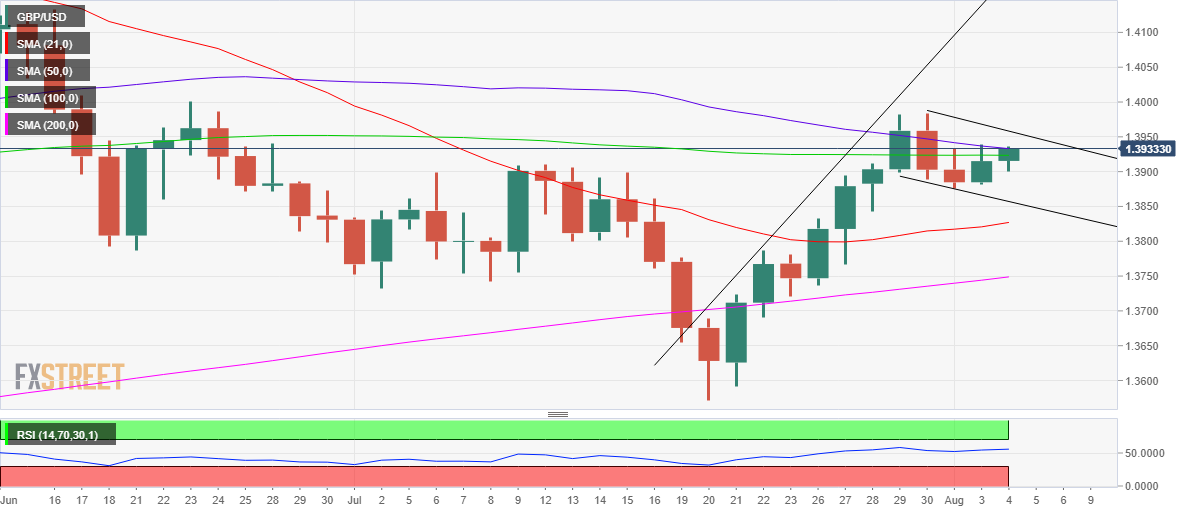
  • The cable carves out a bull flag formation on the daily sticks.
  • UK/ US PMIs eyed, BOE decision and US NFP could yield an upside break.

GBP/USD is heading towards July highs at 1.3985, extending its bounce from near the 1.3875 region

The bulls remain in control above 1.3900 amid a broadly softer US dollar, divided between looming coronavirus worries, progress on US infrastructure bill and dovish Fed expectations.

On the GBP side of the equation, falling covid cases in the UK and its relative success in the vaccination campaigns underpin the pound.

Meanwhile, the GBP bulls also cheer the Brexit optimism, especially after the European Union (EU) has backed off a threat of imminent legal action against the UK over breaches of the Northern Ireland (NI) protocol of the Brexit agreement as the two sides try to work through their differences.

BOE in focus

The immediate focus is now on the US ADP and ISM Services PMI data while the UK Final Services PMI could also offer some trading incentives to the pair. However, the main event risks for the cable are the BOE ‘Super Thursday’ and Friday’s NFP report.

The UK central bank is likely to maintain its monetary policy settings while the focus will be on the economic forecasts, with rising concerns on inflation, which may prompt the BOE to hint at tapering sooner than expected. However, amidst ongoing certainty over the economic recovery, in light of the Delta covid variant flareups, the central bank could refrain from offering any hawkish signals.

GBP/USD technical outlook

With the recent rally that followed a brief consolidative mode, GBP/USD price has taken the shape of a bull flag.

The upcoming events are likely to determine whether the cable will yield the upside breakout from the bullish continuation formation or lead to a pattern failure.

GBP bulls need a firm break above the falling trendline resistance at 1.3958 for the bull flag validation.

Meanwhile, acceptance below the falling trendline support at 1.3857 will revive the bearish interests, with the corrective downside to resume towards the 21-Daily Moving Average (DMA) at 1.3826

The 14-day Relative Strength Index (RSI) is pointing north above the midline, supporting the potential move higher.

GBP/USD daily chart
GBP/USD additional levels to watch

GBP/USD

Overview
Today last price1.3927
Today Daily Change0.0012
Today Daily Change %0.09
Today daily open1.3915
 
Trends
Daily SMA201.3822
Daily SMA501.3937
Daily SMA1001.3924
Daily SMA2001.3744
 
Levels
Previous Daily High1.3939
Previous Daily Low1.3882
Previous Weekly High1.3984
Previous Weekly Low1.3737
Previous Monthly High1.3984
Previous Monthly Low1.3572
Daily Fibonacci 38.2%1.3917
Daily Fibonacci 61.8%1.3903
Daily Pivot Point S11.3885
Daily Pivot Point S21.3855
Daily Pivot Point S31.3828
Daily Pivot Point R11.3942
Daily Pivot Point R21.3969
Daily Pivot Point R31.3999

Author

Dhwani Mehta

Dhwani Mehta

FXStreet

Residing in Mumbai (India), Dhwani is a Senior Analyst and Manager of the Asian session at FXStreet. She has over 10 years of experience in analyzing and covering the global financial markets, with specialization in Forex and commodities markets.


More from Dhwani Mehta
Share:

Editor's Picks

AUD/USD hangs near two-month low, below 0.7000 ahead of Australian CPI report

AUD/USD consolidates below 0.7000 during the Asian session on Wednesday, trading near a two-month low as traders look to the Australian CPI report for more cues on the RBA's policy path. Meanwhile, the US Dollar preserves its bullish undertone amid rising Fed rate-hike bets, which, along with oil-driven inflation fears, push US bond yields to multi-year highs. Moreover, the US-Iran standoff underpins the safe-haven buck and acts as a headwind for the currency pair.

USD/JPY trades below 157.50 as Japan's weak data and bullish USD lend support

USD/JPY extends its consolidative price move during the Asian session on Wednesday, trading below mid-157.00s. Hawkish BoJ expectations, along with intervention risks, underpin the Japanese Yen, though dismal domestic data cap gains. Meanwhile, rising Fed rate hike bets and oil-driven inflation fears push US bond yields to fresh multi-year highs. Moreover, the US-Iran standoff supports a bullish US Dollar and acts as a tailwind for the currency pair.

Gold consolidates below $4,200 as bullish USD and Fed hike bets offset softer bond yields

Gold struggles to capitalize on the previous day's recovery from an eight-week low, consolidating below $4,200 during the Asian session on Wednesday. The overnight slide in oil prices eased the US Treasury bond rout, supporting the bullion. However, Fed rate-hike bets and inflationary concerns keep bond yields near multi-year highs. Moreover, geopolitical uncertainties underpin the safe-haven US Dollar, which, in turn, caps the commodity.

Ethereum sees profit-taking near $2,700 ahead of key US economic data
Ethereum (ETH) has shown signs of profit-taking near $2,700 over the past few days, with rising exchange deposits and a slowdown in exchange-traded fund (ETF) inflows ahead of US inflation and labor market data releases. The top altcoin's Exchange Reserves, which track the total amount of a crypto asset held across exchange wallets, have increased by roughly 125K ETH since Friday.
Silver is more volatile than Gold ahead of PCE and NFP. This chart shows the positioning gap
The market’s attention is focused on American data this week, but there’s something only those with a trained eye may be looking at: Gold and Silver positioning gap. Financial markets are moving on fears, mostly related to persistently high energy prices driven by the Middle East war. Sure, the US Dollar (USD) is strong, but at what cost?
Silver is more volatile than Gold ahead of PCE and NFP. This chart shows the positioning gap
The market’s attention is focused on American data this week, but there’s something only those with a trained eye may be looking at: Gold and Silver positioning gap. Financial markets are moving on fears, mostly related to persistently high energy prices driven by the Middle East war. Sure, the US Dollar (USD) is strong, but at what cost?