GBP/JPY Price Forecast: Looks set to reclaim 200.00
- GBP/JPY flattens around 198.60 as investors shift their focus to the UK labor market data for three-months ending June.
- BoJ's Summary of Opinions shows that officials are concerned about global trade risk.
- GBP/JPY returns above the 20-day EMA

The GBP/JPY pair trades almost flat around 198.60 during the late Asian trading session on Monday. The pair strives to extend its four-day winning streak, with investors awaiting the United Kingdom (UK) labor market data for three-months ending June, which is scheduled to be released on Tuesday.
Investors will pay close attention to the employment data to get cues about whether employers are still hesitant to add jobs due to an increase in their contribution to social security schemes.
Economists expect the ILO Unemployment Rate to have remained steady at 4.7%. Average Earnings (Excluding and Including) bonuses are estimated to have grown moderately by 4.7% on year, compared to the prior reading of 5.0%.
In Japan, the latest Bank of Japan (BoJ) Summary of Opinions showed that officials remain worried about global trade war risk despite the signing of a tariff deal with the United States (US). However, the Japanese central bank has kept the door open for more interest rate hikes in the remainder of the year.
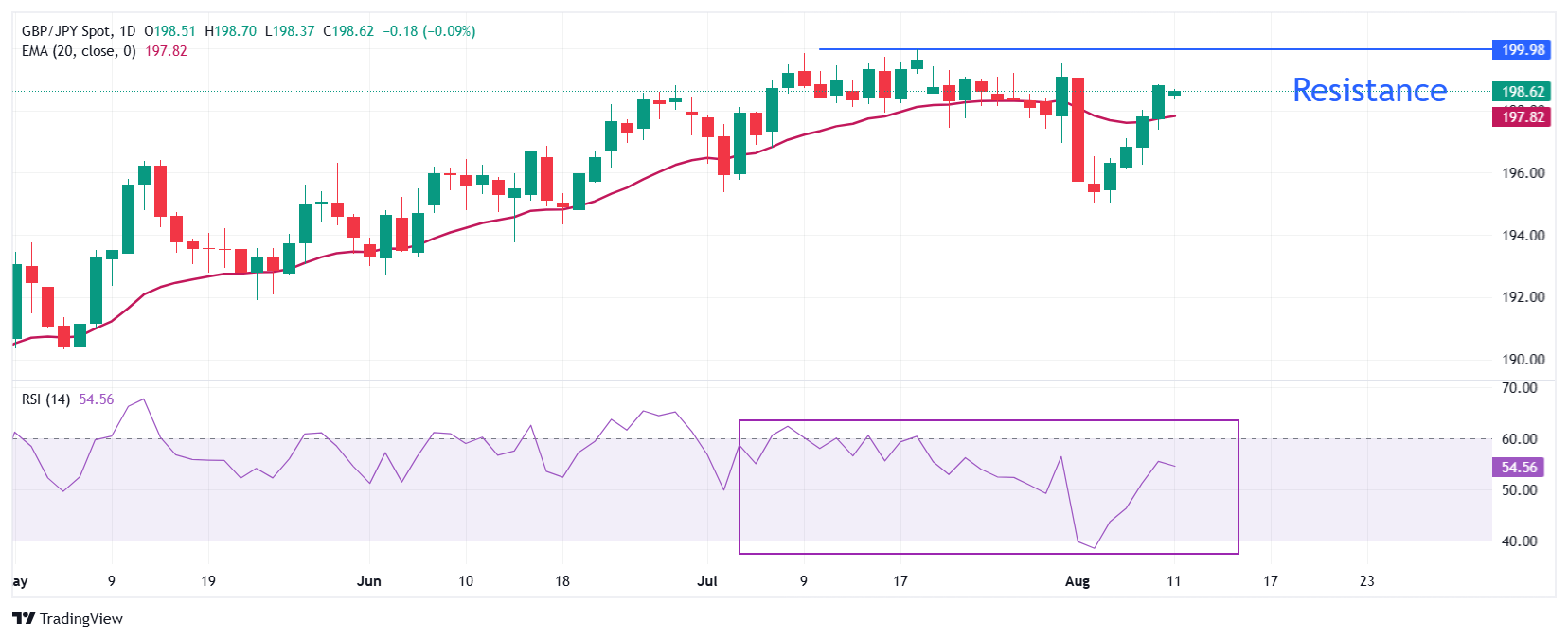
GBP/JPY extends its recent recovery move from 195.00 to near 198.60 in the last week. The near-term trend of the cross has turned bullish as it returns above the 20-day Exponential Moving Average (EMA), which trades around 197.80.
The 14-day Relative Strength Index (RSI) oscillates inside the 40.00-60.00 from a long period, indicating a sideways trend.
The pair could extend its upside towards the psychological level of 200.00 and the 23 July 2024 high of 203.16 if it breaks above Friday’s high of 198.83.
On the flip side, a downside move by the pair below the May 6 low of 190.33 will expose it to the March 11 low of 188.80, followed by the February 7 low of 187.00.
GBP/JPY daily chart
Economic Indicator
ILO Unemployment Rate (3M)
The ILO Unemployment Rate released by the UK Office for National Statistics is the number of unemployed workers divided by the total civilian labor force. It is a leading indicator for the UK Economy. If the rate goes up, it indicates a lack of expansion within the UK labor market. As a result, a rise leads to a weakening of the UK economy. Generally, a decrease of the figure is seen as bullish for the Pound Sterling (GBP), while an increase is seen as bearish.
Read more.Next release: Tue Aug 12, 2025 06:00
Frequency: Monthly
Consensus: 4.7%
Previous: 4.7%
Source: Office for National Statistics
The Unemployment Rate is the broadest indicator of Britain’s labor market. The figure is highlighted by the broad media, beyond the financial sector, giving the publication a more significant impact despite its late publication. It is released around six weeks after the month ends. While the Bank of England is tasked with maintaining price stability, there is a substantial inverse correlation between unemployment and inflation. A higher than expected figure tends to be GBP-bearish.
Author

Sagar Dua
FXStreet
Sagar Dua is associated with the financial markets from his college days. Along with pursuing post-graduation in Commerce in 2014, he started his markets training with chart analysis.


![How Wall Street rigs the game [Video]](https://editorial.fxsstatic.com/images/i/market-chaos-01.jpg)