GBP/JPY Price Forecast: Further decline towards 197.00 looks likely
- The Pound extends losses against a firmer Yen and tests support at 198.25
- The risk-averse market following Trump’s new tariff threats is weighing on the pair.
- Below 198.25, the pair might extend losses to the 196.80 area.

The Pound is correcting lower from last week’s highs, right below the 200.00 psychological level, with bears testing support at the area around previous highs, in the 198.30- 198.40 region at the time of writing.
Market sentiment is sour, as Trump’s latest tariff threats to the Eurozone and Mexico have added uncertainty to the global trade outlook. The market reaction has been moderate, but a mild risk aversion keeps putting pressure on the Sterling, supporting the safe-haven Yen.
Technical Analysis: In a bearish correction within a broader bullish trend
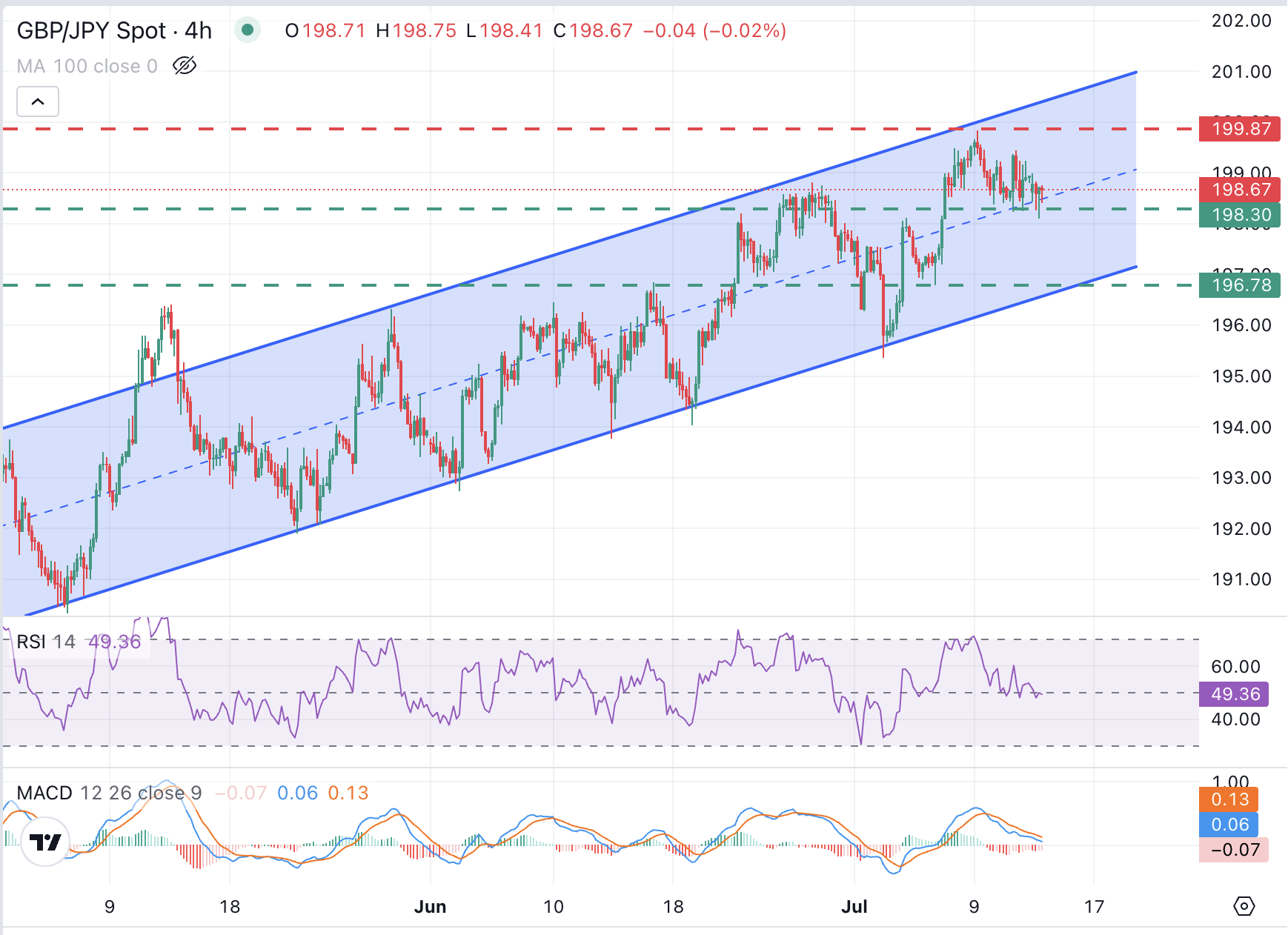
The GBP/JPY’s immediate trend is mildly negative, with price action coming down from 299.85 highs on July 9, and the lower high at 199.45 giving fresh hopes for bears. The RSI has crossed into negative territory below 50, with bears eroding the 198.25 support area.
The broader trend remains bullish, with the pair trading within an ascending channel from early May lows, but, in the current context, a further correction should not be discarded.
A confirmation below Friday’s low, at 198.25, would find support at the July 7 low, which crosses the bottom of the ascending channel, at the 196.80 area. On the upside, the highs of 199.45 and 199.85 on July 11 and 10, respectively, close the path towards the channel´s top, now at 200.40.
Risk sentiment FAQs
In the world of financial jargon the two widely used terms “risk-on” and “risk off'' refer to the level of risk that investors are willing to stomach during the period referenced. In a “risk-on” market, investors are optimistic about the future and more willing to buy risky assets. In a “risk-off” market investors start to ‘play it safe’ because they are worried about the future, and therefore buy less risky assets that are more certain of bringing a return, even if it is relatively modest.
Typically, during periods of “risk-on”, stock markets will rise, most commodities – except Gold – will also gain in value, since they benefit from a positive growth outlook. The currencies of nations that are heavy commodity exporters strengthen because of increased demand, and Cryptocurrencies rise. In a “risk-off” market, Bonds go up – especially major government Bonds – Gold shines, and safe-haven currencies such as the Japanese Yen, Swiss Franc and US Dollar all benefit.
The Australian Dollar (AUD), the Canadian Dollar (CAD), the New Zealand Dollar (NZD) and minor FX like the Ruble (RUB) and the South African Rand (ZAR), all tend to rise in markets that are “risk-on”. This is because the economies of these currencies are heavily reliant on commodity exports for growth, and commodities tend to rise in price during risk-on periods. This is because investors foresee greater demand for raw materials in the future due to heightened economic activity.
The major currencies that tend to rise during periods of “risk-off” are the US Dollar (USD), the Japanese Yen (JPY) and the Swiss Franc (CHF). The US Dollar, because it is the world’s reserve currency, and because in times of crisis investors buy US government debt, which is seen as safe because the largest economy in the world is unlikely to default. The Yen, from increased demand for Japanese government bonds, because a high proportion are held by domestic investors who are unlikely to dump them – even in a crisis. The Swiss Franc, because strict Swiss banking laws offer investors enhanced capital protection.
Author

Guillermo Alcala
FXStreet
Graduated in Communication Sciences at the Universidad del Pais Vasco and Universiteit van Amsterdam, Guillermo has been working as financial news editor and copywriter in diverse Forex-related firms, like FXStreet and Kantox.


![How Wall Street rigs the game [Video]](https://editorial.fxsstatic.com/images/i/market-chaos-01.jpg)