GBP/JPY Price Forecast: Bullish momentum builds after rising above 195.00
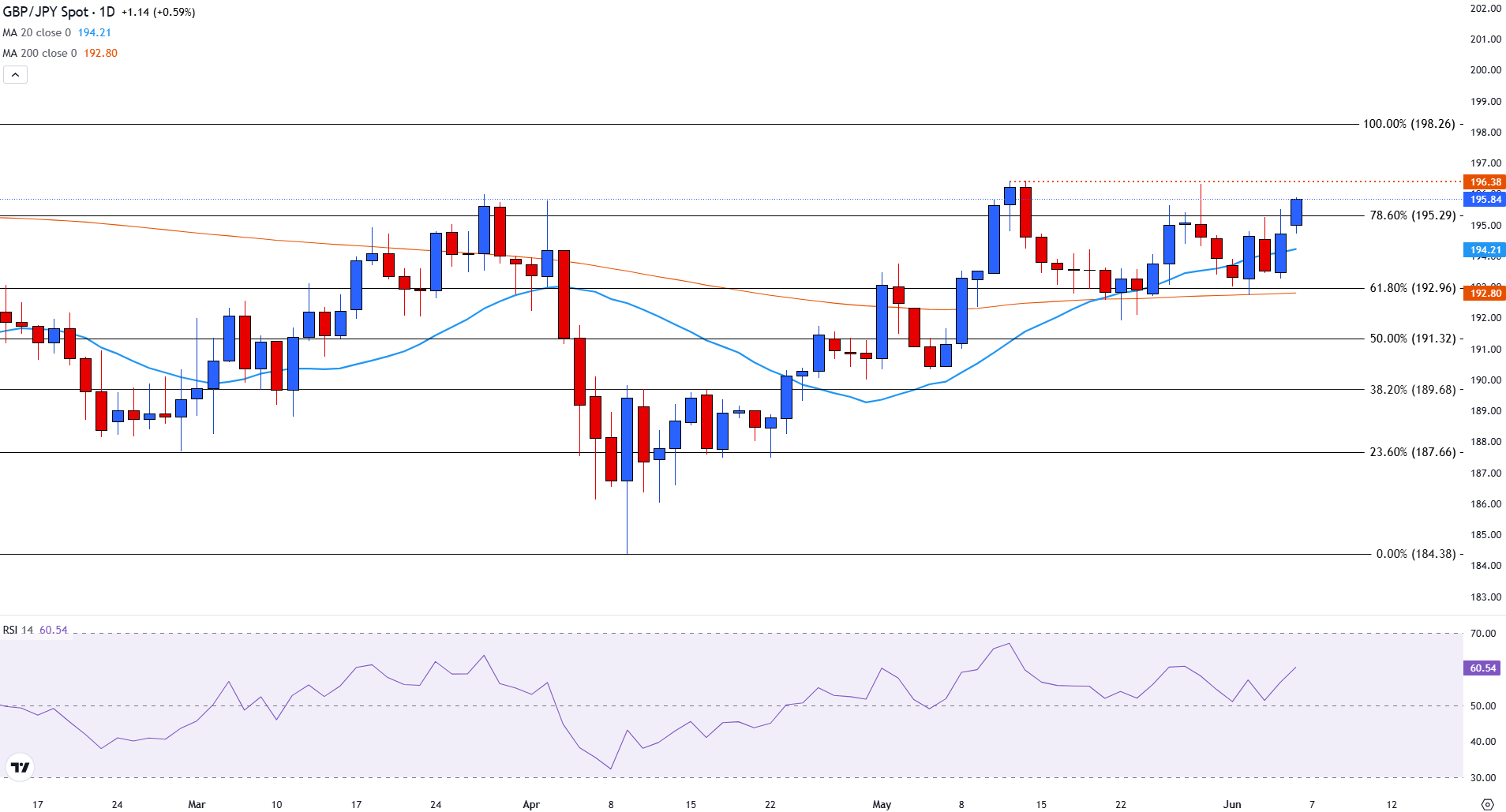
- GBP/JPY rises above the 20-day Simple Moving Average (SMA), providing support at 194.21.
- The Relative Strength Index (RSI) is nearing 60, suggesting that momentum remains in favour of the bulls.
- A decisive break above 195.00 could push prices back to 196.00

The Japanese Yen (JPY) continues to weaken against the British Pound (GBP) on Friday, with the GBP/JPY pair edging up to near 195.20 at the time of writing.
This move marks a continuation of bullish momentum that began earlier in the week, as the pair broke above the 20-day Simple Moving Average (SMA), signaling a shift in near-term sentiment. Despite this strength, GBP/JPY is now testing a significant resistance level that may determine the next directional bias.
The pair has encountered firm resistance at 195.29, which corresponds with the 78.6% Fibonacci retracement of the decline observed between January and April. This level has consistently limited bullish advances since early May, making it a critical technical barrier. Momentum indicators, however, suggest that bulls still have control.
The Relative Strength Index (RSI) is hovering around 60, showing that while the pair isn’t overbought, there is still upward momentum supporting further gains, provided the resistance can be decisively broken.
GBP/JPY daily chart
Can GBP/JPY reclaim 196.00?
Should GBP/JPY manage a daily close above 195.29, the path could open toward the psychological 196.00 mark, with the next potential resistance levels near 197.30, which aligns with previous swing highs. However, failure to breach the current resistance could trigger a short-term pullback.
On the downside, the 194.00 psychological level offers initial support. This level is reinforced by the 20-day SMA, which now acts as a dynamic support zone. A break below this area could expose deeper corrective targets near 193.00, which is aligned with the 61.8% Fibonacci retracement at 192.97. Further bearish pressure could bring the 200-day SMA near 192.80 into focus, a level that may serve as a more significant support zone.
Pound Sterling FAQs
The Pound Sterling (GBP) is the oldest currency in the world (886 AD) and the official currency of the United Kingdom. It is the fourth most traded unit for foreign exchange (FX) in the world, accounting for 12% of all transactions, averaging $630 billion a day, according to 2022 data. Its key trading pairs are GBP/USD, also known as ‘Cable’, which accounts for 11% of FX, GBP/JPY, or the ‘Dragon’ as it is known by traders (3%), and EUR/GBP (2%). The Pound Sterling is issued by the Bank of England (BoE).
The single most important factor influencing the value of the Pound Sterling is monetary policy decided by the Bank of England. The BoE bases its decisions on whether it has achieved its primary goal of “price stability” – a steady inflation rate of around 2%. Its primary tool for achieving this is the adjustment of interest rates. When inflation is too high, the BoE will try to rein it in by raising interest rates, making it more expensive for people and businesses to access credit. This is generally positive for GBP, as higher interest rates make the UK a more attractive place for global investors to park their money. When inflation falls too low it is a sign economic growth is slowing. In this scenario, the BoE will consider lowering interest rates to cheapen credit so businesses will borrow more to invest in growth-generating projects.
Data releases gauge the health of the economy and can impact the value of the Pound Sterling. Indicators such as GDP, Manufacturing and Services PMIs, and employment can all influence the direction of the GBP. A strong economy is good for Sterling. Not only does it attract more foreign investment but it may encourage the BoE to put up interest rates, which will directly strengthen GBP. Otherwise, if economic data is weak, the Pound Sterling is likely to fall.
Another significant data release for the Pound Sterling is the Trade Balance. This indicator measures the difference between what a country earns from its exports and what it spends on imports over a given period. If a country produces highly sought-after exports, its currency will benefit purely from the extra demand created from foreign buyers seeking to purchase these goods. Therefore, a positive net Trade Balance strengthens a currency and vice versa for a negative balance.
Author

Tammy Da Costa, CFTe®
FXStreet
Tammy is an economist and market analyst with a deep passion for financial markets, particularly commodities and geopolitics.