GameStop Stock News: Roaring Kitty meme sends meme stocks soaring
- Keith Gill returns to social media after three-year hiatus.
- GameStop stock soars over 100% on the news on top of early May rally.
- Analysts say Monday's gains might mean $500 million loss for short-sellers.
- AMC, BlackBerry, Koss also see gains on meme stock euphoria.

It was the meme heard ‘round the world. On Sunday, May 12, Keith Gill posted a meme on X (formerly Twitter) of a man leaning forward in his seat, which is normally used by video game enthusiasts to mean a situation is getting serious. That was all it took for GameStop (GME) shares to return to 18-month highs circa October 2022.
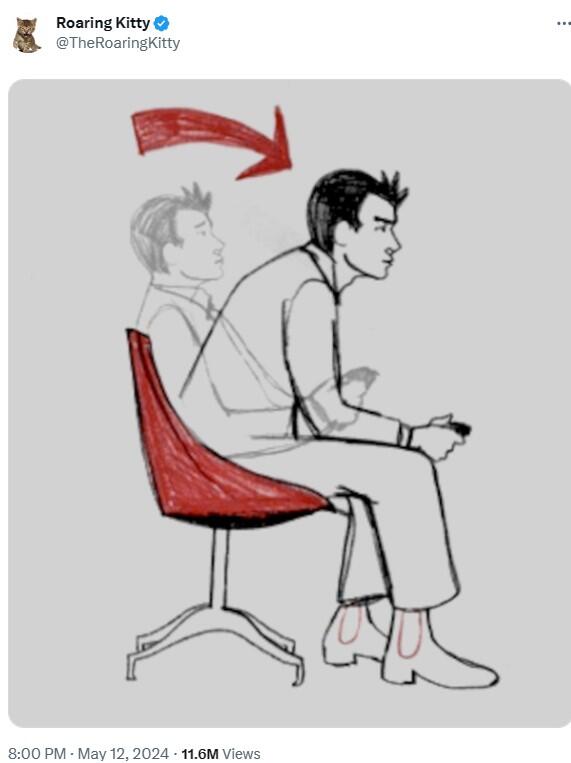
Keith Gill's meme post on X (Twitter) that initiated Monday GME rally
Gill, known as Roaring Kitty or DeepFuckingValue across various social media sites like Twitter, YouTube and Reddit, was the original retail investor who caused GME shares to soar during the meme stock frenzy of January 2021. Sunday’s post was his first post in three years. In late 2021 and early 2021 he grew a large following by shilling GME stock and posting gains that turned about $57,000 into tens of millions by buying options.
The broader US equity market is more subdued to start the week but has gained ground nonetheless.
GameStop stock news
GameStop stock itself has leapt more than 100% on Monday in light of Gill’s return to the spotlight, but it is not alone. AMC Entertainment (AMC) has also surged more than 30% in Monday’s morning session.
Other meme stocks from several years ago like BlackBerry (BB) and Koss (KOSS) are also receiving love from meme traders.
There is no sign yet of Keith Gill returning to the limelight by producing more of his old GME shill videos on YouTube, so it is possible that this momentum fades soon.
GameStop stock was already having a moment before Gill’s tweet however. GME stock gained nearly 17% on May 2 and has continued climbing all month. Market data firm Ortex says that short-sellers have lost some $800 million this month and possibly another $500 million if Monday’s price action holds.
The original short squeeze in 2021 led to the eventual bailout and then demise of short-selling hedge fund Melvin Capital Management.
Gamestop FAQs
GameStop is a retailer of video games and gaming merchandise through its approximately 4,400 branded stores worldwide. More than 2,900 of these locations are in the United States. The company was founded in Dallas, Texas, in 1984 as Babbage’s but changed its name to GameStop in 1999. The company had revenue of $5.93 billion in 2022 but has been falling over the past decade as physical game purchases have been declining in favor of digital downloads directly from hardware providers like Sony’s Playstation, Microsoft’s XBox, Nintendo and the Steam platform. The company trades under the GME symbol on the New York Stock Exchange.
In January of 2021, retail stock traders that organized on Reddit’s r/WallStreetBets forum realized that GameStop’s short ratio exceeded its float through the use of naked shorts. This information circulated until a group of traders decided to buy up the small amount of shares that were available. This caused the price to jump 1,500% in a famous short squeeze that month when short-sellers were forced to repurchase shares to close their short positions at higher and higher prices. Traders like Keith Gill walked away with millions of dollars in profits, while hedge funds like Melvin Capital and White Square Capital would eventually shutter due to extreme losses on their short positions. Traders on the Reddit forum made memes to proselytize their bets on GameStop, which helped the long trade proliferate. Later many of these same traders would glom onto new “meme stocks” like AMC Entertainment and Bed, Bath & Beyond.
In its most recent quarter, Q1 2023, GameStop saw revenue decline 10% YoY to $1.237 billion, which is pretty much par for the course. Much of the reduction in sales is due to declining game and collectible revenue, while hardware and merchandise sales have actually been increasing. GameStop has been making the most of the situation by cutting back on labor costs (SG&A) to the tune of $100 million YoY. These cost-cutting measures led GameStop to cut its net loss YoY by two-thirds to about $50 million. With more than $1 billion in cash on its balance sheet, so its backers think it has enough runway to become profitable again. Out of 12 recent analyst marks, the vast majority gave GME stock a “Hold” rating, while four analysts gave it a “Buy” or “Strong Buy”.
Ryan Cohen, the founder and former CEO of Chewy.com, made a large investment in GameStop in December 2020, preceding the stock’s epic short squeeze. Cohen became one of the most high-profile investors in the meme stock and later became Executive Chairman of the company. His tenure has resulted in a number of high-profile changes to management. A number of executives left GameStop once Cohen arrived, and he is said to have used his perch to install new executives from Chewy and Amazon in key positions. Cohen owns approximately 12% of the company.
GameStop stock forecast
GameStop stock has reached an intraday high of $38.20 in the morning session on Monday. That spike quickly dissipated though, and GME stock fell back to a 60% gain in the volume window between $27 and $30. That range was a common site for most of 2022, at least when GME stock wasn't plunging to support in the $20 or $22 range.
From here, bulls will look to see if GME stock closed above $30. If it does, the $45 to $50 range will be their object. That price window acted as resistance fo the first half of 2022 before GameStop shares fell into the depression that carried it until this month's rally.
Any drop below $27 will be viewed as a sign that the fun is over, however, and that specific price action will likely send the price plunging further as traders head for the exits.

Author

Clay Webster
FXStreet
Clay Webster grew up in the US outside Buffalo, New York and Lancaster, Pennsylvania. He began investing after college following the 2008 financial crisis.

















