FOMC Minutes: ''A gradual tapering process would likely be appropriate''

The Fed released its minutes of the September monetary policy meeting.
Key points coming through:
Participants reaffirmed that the committee's "substantial further progress" standard regarding its asset purchases was distinct from the criteria given in its forward guidance on the federal funds rate.
The committee had articulated a different, and more stringent, test concerning the conditions that would need to be met before it started raising the target range for the federal funds rate
Participants generally assessed that, provided that the economic recovery remained broadly on track, a gradual tapering process that concluded around the middle of next year would likely be appropriate
Various participants stressed that economic conditions were likely to justify keeping the rate at or near its lower bound over the next couple of years
Participants noted that if a decision to begin tapering purchases occurred at the next meeting, the process of tapering could commence with the monthly purchase calendars beginning in either mid-November or mid-December.
A number of participants raised the possibility of beginning to increase the target range by the end of next year because they expected the labour market and inflation outcomes specified in the committee's guidance to be met by then.
Some of these participants saw inflation as likely to remain elevated in 2022 with risks to the upside.
Participants cited upside risks that inflation would continue for longer than expected, especially if labour and other supply shortages proved more persistent than currently anticipated.
Most participants remarked that the standard of "substantial further progress" had been met with regard to the committee's price-stability goal or that it was likely to be met soon.
Several participants expressed concern that the high degree of accommodation being provided by monetary policy, including through continued asset purchases, could increase risks to financial stability.
A number of participants assessed that the standard of substantial further progress toward the goal of maximum employment had not yet been attained but that, if the economy proceeded roughly as they anticipated, it may soon be reached.
A number of other participants indicated that they believed that the test of "substantial further progress" toward maximum employment had been met.
Some of these participants also suggested that labour supply constraints were the main impediments to further improvement in labour market conditions rather than lack of demand.
All participants agreed that it would be appropriate for the current meeting's postmeeting statement to relay that, if progress continued broadly as expected, a moderation in the pace of asset purchases may soon be warranted.
Participants generally commented that the "illustrative path" of taper developed by Fed staff provided a straightforward, appropriate template that policymakers might follow.
Participants noted that uncertainty remained high.
Participants judged that the current stance of monetary policy remained appropriate to promote maximum employment as well as to achieve inflation that averages 2% over time and longer-term inflation expectations that are well anchored at 2%.
The illustrative path encompassed monthly reductions of $10 bln in treasuries and $5 bln of MBS.
Most participants saw inflation risks as weighted to the upside.
A couple of participants observed that giving advance notice to the general public of a plan along these lines may reduce the risk of an adverse market reaction to moderation in asset purchases.
Several participants indicated that they preferred to proceed with a more rapid moderation of purchases than described in the illustrative examples.
Many participants noted the substantial rise in one- and three-year measures of inflation expectations in the New York Fed's survey of consumer expectations or in the one-year measure in the university of Michigan survey.
Participants observed that the inflation rate was elevated, and they expected that it would likely remain so in the coming months before moderating.
Participants marked up their inflation projections and some expressed concerns that elevated rates of inflation could feed through into longer-term inflation expectations of households and businesses.
Several participants indicated that a rise in the labour force participation rate might lag the improvements in other indicators such as the unemployment rate - a pattern consistent with past business cycle recoveries.
Various participants suggested that a complete return to pre-pandemic labour market conditions was unlikely.
Several other participants suggested that the upward pressure on prices would abate as the covid-related demand and supply imbalances subsided.
Members agreed post-meeting statement was an appropriate means of acknowledging that, in the near future, the committee would likely assess that the standard for reducing the pace of net asset purchases had been met.
A number of others assessed that once the covid-related concerns that were currently weighing on labour force participation passed, the participation rate and the EPOP ratio could return to, or even exceed the pre-pandemic levels.
A few participants noted that there was not yet evidence that robust wage growth was exerting upward pressure on prices to a significant degree, but also that the possibility merited close monitoring.
Market implications
The greenback is rising marginally from the lows of the day on the release. Prior to the minutes, the US dollar had eased back from a one-year high as longer-dated Treasury yields fell after US inflation data, despite it showing that prices rose solidly in September, advancing expectations for Federal Reserve tightening. However, the greenback has been ripe for bearish pickings considering how far it has come in just a couple of weeks, rising some 1.7% and running into a wall of resistance as per the Sep 2020 highs.
US dollar monthly chart
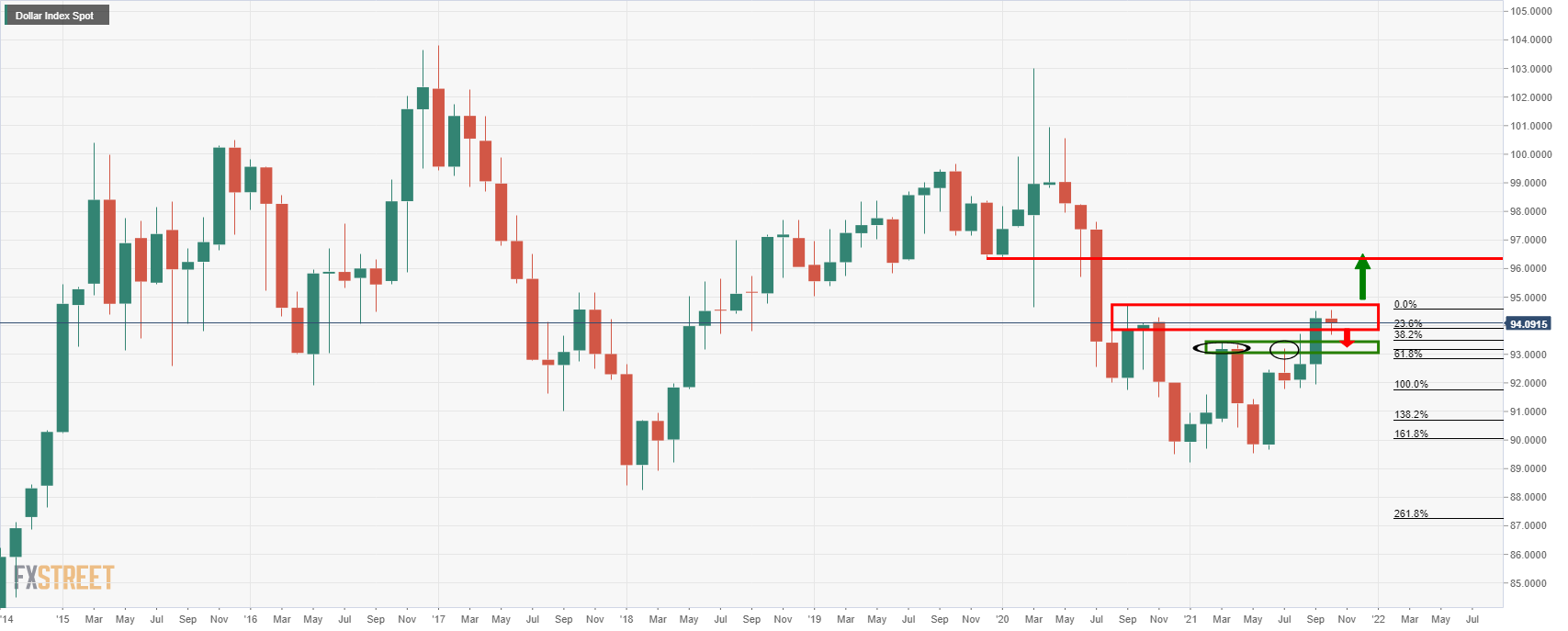
Meanwhile, the Fed funds futures indicate > 95% chance for Dec 22, ~70% chance for a Nov 22 rate hike. That's a big increase vs. last week.
Author

Ross J Burland
FXStreet
Ross J Burland, born in England, UK, is a sportsman at heart. He played Rugby and Judo for his county, Kent and the South East of England Rugby team.

















