|

FOMC lowers federal funds rate by 25 basis points to 1.75% - 2% range as expected

  • Fed lowered the target range for fed funds rate steady at 1.75% - 2%.
  • FOMC votes in favour of policy were 7 to 3.
  • US Dollar Index spiked above 98.40 with the initial reaction. 
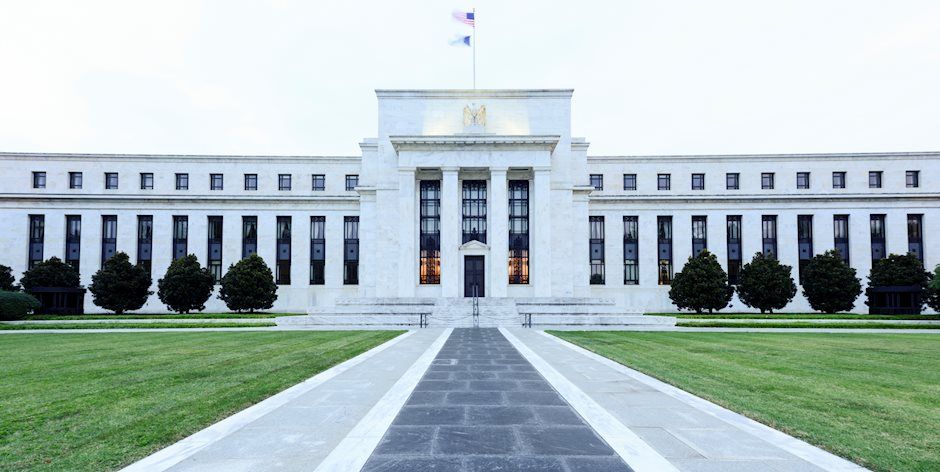
Following its 2-day meeting, the Federal Open Market Committee announced that it lowered the benchmark interest rate by 25 basis points to the target range of 1.75% - 2% in a widely expected decision. Jerome Powell, Chair of the Board of Governors of the Federal Reserve System, is scheduled to deliver his comments on the monetary policy outlook in a press conference at 18:30 GMT. 

With the initial reaction, the US Dollar Index gained traction and rose to a session high above 98.40.

Key highlights from the press release (via Reuters)

"Fed policymaker projection is for no further cuts in 2019 but seven of 17 policymakers saw one more cut as appropriate."

"Fed vote in favour of policy was 7 to 3, Bullard wanted a 50 bp cut, George and Rosengren wanted no change to rates."

"Fed sets interest on excess reserves rate at 1.80%, widening the spread from top of target range to 20 bp from 15 bp, to better control its policy rate."

"Fed sets offering rate for overnight repos at 1.70%, 5 bp below bottom of fed funds target range."

"Will continue reinvesting principal payments from its portfolio holdings."

"Labor market remains strong, economic activity has been rising at moderate rate."

"Household spending rising at a strong pace, but business fixed investment and exports have weakened."

"Inflation is running below 2%."

"Will continue to monitor incoming information, act 'as appropriate' to sustain the expansion."

Author

Eren Sengezer

As an economist at heart, Eren Sengezer specializes in the assessment of the short-term and long-term impacts of macroeconomic data, central bank policies and political developments on financial assets.


More from Eren Sengezer
Share:

Editor's Picks

EUR/USD onsolidates around mid-1.1800s as traders keenly await FOMC Minutes

The EUR/USD pair struggles to capitalize on the previous day's goodish rebound from the 1.1800 neighborhood, or a one-and-a-half-week low, and consolidates in a narrow band during the Asian session on Wednesday. Spot prices currently trade just below mid-1.1800s, nearly unchanged for the day.

GBP/USD seems vulnerable near mid-1.3500s; UK CPI/FOMC Minutes awaited

The GBP/USD pair struggles to capitalize on the previous day's late rebound from an over one-week low – levels below the 1.3500 psychological mark – and trades with a negative bias for the third consecutive day on Wednesday. The downside, however, remains cushioned as investors seem reluctant to place aggressive directional bets ahead of the release of the latest UK consumer inflation figures and FOMC Minutes.

Gold regains positive traction after Tuesday's over 2% slump as traders await FOMC Minutes

Gold gains some positive traction during the Asian session on Wednesday and recovers a part of the previous day's heavy losses more than 2%, to the $4,843-4,842 region or a nearly two-week low. The intraday move higher could be attributed to repositioning trade ahead of the release of the FOMC Minutes. 

Top Crypto Gainers: Jito drops, Morpho holds steady, Convex Finance climbs

Decentralized Finance tokens, including Jito, Morpho, and Convex Finance, rank among the top-performing crypto assets over the last 24 hours. Jito dips on Wednesday after rallying 22% the previous day on the launch of a new mainnet node.

UK jobs market weakens, bolstering rate cut hopes

In the UK, the latest jobs report made for difficult reading. Nonetheless, this represents yet another reminder for the Bank of England that they need to act swiftly given the collapse in inflation expected over the coming months. 

Ripple slides to $1.45 as downside risks surge

Ripple edges lower at the time of writing on Tuesday, from the daily open of $1.48, as headwinds persist across the crypto market. A short-term support is emerging at $1.45, but a buildup of bearish positions could further weaken the derivatives market and prolong the correction.