Fitch affirms Mexico at 'BBB-'; outlook stable

Fitch Ratings gave Mexico a confidence vote, affirming that its long-term foreign currency issuer default rating (IDR) is at 'BBB-' with a stable outlook.
Key highlights
Credit fundamentals: Mexico's rating is supported by a prudent macroeconomic policy framework, robust external finances, and its large and diversified economy. The rating is constrained by muted long-term growth, weak governance indicators, fiscal challenges related to a low revenue base and budgetary rigidities, and contingent liabilities from Pemex.
Stable outlook: The stable outlook reflects Fitch's view that Mexico's rating has headroom to withstand the tougher economic environment implicit in our new baseline. An economic slowdown already underway is likely to worsen amid an aggressive turn toward trade protectionism in the US under the Trump administration. However, we currently expect these developments will reinforce the muted growth already captured in the rating, but not worsen it in a major and lasting manner. We expect the administration of President Sheinbaum will keep its fiscal consolidation goals broadly on track despite this difficult backdrop.
Elevated Tariff Uncertainty: Mexico is especially vulnerable to US trade protectionism, as decades of integration have made exports to its northern neighbor a mainstay of the economy (27% of GDP in 2024). Tariffs already imposed could have significant impacts, especially in the auto sector, and the uncertainty is weighing on activity. These developments remain fluid, and the fate of the trade relationship is likely to remain unclear at least until a review of the USMCA agreement scheduled for mid-2026. Even if US tariff policy preserves a preferential treatment for Mexico relative to competitors, we see dimmer prospects for "nearshoring" so long as this uncertainty persists.
Economic Contraction In 2025: Real GDP growth slowed to 1.5% in 2024, ending the year on a weak note (-0.6% qoq seasonally adjusted in 4Q24) due to a falloff in public investment and elevated uncertainty. We expect a 0.4% contraction this year as tariffs, tariff-induced uncertainty, fiscal adjustments, and a slowdown in the U.S. weigh on activity. Risks are tilted to the downside, and counter-cyclical policy scope is limited.
USD/MXN Reaction to Fitch's ratings headline
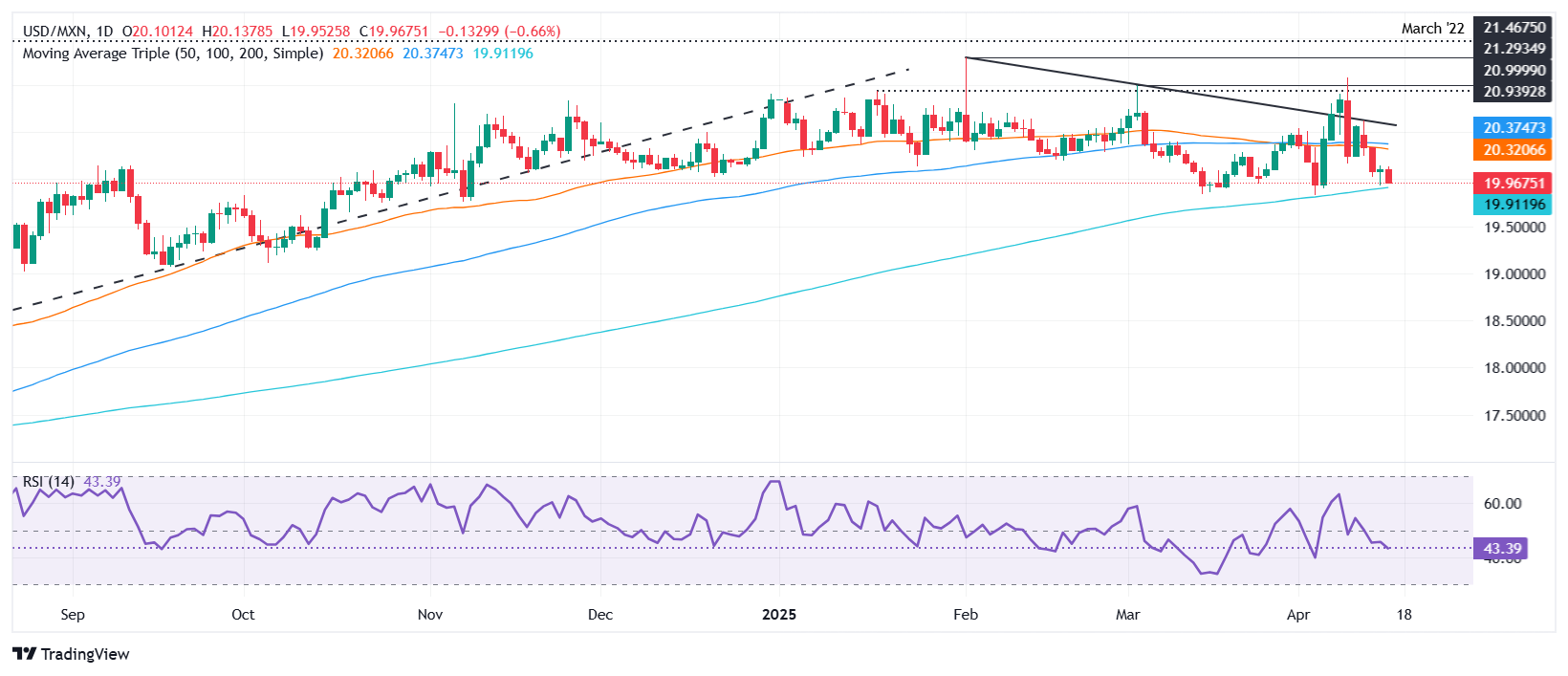
USD/MXN continues to trade lower, below the 20.00 psychological figure, with the Mexican Peso appreciating sharply. On further weakness, the exotic pair might test the 200-day Simple Moving Average (SMA) at 19.86, followed by the 19.50 figure. Otherwise, buyers could drive the pair towards the 20.00 psychological figure.
Mexican Peso FAQs
The Mexican Peso (MXN) is the most traded currency among its Latin American peers. Its value is broadly determined by the performance of the Mexican economy, the country’s central bank’s policy, the amount of foreign investment in the country and even the levels of remittances sent by Mexicans who live abroad, particularly in the United States. Geopolitical trends can also move MXN: for example, the process of nearshoring – or the decision by some firms to relocate manufacturing capacity and supply chains closer to their home countries – is also seen as a catalyst for the Mexican currency as the country is considered a key manufacturing hub in the American continent. Another catalyst for MXN is Oil prices as Mexico is a key exporter of the commodity.
The main objective of Mexico’s central bank, also known as Banxico, is to maintain inflation at low and stable levels (at or close to its target of 3%, the midpoint in a tolerance band of between 2% and 4%). To this end, the bank sets an appropriate level of interest rates. When inflation is too high, Banxico will attempt to tame it by raising interest rates, making it more expensive for households and businesses to borrow money, thus cooling demand and the overall economy. Higher interest rates are generally positive for the Mexican Peso (MXN) as they lead to higher yields, making the country a more attractive place for investors. On the contrary, lower interest rates tend to weaken MXN.
Macroeconomic data releases are key to assess the state of the economy and can have an impact on the Mexican Peso (MXN) valuation. A strong Mexican economy, based on high economic growth, low unemployment and high confidence is good for MXN. Not only does it attract more foreign investment but it may encourage the Bank of Mexico (Banxico) to increase interest rates, particularly if this strength comes together with elevated inflation. However, if economic data is weak, MXN is likely to depreciate.
As an emerging-market currency, the Mexican Peso (MXN) tends to strive during risk-on periods, or when investors perceive that broader market risks are low and thus are eager to engage with investments that carry a higher risk. Conversely, MXN tends to weaken at times of market turbulence or economic uncertainty as investors tend to sell higher-risk assets and flee to the more-stable safe havens.
Author

Christian Borjon Valencia
FXStreet
Markets analyst, news editor, and trading instructor with over 14 years of experience across FX, commodities, US equity indices, and global macro markets.