|

Fed's Harker reiterates support for moving to 25bp rate hikes

Reuters reports that Philadelphia Federal Reserve President Patrick Harker reiterated on Wednesday that he's ready for the US central bank to move to a slower pace of interest rate rises amid some signs that hot inflation is cooling off.

"High inflation is a scourge, leading to economic inefficiencies and hurting Americans of limited means disproportionately," Harker said in prepared remarks for a speech that closely followed remarks from earlier in the month. To get inflation under control, the Fed's "goal is to slow the economy modestly and to bring demand more in line with supply," he told a group in Newark, Delaware.

Key comments

  • Reiterates support for moving to 25-basis-point interest rate hikes.
  • Reiterates that the time for supercharging rate hikes is over.
  • Says fed committed to lowering inflation back to 2% target.
  • Harker expects Fed to raise rates 'a few more times' this year.
  • Expects inflation to moderate to 3.5% this year.
  • Says inflation will fall to fed's 2% target in 2025.
  • Expects US economy to grow 1% this year, unlikely to suffer recession.
  • Expects US unemployment rate to tick up to 4.5% this year before ebbing.

US Dollar update
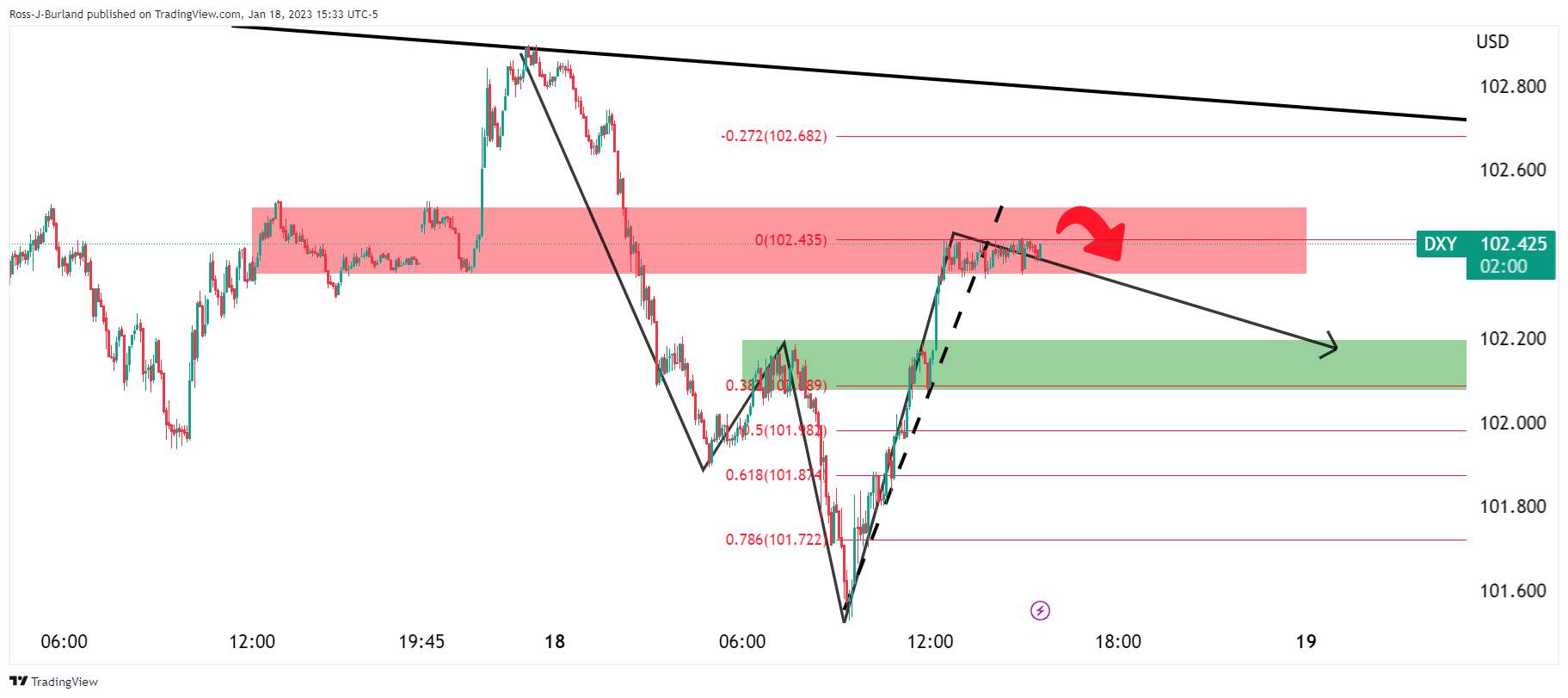
It has been a volatile spell in the forex space on Wednesday. The US Dollar has been whipsawed on the back of the Bank of Japan's deliberations and subsequent announcements combined around the weak US data that came in the US session.  

However, the bulls moved into the greenback as per the above chart following hawkish remarks from the likes of Fed's James Bullard that helped to flip sentiment on Wall Street. However, the DXY index W-formation could be a pull on the US Dollar with 102.20 vulnerable of a restest. 

Author

Ross J Burland

Ross J Burland, born in England, UK, is a sportsman at heart. He played Rugby and Judo for his county, Kent and the South East of England Rugby team.


More from Ross J Burland
Share:

Editor's Picks

GBP/USD defends 1.3300 after strong UK PMI data

Following Thursday's sharp decline, GBP/USD clings to small gains above 1.3300 in the American session on Friday, supported by the upbeat UK Retail Sales and July PMI data. Nevertheless, the pair's upside remains capped as investors cling to a cautious stance amid a further escalation of tensions in the Middle East. The US July PMI data failed to trigger relevant price action.

EUR/USD remains below 1.1400 after mixed US PMIs

EUR/USD pressures daily lows below the 1.1400 mark in the American session on Friday. Mixed S&P Global PMIs, as manufacturing output contracted while services activity expanded in July, triggered no relevant market reaction. The focus remains in Middle East developments and inflation-related concerns.

Gold holds above $4,050 but momentum still missing

Gold builds on its modest intraday bounce and climbs above the $4,050 level on Friday, hitting a fresh daily high amid a modest US Dollar pullback. The fundamental backdrop, however, warrants some caution before confirming that the pullback from an over two-week high, touched on Wednesday, has run its course and positioning for any meaningful upside.

Ethereum: Derivatives interest in ETH improves, but signs of caution remain

Ethereum is hovering slightly below the $1,900 level, down 3% on Thursday following a slight expansion in derivatives interest. The top altcoin's open interest has increased to 14.60 million ETH, marking a 600K ETH increase over the past two days and its highest level since June 7.

XRP retreats as ETF interest cools
Ripple (XRP) slides toward the short-term $1.10 support on Friday, as broader crypto market sentiment weighs on crypto assets. The sell-off mainly stems from fears of inflation in the United States (US) amid the ongoing war in the Middle East and rising Oil prices.
US Dollar mid-year outlook: Exceptional currency, exceptional risks?
The US Dollar enters the second half of 2026 in a markedly different position from a year ago. The King currency has recovered, reflecting persistent US inflation, changing expectations for Fed policy, geopolitical tensions and renewed demand for defensive assets.















