EURUSD surged almost 4% weekly, eyeing the 200-DMA
- EURUSD finished up in the week close to 4%, spurred by a weak US Dollar.
- Softer-than-expected US CPI report and consumer inflation expectations rising tumbled the US Dollar.
- The double-digit inflation level in Germany underpinned the Euro.
- EURUSD Price Analysis: Upward biased, might test the 200-DMA in the short term.

The Euro (EUR) finished the week on a higher note, following the release of a soft inflation report in the United States, as informed by the Department of Labor (DoL) October’s Consumer Price Index (CPI) report. Consequently, the US Dollar (USD) extended its losses to four consecutive weeks as hopes for a slowdown in the Federal Reserve (Fed) tightening cycle following the CPI release remained high. Therefore, the Euro continued its advance, as the EURUSD gained 1.42%, exchanging hands at 1.0352.
US Consumer Price Index weighs on the US Dollar
Wall Street finished the week with solid gains. The US inflation report on Thursday showed that core CPI, closely followed by the Federal Reserve, eased from 6.6% YoY in September to 6.3%, well below estimates. Meanwhile, the University of Michigan (UoM) Consumer Sentiment for November tumbled to a four-month low from 59.5 to 54.7, as reported on Friday. Delving the UoM poll, inflation expectations for the one-year horizon increased to 5.1%, while the five to 10-year horizon jumped from 2.9% to 3%. Joanne Hsu, director of the survey, said, “Continued uncertainty over inflation expectations suggests that such entrenchment in the future is still possible.”
Last Thursday’s CPI report overshadowed traders’ reaction to the UoM poll. The EURUSD extended its rally on Friday after dipping to its daily low of 1.0163 and soaring sharply toward its daily high at 1.0364.
Traders expect the Fed to hike 50 bps in December
Investors are beginning to price in a less “hawkish” Fed. As shown by the CME FedWatch Tool, money market futures are pricing in a 50 bps rate hike, with odds at around 85.6%, unchanged after the release of US inflation data.
German Harmonised Index of Consumer Prices above 11%
On the Eurozone (EU) side, CPI in Germany increased by 10.4%, at a yearly pace, aligned with the estimate. Meanwhile, as expected, the German Harmonised Index of Consumer Prices (HICP) for October jumped by 11.6% YoY, but 0.7% higher than September’s figures.
Aside from this, a tranche of European Central Bank (ECB) policymakers crossed newswires and kept its hawkish stance, bolstering the Euro. ECB member Robert Holtzman said he would vote for a 50 or 75 bps hike at the December meeting, while the ECB Vice-President Luis De Guindos said that a technical recession in the Eurozone is likely, and added that markets overreacted to US CPI.
Furthermore, ECB Pablo Hernandez de Cos added that the Quantitative Tightening (QT) could be announced in December and that recession probability had increased. In the meantime, ECB member Mario Centeno said that the Euro is not going through an “existential crisis.”
EURUSD Price Forecast: Technical outlook
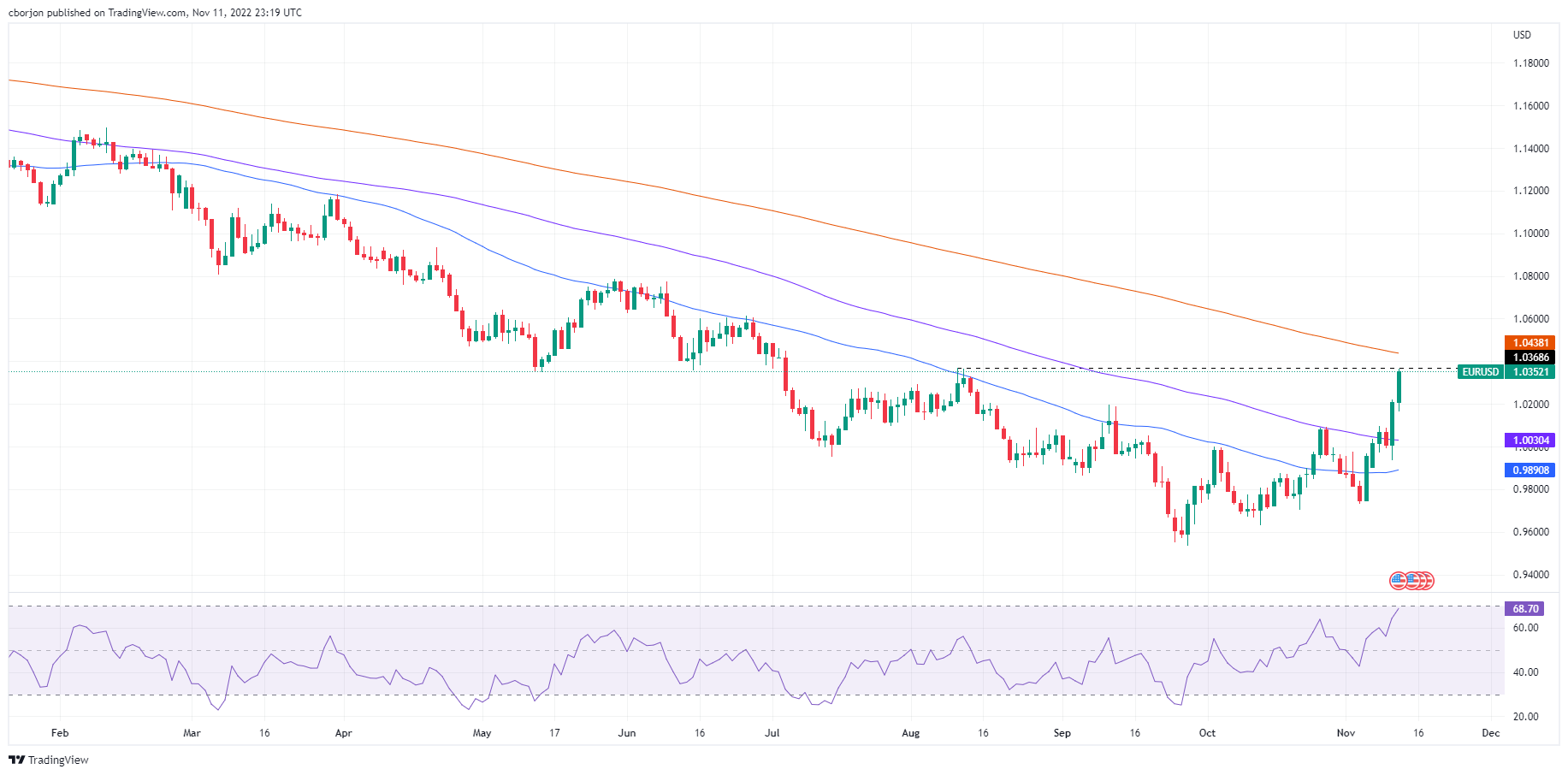
Given the fundamental backdrop, the EURUSD climbed toward the August 10 swing high at 1.0364. Nevertheless, it failed short of achieving a daily close above it, which could have exacerbated a rally to the 200-day Exponential Moving Average (EMA) at 1.0438. OF note, the Relative Strength Index (RSI), at bullish territory, is almost overbought, but given that the uptrend is strong, technicians consider RSI’s 80 levels as the most extreme. That said, the path of least resistance is upwards.
Therefore, the EURUSD’s first resistance would be the August 10 daily high at 1.0364, followed by the psychological 1.0400 figure. The break above will expose the 200-day EMA. On the other hand, the EURUSD’s first support would be the 1.0300 mark, followed by the 1.0250 and the November 11 low at 1.0163.
Author

Christian Borjon Valencia
FXStreet
Markets analyst, news editor, and trading instructor with over 14 years of experience across FX, commodities, US equity indices, and global macro markets.














