EURUSD falls below key technical levels with US NFP in the barrel
- EUR/USD slipped back below 1.0800 as bearish pullback gains strength.
- Mixed US data reignited fears over a possible recession in the US.
- US NFP jobs report in the pipe for Friday, market attention fixed squarely on hiring numbers.

EUR/USD lost a foothold above key technical levels on Thursday, slumping below the 1.0800 handle after a miss in US Purchasing Managers Index (PMI) figures sparked fresh fears of worsening economic data signaling the possibility of a hard landing scenario in the US economy.
Forex today: Markets’ attention shifts to US NFP
European economic data remains thin for what’s left of the trading week, and next week sees little of note on the meaningful release side for the EU as broader markets pivot to fully face down Friday’s US Nonfarm Payrolls (NFP) jobs report for July. Investors hope for a moderate drop to 175K new US jobs in July from 206K last month. Too high of a print could splash cold water on rate cut hopes for September, while too low of a figure would add further weight to concerns of a too-fast economic decline dragging the US economy into a recession.
Markets are struggling to balance on the edge of a very sharp knife as a downturn in economic figures is helping to pin rate cut expectations even further into the ceiling. According to the CME’s FedWatch Tool, rate traders are pricing in 100% odds of at least a quarter-point rate cut from the Fed on September 18, with further one-in-five odds of a double-cut for 50 basis points. On the downside, too much of a downturn will obliterate market sentiment as a hard landing economic scenario for the US economy makes any rate cuts from the Fed irrelevant, and investors are strung along a difficult middle ground where they hope for rate cuts on soft data, but not so soft that the US economy rolls over.
US Initial Jobless Claims for the week ended July 26 rose to 249K from the previous week’s 235K, lurching past the forecast uptick to 236K. July’s US ISM Manufacturing Purchasing Managers Index (PMI) tumbled to an eight-month low of 46.8 compared to the previous 48.5 and entirely reversing the forecast move up to 48.8.
On the other side of the same coin, ISM Manufacturing Prices Paid in July accelerated to 52.9 versus the previous 52.1 and entirely missing a forecast easing to 48.8 as input prices for manufacturers drift higher than markets anticipated even as activity declines.
Economic Indicator
Nonfarm Payrolls
The Nonfarm Payrolls release presents the number of new jobs created in the US during the previous month in all non-agricultural businesses; it is released by the US Bureau of Labor Statistics (BLS). The monthly changes in payrolls can be extremely volatile. The number is also subject to strong reviews, which can also trigger volatility in the Forex board. Generally speaking, a high reading is seen as bullish for the US Dollar (USD), while a low reading is seen as bearish, although previous months' reviews and the Unemployment Rate are as relevant as the headline figure. The market's reaction, therefore, depends on how the market assesses all the data contained in the BLS report as a whole.
Read more.Next release: Fri Aug 02, 2024 12:30
Frequency: Monthly
Consensus: 175K
Previous: 206K
Source: US Bureau of Labor Statistics
America’s monthly jobs report is considered the most important economic indicator for forex traders. Released on the first Friday following the reported month, the change in the number of positions is closely correlated with the overall performance of the economy and is monitored by policymakers. Full employment is one of the Federal Reserve’s mandates and it considers developments in the labor market when setting its policies, thus impacting currencies. Despite several leading indicators shaping estimates, Nonfarm Payrolls tend to surprise markets and trigger substantial volatility. Actual figures beating the consensus tend to be USD bullish.
EUR/USD technical outlook
The Fiber’s downside performance sent the pair tumbling below the 200-day Exponential Moving Average (EMA) at 1.0805, and dragged bids back under the 1.0800 handle as a bearish turnaround in EUR/USD grows its legs, sinking the Euro into a -1.56% decline against the Greenback.
EUR/USD set a near-term high of 1.0948 in recent weeks, falling just short of the 1.0950 level and price action has once again slumped within the range of a choppy descending channel that has plagued the chart since late last year.
EUR/USD daily chart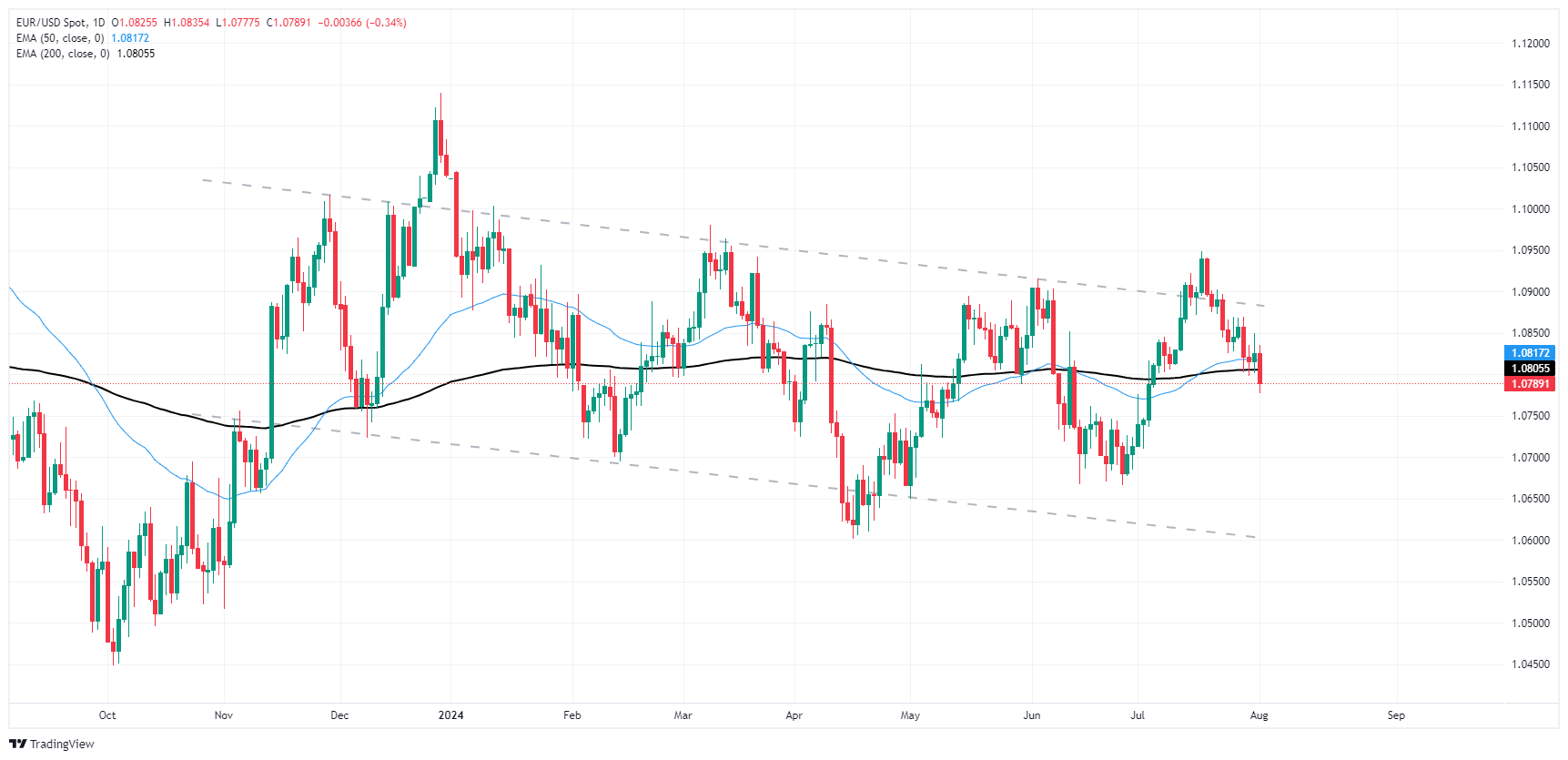
Euro FAQs
The Euro is the currency for the 20 European Union countries that belong to the Eurozone. It is the second most heavily traded currency in the world behind the US Dollar. In 2022, it accounted for 31% of all foreign exchange transactions, with an average daily turnover of over $2.2 trillion a day. EUR/USD is the most heavily traded currency pair in the world, accounting for an estimated 30% off all transactions, followed by EUR/JPY (4%), EUR/GBP (3%) and EUR/AUD (2%).
The European Central Bank (ECB) in Frankfurt, Germany, is the reserve bank for the Eurozone. The ECB sets interest rates and manages monetary policy. The ECB’s primary mandate is to maintain price stability, which means either controlling inflation or stimulating growth. Its primary tool is the raising or lowering of interest rates. Relatively high interest rates – or the expectation of higher rates – will usually benefit the Euro and vice versa. The ECB Governing Council makes monetary policy decisions at meetings held eight times a year. Decisions are made by heads of the Eurozone national banks and six permanent members, including the President of the ECB, Christine Lagarde.
Eurozone inflation data, measured by the Harmonized Index of Consumer Prices (HICP), is an important econometric for the Euro. If inflation rises more than expected, especially if above the ECB’s 2% target, it obliges the ECB to raise interest rates to bring it back under control. Relatively high interest rates compared to its counterparts will usually benefit the Euro, as it makes the region more attractive as a place for global investors to park their money.
Data releases gauge the health of the economy and can impact on the Euro. Indicators such as GDP, Manufacturing and Services PMIs, employment, and consumer sentiment surveys can all influence the direction of the single currency. A strong economy is good for the Euro. Not only does it attract more foreign investment but it may encourage the ECB to put up interest rates, which will directly strengthen the Euro. Otherwise, if economic data is weak, the Euro is likely to fall. Economic data for the four largest economies in the euro area (Germany, France, Italy and Spain) are especially significant, as they account for 75% of the Eurozone’s economy.
Another significant data release for the Euro is the Trade Balance. This indicator measures the difference between what a country earns from its exports and what it spends on imports over a given period. If a country produces highly sought after exports then its currency will gain in value purely from the extra demand created from foreign buyers seeking to purchase these goods. Therefore, a positive net Trade Balance strengthens a currency and vice versa for a negative balance.
Author

Joshua Gibson
FXStreet
Joshua joins the FXStreet team as an Economics and Finance double major from Vancouver Island University with twelve years' experience as an independent trader focusing on technical analysis.