Euro drops to two-day lows around 1.0840, Dollar gathers extra steam
- The Euro accelerates its decline to 1.0840 vs. the US Dollar.
- European stocks on their way to close with gains on Thursday.
- EUR/USD reaches tw-day lows around 1.0840 amidst USD bounce.
- The USD Index (DXY) rebounds markedly and revisits 103.70.
- US, German yields trade slightly on the defensive.
- Germany’s labour market report came in mixed in August.
- EMU advanced figures showed inflation remained sticky in August.
- US PCE, Core PCE matched expectations in July.

The Euro (EUR) continues to face selling pressure against the US Dollar (USD), resulting in a break below the important 1.0900 level for EUR/USD and a return to the area around 1.0840 on Thursday.
At the same time, the Greenback is experiencing a recovery, leading to a rebound in the USD Index (DXY) from the two-week lows near the 103.00 level and a challenge of the 103.70 region. Additionally, US yields are declining across the yield curve as investors reassess the likelihood of the Federal Reserve pausing its normalization process for the next few months.
In the meantime, the narrative surrounding the Federal Reserve’s (Fed) tighter-for-longer stance appears to have dwindled following the recent weaker-than-expected economic data.
By contrast, there is no news around the European Central Bank (ECB) regarding its potential decision on rates once the summer season is over, while rising market chatter around an incipient stagflation in the region puts further ECB hiking prospects to the test.
Still around the ECB, its Accounts for the July 27 gathering stated that it was first proposed that interest rates not be raised. The explanation was that there was a substantial possibility that the ECB staff's September inflation predictions would be revised downward sufficiently to meet the objective of 2%, making an extra interest rate rise in September unnecessary. It was also said that underlying inflation was projected to stay high for a long time.
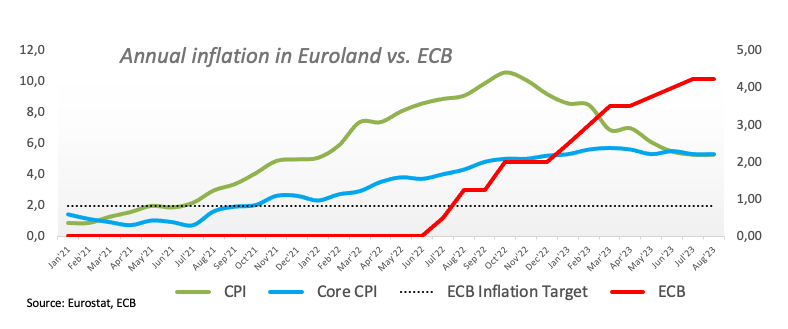
In the domestic calendar, Retail Sales in Germany contracted 0.8% MoM in July and 2.2% over the last twelve months. Still in Germany, the Unemployment Change increased by 18K individuals in August and the Unemployment Rate ticked higher to 5.7%. Looking at the broader euro area, advanced inflation figures saw the headline CPI rise 5.3% YoY and 5.3% YoY when it comes to the Core CPI.
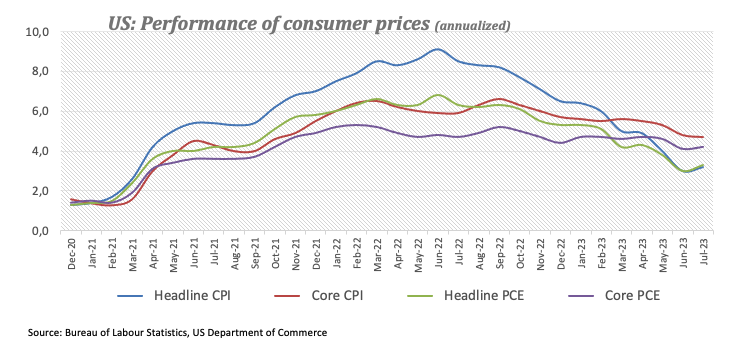
In the US docket, headline PCE rose 3.3% YoY in July and Core PCE gained 4.2% from a year eaerlier. In addition, Initial Jobless Claims increased by 228K in the week to August 26, Personal Income expanded 0.2% MoM in July and Personal Spending rose 0.8% MoM in the same period. Later in the session, Boston Fed Chair Susan Collins is also due to speak.
Daily digest market movers: Euro weakens further south of 1.0900
- The EUR surrenders a big chunk of the recent strong advance against the USD.
- Fundamentals in Germany continue to deteriorate amidst stagflation talks.
- Investors see the Fed keeping rates on hold in the next few months.
- BoE’s Huw Pill said the country is facing second-round effects from inflation.
- Investors see the Fed on hold for the remainder of the year.
- ECB's Isabel Schnabel said there is uncertainty around the peak rate.
- ECB's Robert Holzmann advocated for 1-2 extra rate hikes.
- Further stimulus measures are likely to be taken by the PBoC in the near term.
- BoJ’s Toyoaki Nakamura said economic recovery is needed to end the loose policy.
- US docket showed a stubborn PCE and firm weekly Claims.
Technical Analysis: Euro could extend losses to the 1.0810 area
The three-day rebound in EUR/USD seems to have met quite a decent obstacle ahead of the 1.0950 region.
In case bulls regain the upper hand and EUR/USD surpasses the weekly top of 1.0945, the pair is expected to meet the provisional 55-day Simple Moving Average (SMA) at 1.0967 prior to the psychological 1.1000 barrier and the August top at 1.1064 (August 10). Once the latter is cleared, spot could challenge the July 27 peak at 1.1149. If the pair surpasses this region, it could alleviate some of the downward pressure and potentially visit the 2023 peak of 1.1275 seen on July 18. Further up comes the 2022 high at 1.1495, which is closely followed by the round level of 1.1500.
The resumption of the downward bias could motivate the pair to initially test the key 200-day SMA at 1.0813 ahead of the August low of 1.0765 (August 25). The breach of the latter exposes the May 31 low of 1.0635 prior to the March 15 low of 1.0516 and the 2023 low at 1.0481 seen on January 6.
Furthermore, sustained losses are likely in EUR/USD once the 200-day SMA is breached in a convincing fashion.
Euro FAQs
What is the Euro?
The Euro is the currency for the 20 European Union countries that belong to the Eurozone. It is the second most heavily traded currency in the world behind the US Dollar. In 2022, it accounted for 31% of all foreign exchange transactions, with an average daily turnover of over $2.2 trillion a day.
EUR/USD is the most heavily traded currency pair in the world, accounting for an estimated 30% off all transactions, followed by EUR/JPY (4%), EUR/GBP (3%) and EUR/AUD (2%).
What is the ECB and how does it impact the Euro?
The European Central Bank (ECB) in Frankfurt, Germany, is the reserve bank for the Eurozone. The ECB sets interest rates and manages monetary policy.
The ECB’s primary mandate is to maintain price stability, which means either controlling inflation or stimulating growth. Its primary tool is the raising or lowering of interest rates. Relatively high interest rates – or the expectation of higher rates – will usually benefit the Euro and vice versa.
The ECB Governing Council makes monetary policy decisions at meetings held eight times a year. Decisions are made by heads of the Eurozone national banks and six permanent members, including the President of the ECB, Christine Lagarde.
How does inflation data impact the value of the Euro?
Eurozone inflation data, measured by the Harmonized Index of Consumer Prices (HICP), is an important econometric for the Euro. If inflation rises more than expected, especially if above the ECB’s 2% target, it obliges the ECB to raise interest rates to bring it back under control.
Relatively high interest rates compared to its counterparts will usually benefit the Euro, as it makes the region more attractive as a place for global investors to park their money.
How does economic data influence the value of the Euro?
Data releases gauge the health of the economy and can impact on the Euro. Indicators such as GDP, Manufacturing and Services PMIs, employment, and consumer sentiment surveys can all influence the direction of the single currency.
A strong economy is good for the Euro. Not only does it attract more foreign investment but it may encourage the ECB to put up interest rates, which will directly strengthen the Euro. Otherwise, if economic data is weak, the Euro is likely to fall.
Economic data for the four largest economies in the euro area (Germany, France, Italy and Spain) are especially significant, as they account for 75% of the Eurozone’s economy.
How does the Trade Balance impact the Euro?
Another significant data release for the Euro is the Trade Balance. This indicator measures the difference between what a country earns from its exports and what it spends on imports over a given period.
If a country produces highly sought after exports then its currency will gain in value purely from the extra demand created from foreign buyers seeking to purchase these goods. Therefore, a positive net Trade Balance strengthens a currency and vice versa for a negative balance.
Author

Pablo Piovano
FXStreet
Born and bred in Argentina, Pablo has been carrying on with his passion for FX markets and trading since his first college years.