EUR/USD wavers in range ahead of US Retail Sales, PPI data
- The Euro edged up to 1.1530 against the US Dollar, but remains capped below 1.1550.
- German GDP confirms that the economy stalled in the third quarter.
- Dovish Fed rhetoric has boosted monetary easing hopes and is weighing on the USD.

EUR/USD posts mild gains on Tuesday's European session, but remains trapped below 1.1550, changing hands at 1.1530 at the time of writing. German GDP data failed to boost the Euro (EUR), but the US Dollar Index (DXY) has been trading lower during most of the European session, with traders awaiting the release of the delayed US Retail Sales and Producer Prices Index (PPI) data, due later today.
Data released earlier on Tuesday revealed that Germany's Gross Domestic Product (GDP) has confirmed the preliminary estimations of a stalled economic growth in the third quarter, following a 0.3% contraction in the second.
On Monday, Fed Governor Christopher Waller seconded last week's comments from the New York Fed President John Williams and called for a quarter-point interest rate cut next month. Waller affirmed that the available data points to a weakening labour market while inflation is expected to ease.
These comments boosted market expectations that the central bank will ease its monetary policy further in December, although investors know that the decision will be a coin toss amid the wide divergence among policymakers.
Furthermore, US President Donald Trump posted on social media on Monday that relations with China are "extremely strong" after a phone call with Chinese President Xi Jinping. Trump called Japanese Prime Minister Sanae Takaichi shortly afterwards, in an attempt to ease the geopolitical frictions between the two Asian countries.
Some European Central Bank (ECB) speakers will take the stage later in the day, although the main focus will be in the US, with September's Producer Prices Index (PPI), and Retail Sales figures, and November's Consumer Confidence data on tap.
Euro Price Today
The table below shows the percentage change of Euro (EUR) against listed major currencies today. Euro was the strongest against the New Zealand Dollar.
| USD | EUR | GBP | JPY | CAD | AUD | NZD | CHF | |
|---|---|---|---|---|---|---|---|---|
| USD | -0.05% | -0.06% | -0.20% | 0.08% | 0.30% | 0.33% | 0.23% | |
| EUR | 0.05% | -0.00% | -0.16% | 0.13% | 0.34% | 0.38% | 0.27% | |
| GBP | 0.06% | 0.00% | -0.14% | 0.17% | 0.35% | 0.38% | 0.28% | |
| JPY | 0.20% | 0.16% | 0.14% | 0.29% | 0.50% | 0.52% | 0.43% | |
| CAD | -0.08% | -0.13% | -0.17% | -0.29% | 0.22% | 0.23% | 0.14% | |
| AUD | -0.30% | -0.34% | -0.35% | -0.50% | -0.22% | 0.04% | -0.07% | |
| NZD | -0.33% | -0.38% | -0.38% | -0.52% | -0.23% | -0.04% | -0.10% | |
| CHF | -0.23% | -0.27% | -0.28% | -0.43% | -0.14% | 0.07% | 0.10% |
The heat map shows percentage changes of major currencies against each other. The base currency is picked from the left column, while the quote currency is picked from the top row. For example, if you pick the Euro from the left column and move along the horizontal line to the US Dollar, the percentage change displayed in the box will represent EUR (base)/USD (quote).
The Euro wavers in range with Fed expectations grabbing the focus
- The common currency is consolidating near the 1.1500 level as Eurozone data fails to cheer investors, with investors awaiting the release of delayed US macroeconomic figures for a better picture of the Fed's monetary policy path.
- Figures from Germany released on Tuesday confirmed that the region's leading economy remains gripped, with the GDP showing a 0% growth in Q3, following a 0.3% contraction in Q2. Year-on-year, the German economy ticked up to a 0.3% growth from 0.2% in the second quarter.
- On Monday, the German IFO Business Climate eased to 88.1 in November, from 88.4 in October, against market expectations of a slight improvement to 88.5. The Index measuring the current economic situation improved to 85.6 from 85.3, but the economic expectations deteriorated by a whole point, to 90.6 in November from 91.6 in October.
- The US Dollar Index has pulled back to the lower boundary of the last few days' trading range amid dovish comments from Fed officials and higher hopes of a Fed interest rate cut next month. Data from the CME Group's Fedwatch Tool shows that the odds for a 25 basis points interest rate cut on December 10 have risen beyond 80%, from about 40% last week.
- In the US, later on Tuesday, September's US PPI is expected to have picked up to 0.3% in the month, from a 0.1% decline in August. The yearly inflation is seen accelerating to 2.7% from 2.6% in the previous month. The Core PPI, however, is seen easing to a 2.7% yearly rate from August's 2.8%.
- At the same time, US Retail Sales are expected to have grown at a 0.4% in September, down from 0.6% in August. Excluding automobiles, sales of all other products are seen slowing down to 0.4% from the previous month's 0.7% growth.
Technical Analysis: EUR/USD remains capped below 1.1550 resistance
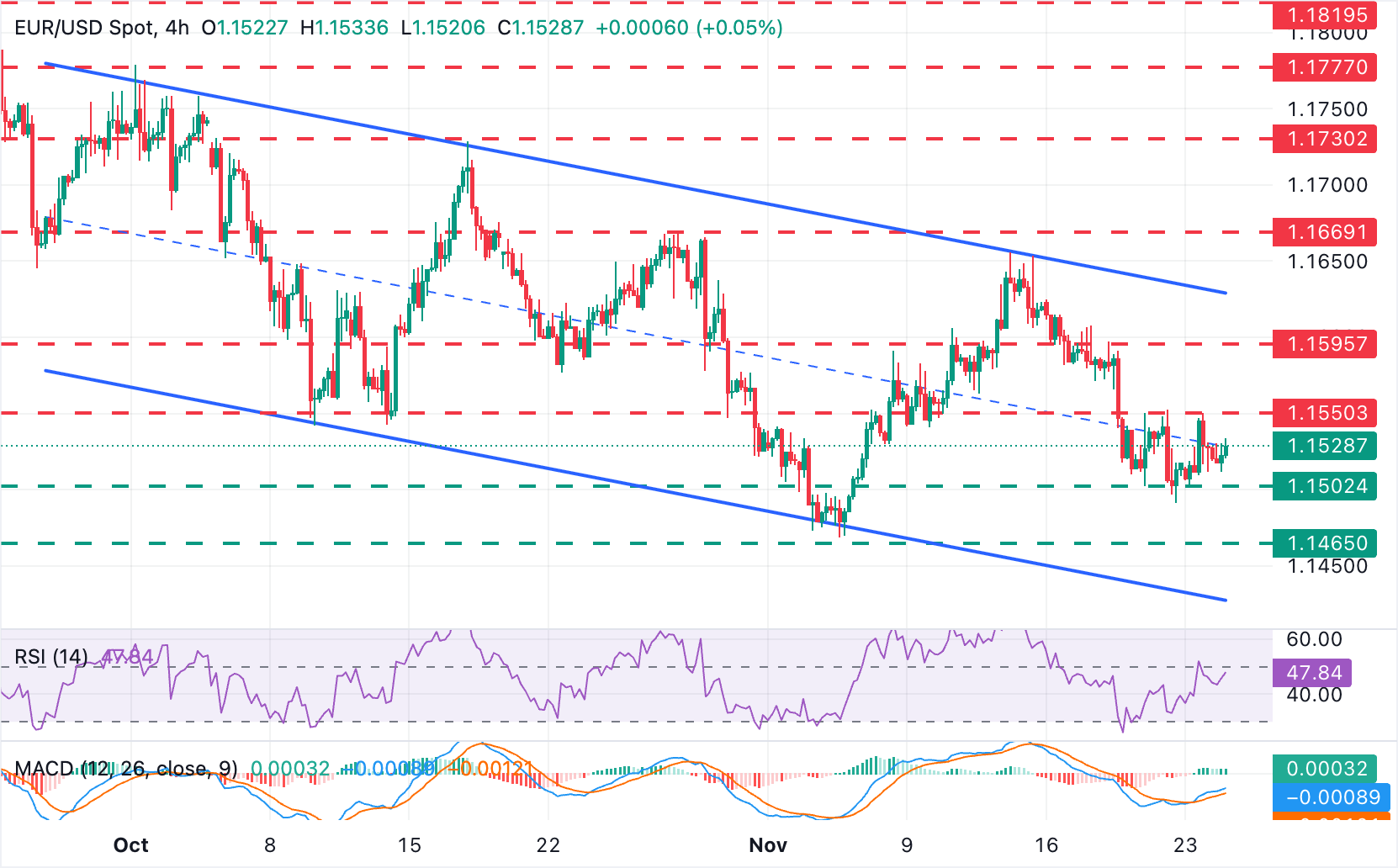
The EUR/USD pair keeps languishing near two-week lows at the 1.1500 area, with upside attempts capped below 1.1550, although the broader bearish trend is still in play. The 4-hour Relative Strength Index (RSI) failed to consolidate above the 50 level on Monday. The Moving Average Convergence Divergence (MACD) has crossed above the signal line, but remains at levels below zero, underscoring the fragility of the rebound from Friday's lows.
Resistance at the 1.1550 level has capped bulls in the last three trading days, which leaves the pair in no man's land above 1.1500. The pair should break that level to confirm a bullish reaction and aim for the November 18 and 19 highs, near 1.1600, and the top of a descending channel from the mid-October highs, which is now around 1.1625.
On the downside, below the 1.1500 psychological level, bears would gain confidence to retest the November 5 lows, near 1.1470, and the bottom of the descending channel from early October highs, now around 1.1425.
Economic Indicator
Retail Sales (MoM)
The Retail Sales data, released by the US Census Bureau on a monthly basis, measures the value in total receipts of retail and food stores in the United States. Monthly percent changes reflect the rate of changes in such sales. A stratified random sampling method is used to select approximately 4,800 retail and food services firms whose sales are then weighted and benchmarked to represent the complete universe of over three million retail and food services firms across the country. The data is adjusted for seasonal variations as well as holiday and trading-day differences, but not for price changes. Retail Sales data is widely followed as an indicator of consumer spending, which is a major driver of the US economy. Generally, a high reading is seen as bullish for the US Dollar (USD), while a low reading is seen as bearish.
Read more.Next release: Tue Nov 25, 2025 13:30
Frequency: Monthly
Consensus: 0.4%
Previous: 0.6%
Source: US Census Bureau
Retail Sales data published by the US Census Bureau is a leading indicator that gives important information about consumer spending, which has a significant impact on the GDP. Although strong sales figures are likely to boost the USD, external factors, such as weather conditions, could distort the data and paint a misleading picture. In addition to the headline data, changes in the Retail Sales Control Group could trigger a market reaction as it is used to prepare the estimates of Personal Consumption Expenditures for most goods.
Economic Indicator
Producer Price Index (YoY)
The Producer Price Index released by the Bureau of Labor statistics, Department of Labor measures the average changes in prices in primary markets of the US by producers of commodities in all states of processing. Changes in the PPI are widely followed as an indicator of commodity inflation. Generally speaking, a high reading is seen as positive (or bullish) for the USD, whereas a low reading is seen as negative (or bearish).
Read more.Next release: Tue Nov 25, 2025 13:30
Frequency: Monthly
Consensus: 2.7%
Previous: 2.6%
Source: US Bureau of Labor Statistics
Author

Guillermo Alcala
FXStreet
Graduated in Communication Sciences at the Universidad del Pais Vasco and Universiteit van Amsterdam, Guillermo has been working as financial news editor and copywriter in diverse Forex-related firms, like FXStreet and Kantox.

















