EUR/USD tumbles as Powell delivers ‘hawkish cut,’ dials back December easing bets
- EUR/USD drops over 0.40% after Powell says December rate cut is far from guaranteed.
- Powell highlights internal Fed division, suggesting policy may already be near neutral, tempering dovish bets.
- Market odds for another rate cut fall to 62% from 85% pre-decision, per LSEG data.

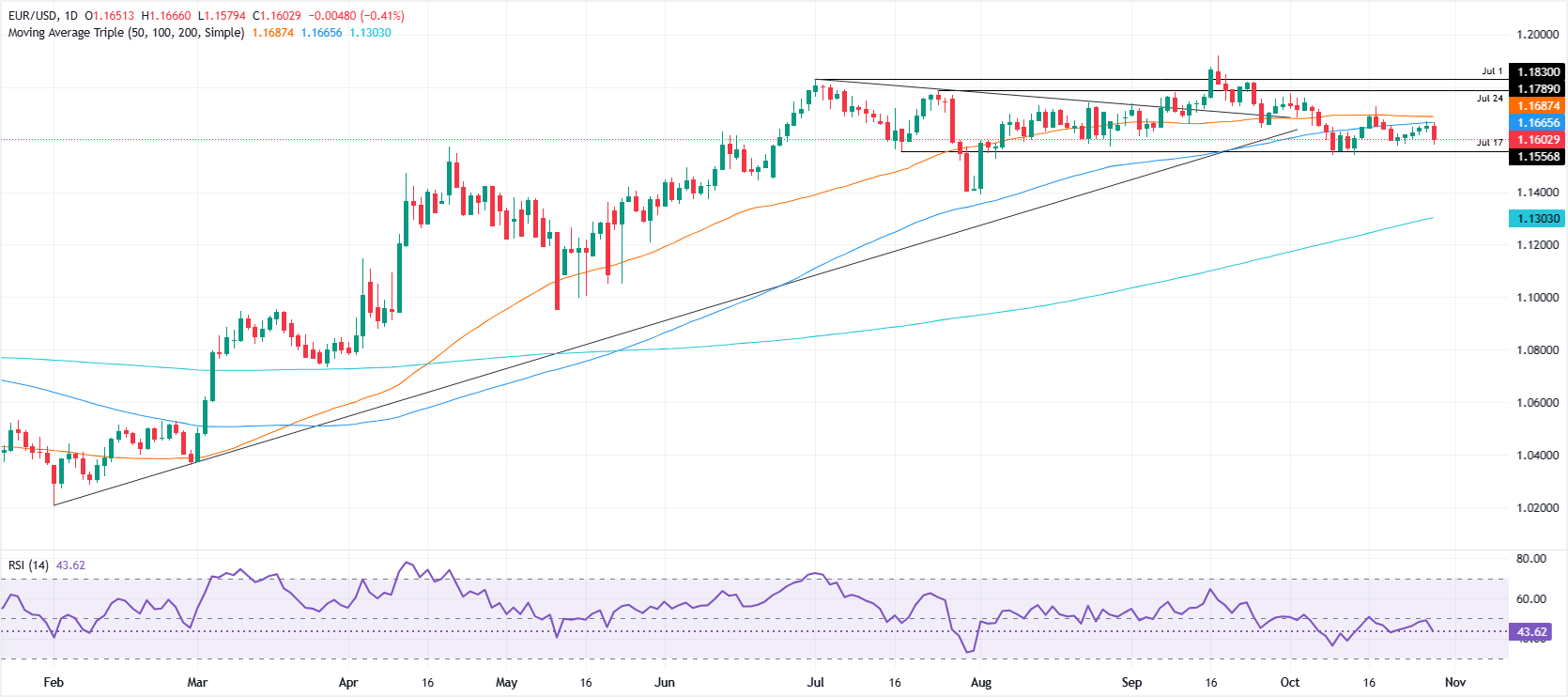
EUR/USD slid on Wednesday over 0.43% as the Federal Reserve delivered a “hawkish cut” after Fed Chair Jerome Powell said that “rate cut in December is far from foregone conclusion.” At the time of writing, the pair trades near weekly lows of 1.1601 with traders eyeing monthly lows of 1.1542.
Euro hits five-day low near 1.1577 after Fed signals policy pause may be near
After the Fed’s decision, Jerome Powell said “A further reduction in the policy rate at the December meeting is not a foregone conclusion, far from it.” He said that there are different views at the Federal Open Market Committee (FOMC) yet mostly were focused on the upcoming December meeting.
Powell added that “there’s a sense” that some officials would like to move to the sidelines, commenting that the fed funds rate is at neutral or near neutral, according to the September’s Summary of Economic Projections (SEP).
On his remarks, the EUR/USD moved lower, clearing the 1.1600 figure, plunged to a five-day low of 1.1577, before reclaiming 1.1500.
Data from LSEG showed that the odds for a Fed cut in December are at 62%, down from around 85% before the Fed’s decision.
The US Dollar Index (DXY), which tracks the performance of the buck versus six currencies, edges up 0.63%, at 99.28
Traders’ eyes shift to the European Central Bank’s (ECB) monetary policy decision on Thursday, in which President Christine Lagarde and Co. are expected to hold rates unchanged.
Daily market movers: EUR/USD tumbles as Fed leans hawkish
- The Federal Reserve reduced rates by 25 basis points as expected by the markets, to 3.75%-4%. The decision was not unanimous as there were two dissenters, as Governor Stephen Miran wanted a 50-bps reduction while Jeffrey Schmid of the Kansas City Fed opted to keep rates unchanged.
- Regarding the balance sheet reduction “The Committee decided to conclude the reduction of its aggregate securities holdings on December 1.”
- Traders are also focused on the prospect of trade deal between the United States and China ahead of a meeting between Trump and Chinese President Xi Jinping in South Korea on Thursday.
- The debate in France regarding the budget is ongoing, with focus on a potential wealth tax. France’s Socialist Party warned it is prepared to bring down the government by the end of the week unless next year’s budget includes a substantial tax increase on the wealthy.
Technical outlook: EUR/USD turned bearish, sellers eye 1.1500
The EUR/USD resumed its downtrend, with sellers eyeing a clear break of 1.1550 as they target the October 9 low of 1.1542. A breach of the latter will expose 1.1500 and the August 1 low of 1.1391.
Conversely, if EUR/USD stays above 1.1600, the pair could consolidate within 1.1600-1.1650, before buyers clear the latter and target the 1.1700 milestone.
Euro FAQs
The Euro is the currency for the 20 European Union countries that belong to the Eurozone. It is the second most heavily traded currency in the world behind the US Dollar. In 2022, it accounted for 31% of all foreign exchange transactions, with an average daily turnover of over $2.2 trillion a day. EUR/USD is the most heavily traded currency pair in the world, accounting for an estimated 30% off all transactions, followed by EUR/JPY (4%), EUR/GBP (3%) and EUR/AUD (2%).
The European Central Bank (ECB) in Frankfurt, Germany, is the reserve bank for the Eurozone. The ECB sets interest rates and manages monetary policy. The ECB’s primary mandate is to maintain price stability, which means either controlling inflation or stimulating growth. Its primary tool is the raising or lowering of interest rates. Relatively high interest rates – or the expectation of higher rates – will usually benefit the Euro and vice versa. The ECB Governing Council makes monetary policy decisions at meetings held eight times a year. Decisions are made by heads of the Eurozone national banks and six permanent members, including the President of the ECB, Christine Lagarde.
Eurozone inflation data, measured by the Harmonized Index of Consumer Prices (HICP), is an important econometric for the Euro. If inflation rises more than expected, especially if above the ECB’s 2% target, it obliges the ECB to raise interest rates to bring it back under control. Relatively high interest rates compared to its counterparts will usually benefit the Euro, as it makes the region more attractive as a place for global investors to park their money.
Data releases gauge the health of the economy and can impact on the Euro. Indicators such as GDP, Manufacturing and Services PMIs, employment, and consumer sentiment surveys can all influence the direction of the single currency. A strong economy is good for the Euro. Not only does it attract more foreign investment but it may encourage the ECB to put up interest rates, which will directly strengthen the Euro. Otherwise, if economic data is weak, the Euro is likely to fall. Economic data for the four largest economies in the euro area (Germany, France, Italy and Spain) are especially significant, as they account for 75% of the Eurozone’s economy.
Another significant data release for the Euro is the Trade Balance. This indicator measures the difference between what a country earns from its exports and what it spends on imports over a given period. If a country produces highly sought after exports then its currency will gain in value purely from the extra demand created from foreign buyers seeking to purchase these goods. Therefore, a positive net Trade Balance strengthens a currency and vice versa for a negative balance.
Author

Christian Borjon Valencia
FXStreet
Markets analyst, news editor, and trading instructor with over 14 years of experience across FX, commodities, US equity indices, and global macro markets.