EUR/USD consolidates losses in cautious markets with US GDP on focus
- The Euro wavers near 1.1730 lows following a 0.6% reversal on Wednesday.
- Weak Eurozone data and a cautious Fed rhetoric sent the Euro tumbling on Wednesday.
- The final reading of US Q2 GDP and more Fed speakers are set to move markets during the day.

EUR/USD is trading at 1.1735 at the moment of writing on Thursday, after retreating from weekly highs above 1.1800 the previous day. A sour market mood and Lukewarm German Consumer Confidence figures have failed to support the Euro, while in the US, Federal Reserve (Fed) speakers keep pointing at a gradual monetary policy easing cycle.
Data from Germany released earlier on Thursday revealed that the GfK Consumer Confidence Index improved to -22.5 in the previous month but remains below the historical average levels. These figures come after the weak IFO German Business Climate Survey seen on Wednesday, which boosted concerns about the momentum of the region's leading economy.
Also on Wednesday, San Francisco Fed President Mary Daly showed openness to easing monetary policy, but she also highlighted the need to balance both central bank goals, employment and inflation, which casts some doubt on the timing of the next rate cut.
These comments align with the principles of Fed Chairman Jerome Powell's speech on Tuesday. He showed concern about inflation and affirmed that the bank will proceed slowly with interest rate cuts, contradicting the steep monetary easing cycle foreseen by the market's consensus.
The focus on Thursday will be on the final reading of US Q2 Gross Domestic Product (GDP) and several speeches by some Fed officials, although the highlight of the week is Friday's US Personal Consumption Expenditures (PCE) Price Index data, the Fed's favorite inflation gauge.
Euro Price Today
The table below shows the percentage change of Euro (EUR) against listed major currencies today. Euro was the strongest against the Swiss Franc.
| USD | EUR | GBP | JPY | CAD | AUD | NZD | CHF | |
|---|---|---|---|---|---|---|---|---|
| USD | -0.06% | -0.00% | -0.07% | -0.02% | -0.23% | -0.18% | 0.06% | |
| EUR | 0.06% | 0.06% | -0.03% | 0.03% | -0.15% | -0.12% | 0.13% | |
| GBP | 0.00% | -0.06% | -0.06% | -0.03% | -0.23% | -0.15% | 0.11% | |
| JPY | 0.07% | 0.03% | 0.06% | 0.02% | -0.17% | 0.06% | 0.16% | |
| CAD | 0.02% | -0.03% | 0.03% | -0.02% | -0.17% | -0.15% | 0.13% | |
| AUD | 0.23% | 0.15% | 0.23% | 0.17% | 0.17% | 0.34% | 0.29% | |
| NZD | 0.18% | 0.12% | 0.15% | -0.06% | 0.15% | -0.34% | -0.00% | |
| CHF | -0.06% | -0.13% | -0.11% | -0.16% | -0.13% | -0.29% | 0.00% |
The heat map shows percentage changes of major currencies against each other. The base currency is picked from the left column, while the quote currency is picked from the top row. For example, if you pick the Euro from the left column and move along the horizontal line to the US Dollar, the percentage change displayed in the box will represent EUR (base)/USD (quote).
Daily digest market movers: Cautious Fed rhetoric underpins the US Dollar's recovery
- The US Dollar holds gains as Fed officials put investors' hopes of back-to-back rate cuts into question. Fed's Daly suggested on Wednesday that further monetary easing might have to wait until next year, in contrast with the dovish projections released after last week's monetary policy meeting, which has provided some support to the Greenback.
- On the macroeconomic front, Eurozone data released on Wednesday revealed that the German Business Climate Index fell to 87.7 in September from 89.0 in August, against market expectations of an improvement to 89.3. Investors' assessment of the current economic conditions also deteriorated, to 85.67 from 86.4, while the economic expectations gauge dropped to 89.7 from 91.6 in the previous month.
- Later this Thursday, the US GDP is expected to confirm that the economy grew at a 3.3% annualized rate in the second quarter, following a 0.5% contraction in the first three months of the year.
- At the same time, weekly US Initial Jobless Claims will gather some interest and are expected to have risen again, to 235K from 231K in the previous week. Considering the weak momentum of the labor market, a larger-than-expected rise might hurt the US Dollar's recovery.
- Apart from that, some more Fed speakers will hit the wires. Kansas Fed President Jeffrey Schmid and New York Fed President John Williams are expected to speak at 13:00 GMT. Later on, Dallas Fed President Lorie Logan, San Francisco Fed President Mary Daly, Fed Vice Chair for Supervision Michelle Bowman, and Fed Governor Michael Barr will also appear in public.
Technical Analysis: EUR/USD trendline support at 1.1750 has turned into resistance
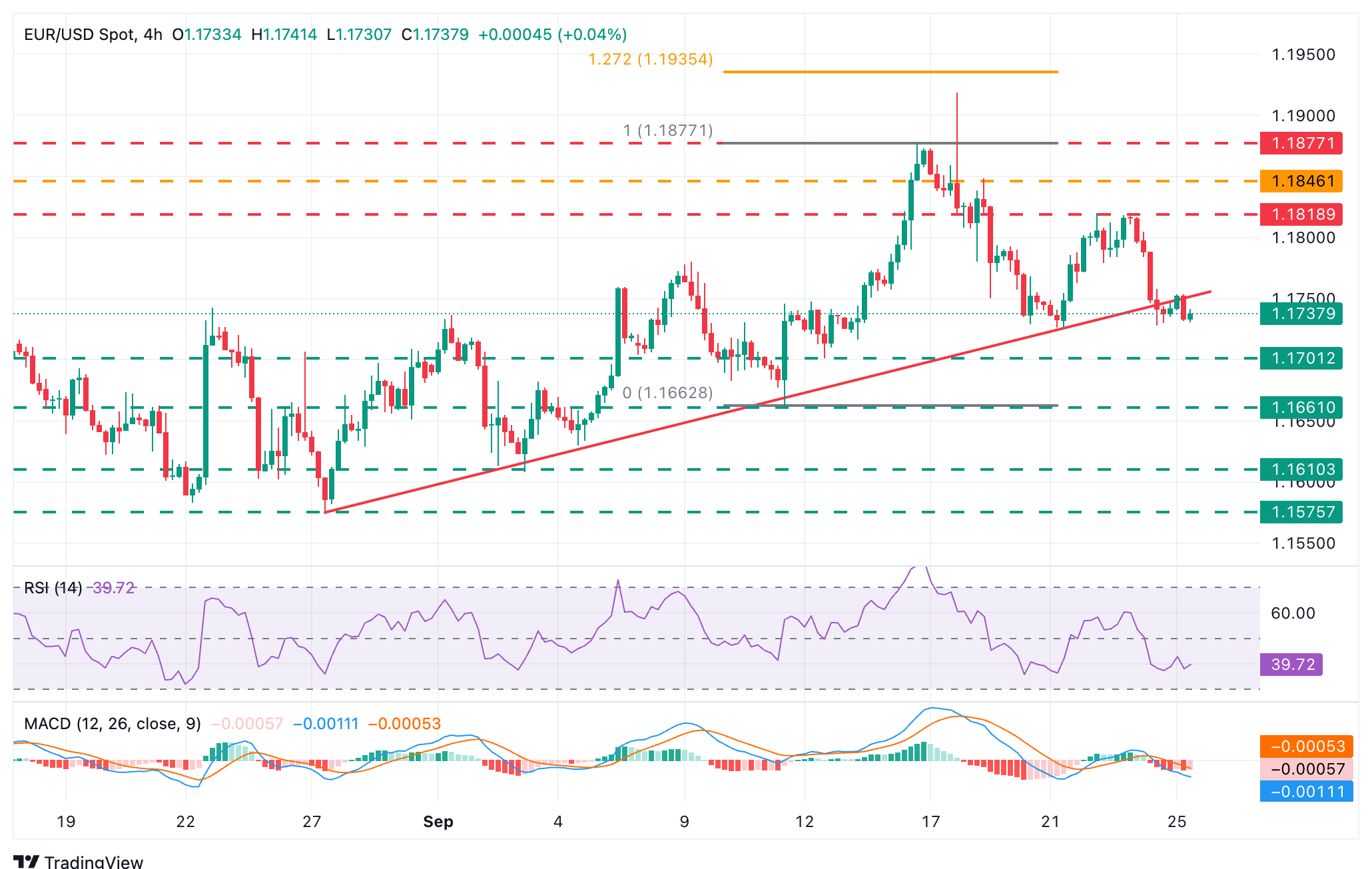
EUR/USD came under strong bearish pressure on Wednesday and reversed the previous two days' gains to breach the trendline support from September 2 lows, now around 1.1750. Momentum indicators on the 4-hour chart are well into negative territory, and Tuesday's lower high strengthens the case for a trend shift.
Immediate support is now at the 1.1730 area (September 22 lows). Further down, the September 12 low, near 1.1700, and the September 11 low, at 1.1660, will come into focus. To the upside, the reverse trendline is acting now as resistance at the 1.1750 area. Above here, the targets are the September 23 high and the September 18 high, near 1.1850.
(This story was corrected on September 25 at 10:30 GMT to say the German GFK Consumer Confidence Index improved to -22.3 from -23.5, instead of deteriorating, as it was previously reported.)
Economic Indicator
Gross Domestic Product Annualized
The real Gross Domestic Product (GDP) Annualized, released quarterly by the US Bureau of Economic Analysis, measures the value of the final goods and services produced in the United States in a given period of time. Changes in GDP are the most popular indicator of the nation’s overall economic health. The data is expressed at an annualized rate, which means that the rate has been adjusted to reflect the amount GDP would have changed over a year’s time, had it continued to grow at that specific rate. Generally speaking, a high reading is seen as bullish for the US Dollar (USD), while a low reading is seen as bearish.
Read more.Next release: Thu Sep 25, 2025 12:30
Frequency: Quarterly
Consensus: 3.3%
Previous: 3.3%
Source: US Bureau of Economic Analysis
The US Bureau of Economic Analysis (BEA) releases the Gross Domestic Product (GDP) growth on an annualized basis for each quarter. After publishing the first estimate, the BEA revises the data two more times, with the third release representing the final reading. Usually, the first estimate is the main market mover and a positive surprise is seen as a USD-positive development while a disappointing print is likely to weigh on the greenback. Market participants usually dismiss the second and third releases as they are generally not significant enough to meaningfully alter the growth picture.
Economic Indicator
Gross Domestic Product Price Index
The Gross Domestic Product (GDP) Price Index, released quarterly by the Bureau of Economic Analysis, measures the change in the prices of goods and services produced in the United States. The prices that Americans pay for imports aren’t included. Changes in the GDP price index are followed as an indicator of inflationary pressures, which may anticipate higher interest rates. A high reading is seen as bullish for the US Dollar (USD), while a low reading is seen as bearish.
Read more.Next release: Thu Sep 25, 2025 12:30
Frequency: Quarterly
Consensus: 2%
Previous: 2%
Source: US Bureau of Economic Analysis
Author

Guillermo Alcala
FXStreet
Graduated in Communication Sciences at the Universidad del Pais Vasco and Universiteit van Amsterdam, Guillermo has been working as financial news editor and copywriter in diverse Forex-related firms, like FXStreet and Kantox.