EUR/USD trades near weekly high as USD faces weekly loss on Fed bets, geopolitical hopes
- EUR/USD trades at 1.1648, easing 0.14% but holding close to the 1.1700 mark.
- Reports suggest Trump–Putin meeting next week could lead to ceasefire in Eastern Europe.
- Euro’s upside capped by stronger USD and speculation over Waller’s potential nomination as next Fed Chair.

The EUR/USD consolidates near the week's highs, shy of testing the 1.1700 figure on a week in whichthe US Dollar is poised to finish the week with over 1.84% losses against its peers. The hangover of last week’s US Nonfarm Payroll figures, and subsequent worse-than-expected employment data, underpins the Euro, due to increasing chances that the Federal Reserve (Fed) will resume its easing cycle.
The EUR/USD trades at 1.1648, down 0.14% daily, as market mood is upbeat due to the chance that the Ukraine-Russia war could end. News of a possible Trump-Putin meeting next week leads some to expect a deal that could halt hostilities in Ukraine.
The shared currency reacted positively to the newswires, though it failed to edge higher as the Greenback staged a comeback, gaining 0.14% on Friday in the US Dollar Index (DXY).
Besides the data, the nomination of the Council of Economic Advisers Chairman Stephen Miran and rumors that Fed Governor Christopher Waller could be nominated as the next Fed Chair to succeed Powell, capped the Euro’s advance to retest the YTD peak of 1.1829.
In the meantime, the St. Louis Fed President Alberto Musalem hit the wires, turned slightly more neutral, contrary to his hawkish stance, and said the Fed faces risks to both its inflation and jobs goals.
A muted economic docket in the European Union (EU) left traders adrift to ongoing developments in the US, alongside the usual geopolitical risks.
Next week, the EU’s docket will feature inflation figures in Italy and Germany, the release of the ZEW Economic Survey in Germany and the EU. Additionally, traders will eye the release of the EU’s Gross Domestic Product (GDP) print for Q2 2025.
Across the Atlantic, the US economic calendar will include remarks from Fed officials, the latest Initial Jobless Claims, Retail Sales figures, and the University of Michigan’s Consumer Sentiment survey.
Daily digest market movers: Euro rally stalls as the US Dollar advances
- Thursday’s US Jobless Claims rose by 226K, exceeding estimates, and the previous week's number showed that the labor market is softening. Nevertheless, what sounded the alarms was Continuing Claims for the week ending July 26, which rose by 1.97 million, its highest level since November 2021. This and the latest inflation figures in the US indicate that a stagflationary scenario looms, which could be further confirmed by next week’s Consumer Price Index (CPI) data.
- Recent weakness in the labor market, alongside higher prices, raised concerns among economists, as read in a Bloomberg headline, “Stagflation Concerns Ripple Through Wall Street as Tariffs Hit.”
- The US Dollar Index , which tracks the performance of the buck’s value against a basket of its peers, is up 0.10% at 98.14.
- Fed’s Musalem added that between tariffs and job growth taking a hit, “there are risks on both sides of our mandate, and when that happens, when you have risks on both sides, you have to take a balanced approach, which means you have to think about the likelihood of missing on each side of the mandate, the size of the potential miss, and how long that miss will be in place.”
- The latest economic data released in the US spurred investor speculation that the Fed might resume its easing cycle at the upcoming September FOMC meeting. Odds for a 25 bps cut are at 88%, according to Prime Market Terminal (PMT).
- On the European Central Bank (ECB) front, the easing cycle seems to be on pause for the September meeting, with 88% odds for the ECB to keep rates unchanged and a slim 12% chance of a 25 bps rate cut.
Technical outlook: Bulls' lack of strength keeps EUR/USD below 1.1700
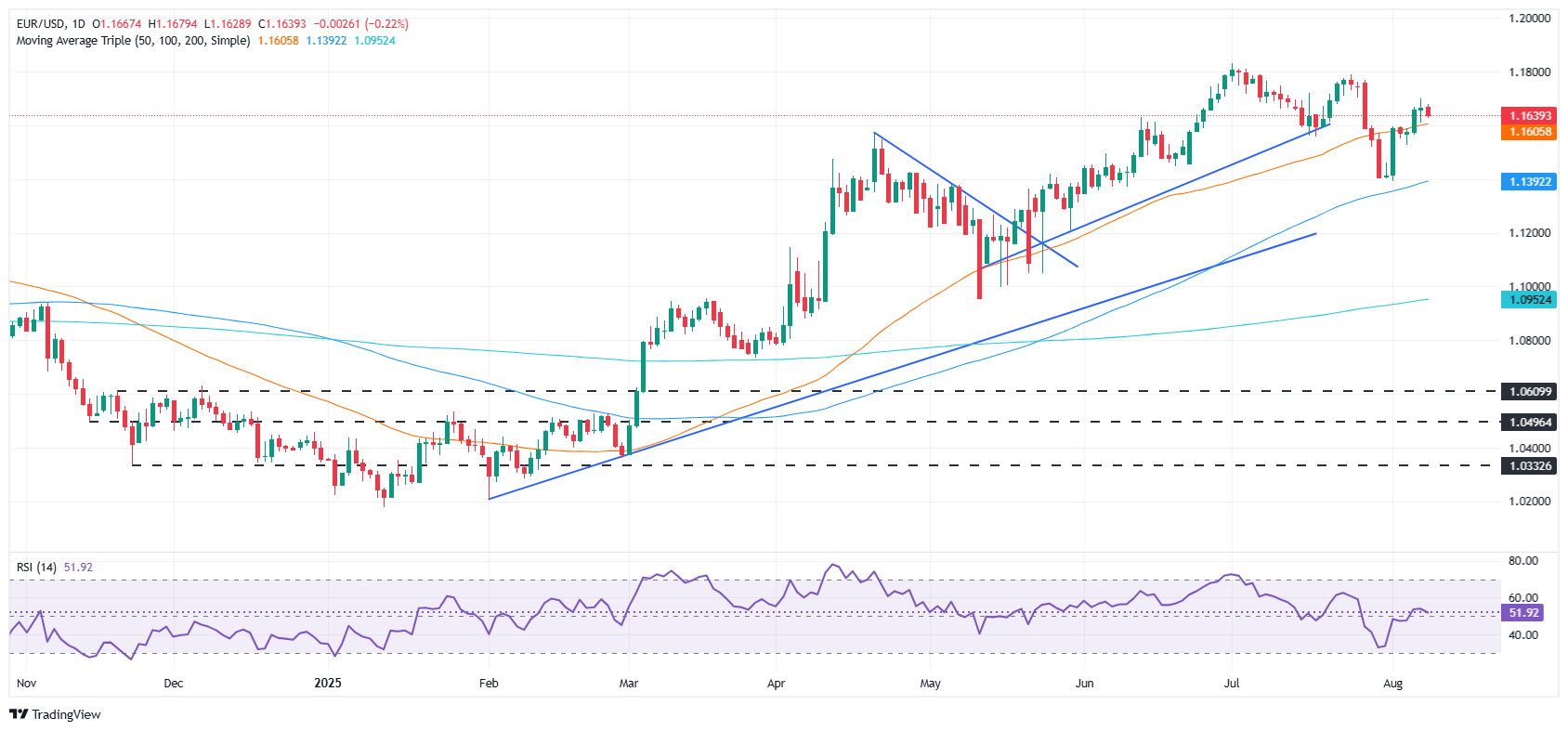
The EUR/USD’s rally lost steam at just under the 1.1700 level after breaking above the 20-day Simple Moving Average (SMA) at 1.1624. Although the Relative Strength Index (RSI) remains in bullish territory, it has turned slightly downward, an indication that buyers are losing steam. However, remaining above its neutral line suggests consolidation lies ahead.
A sustained move above 1.1700 would open the door for a climb toward 1.1800, followed by a test of the yearly high at 1.1829. Otherwise, a break back below the 20-day SMA would expose the 50-day SMA at 1.1604 and the 1.1600 handle, with further weakness targeting the 1.1500 level.
Euro FAQs
The Euro is the currency for the 19 European Union countries that belong to the Eurozone. It is the second most heavily traded currency in the world behind the US Dollar. In 2022, it accounted for 31% of all foreign exchange transactions, with an average daily turnover of over $2.2 trillion a day. EUR/USD is the most heavily traded currency pair in the world, accounting for an estimated 30% off all transactions, followed by EUR/JPY (4%), EUR/GBP (3%) and EUR/AUD (2%).
The European Central Bank (ECB) in Frankfurt, Germany, is the reserve bank for the Eurozone. The ECB sets interest rates and manages monetary policy. The ECB’s primary mandate is to maintain price stability, which means either controlling inflation or stimulating growth. Its primary tool is the raising or lowering of interest rates. Relatively high interest rates – or the expectation of higher rates – will usually benefit the Euro and vice versa. The ECB Governing Council makes monetary policy decisions at meetings held eight times a year. Decisions are made by heads of the Eurozone national banks and six permanent members, including the President of the ECB, Christine Lagarde.
Eurozone inflation data, measured by the Harmonized Index of Consumer Prices (HICP), is an important econometric for the Euro. If inflation rises more than expected, especially if above the ECB’s 2% target, it obliges the ECB to raise interest rates to bring it back under control. Relatively high interest rates compared to its counterparts will usually benefit the Euro, as it makes the region more attractive as a place for global investors to park their money.
Data releases gauge the health of the economy and can impact on the Euro. Indicators such as GDP, Manufacturing and Services PMIs, employment, and consumer sentiment surveys can all influence the direction of the single currency. A strong economy is good for the Euro. Not only does it attract more foreign investment but it may encourage the ECB to put up interest rates, which will directly strengthen the Euro. Otherwise, if economic data is weak, the Euro is likely to fall. Economic data for the four largest economies in the euro area (Germany, France, Italy and Spain) are especially significant, as they account for 75% of the Eurozone’s economy.
Another significant data release for the Euro is the Trade Balance. This indicator measures the difference between what a country earns from its exports and what it spends on imports over a given period. If a country produces highly sought after exports then its currency will gain in value purely from the extra demand created from foreign buyers seeking to purchase these goods. Therefore, a positive net Trade Balance strengthens a currency and vice versa for a negative balance.
Author

Christian Borjon Valencia
FXStreet
Markets analyst, news editor, and trading instructor with over 14 years of experience across FX, commodities, US equity indices, and global macro markets.

















