EUR/USD surges above 1.16 on Fed dovish bets, trade-war woes
- DXY falls to six-day low as markets discount further Fed easing on stagflation concerns.
- Trade war escalates with new port fees between the US and China despite Trump’s softer tone.
- Mixed Eurozone inflation data reinforce expectations that the ECB will maintain its dovish stance.

EUR/USD traded with gains on Wednesday, up by 0.35% and above the 1.1600 figure for the second straight day as the Greenback is pressured by firm expectations of rate cuts by the Federal Reserve and the escalation of the trade-war between the US and China.
Euro rises for a second day as dovish Fed outlook and US-China conflict pressure the Greenback
The Euro trades at 1.1647 after hitting a daily low of 1.1601 as the Dollar reaches a six-day low, according to the US Dollar Index (DXY). The DXY, which tracks the performance of the US currency against a basket of six others, is down 0.37% at 98.66.
Discussions between Washington and Beijing had extended, since the Chinese began its export controls on rare earths and port fees to US vessels. US President Trump escalated the conflict after threatening to impose 100% additional tariffs on Chinese products, but refrained from that decision, saying that the US does not what to “hurt” China.
Nevertheless, both countries imposed port fees interchangeably, as tensions continue to rise between the nations.
Data-wise the US docket is scarce, but the Beige Book was released by the Fed, hinting a stagflationary scenario.
Across the pond, inflation figures in France came as expected, below the European’s Central Bank (ECB) 2% goal. In Spain, priced rose by 3% in September, well above the ECB’s target. Some ECB officials crossed the wires, like the Bundesbank President Joachim Nagel and Banque de France Governor Francois Villeroy de Galhau.
Daily market movers: EUR/USD rallies towards 1.1650 on Dollar weakness
- The Fed’s Beige Book announced ahead of the October 28-29 meeting, revealed that employment levels remained largely stable in recent weeks, while labor demand was generally subdued across most Districts and sectors.
- Overall economic activity showed little change since the previous report, with three Districts noting slight to modest growth, five reporting no change, and four indicating mild softening. Consumer spending edged lower, particularly in retail goods.
- US Treasury Secretary Scott Bessent said Washington could consider a longer pause on high tariffs for Chinese products in exchange for easing Beijing’s recently tightened restrictions on critical rare earth exports. “Is it possible that we could go to a longer roll in return? Perhaps. But all that’s going to be negotiated in the coming weeks,” Bessent told reporters during a press conference in Washington.
- On Tuesday, Fed Chair Jerome Powell was dovish, acknowledged the weakness of the labor market, adding that the central bank should move to more “neutral” interest rates.
- ECB's Joachim Nagel said the German economy is improving. Echoing some of his comments was Francois Villeroy, who said the global economy is surprisingly resilient, while also commenting that France can’t afford to fixate on short-term fiscal challenges and must find credible solutions for reducing its deficit.
- Industrial Production in the Eurozone (EZ) decelerated from 1.8% to 1.1% YoY in August, better than the expected -0.2% contraction.
- Money markets are fully pricing in a 25-basis-point rate cut at the Fed’s October 29 meeting, with odds at 97%, according to the Prime Market Terminal probability tool.
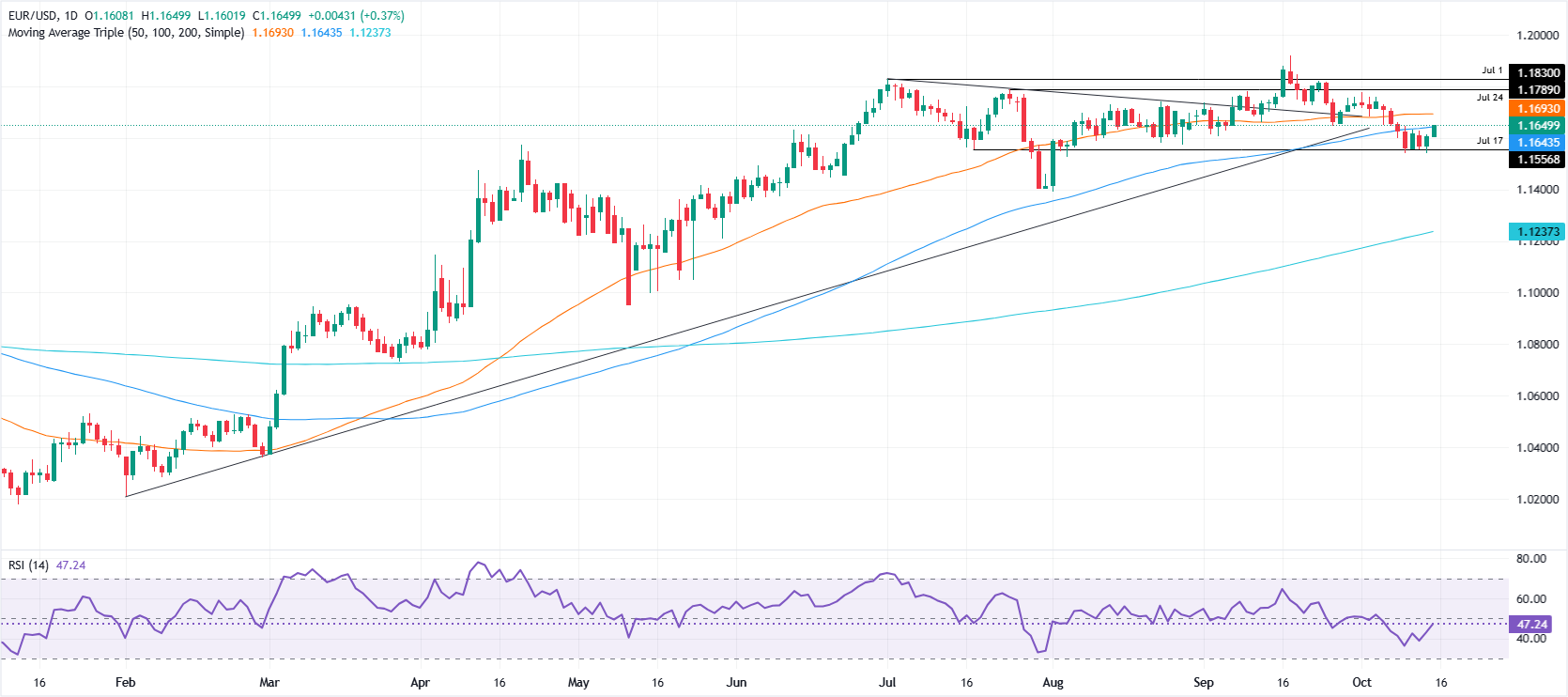
Technical outlook: EUR/USD dwindles at around 100-day SMA
EUR/USD’s technical outlook had improved but the pair remains neutral-to-bearish as it continues to trade above/below the 100-day Simple Moving Average (SMA) at 1.1644. The Relative Strength Index (RSI) slipped below the neutral 50 level last Friday, signaling that downside momentum is strengthening.
Immediate support is seen at 1.1600, followed by 1.1550 and 1.1500. A break below these levels would expose the August 1 cycle low near 1.1391. On the upside, resistance stands at 1.1650 and 1.1700, with a clear break above the latter opening the path toward 1.1800 and the July 1 high at 1.1830.
Euro FAQs
The Euro is the currency for the 19 European Union countries that belong to the Eurozone. It is the second most heavily traded currency in the world behind the US Dollar. In 2022, it accounted for 31% of all foreign exchange transactions, with an average daily turnover of over $2.2 trillion a day. EUR/USD is the most heavily traded currency pair in the world, accounting for an estimated 30% off all transactions, followed by EUR/JPY (4%), EUR/GBP (3%) and EUR/AUD (2%).
The European Central Bank (ECB) in Frankfurt, Germany, is the reserve bank for the Eurozone. The ECB sets interest rates and manages monetary policy. The ECB’s primary mandate is to maintain price stability, which means either controlling inflation or stimulating growth. Its primary tool is the raising or lowering of interest rates. Relatively high interest rates – or the expectation of higher rates – will usually benefit the Euro and vice versa. The ECB Governing Council makes monetary policy decisions at meetings held eight times a year. Decisions are made by heads of the Eurozone national banks and six permanent members, including the President of the ECB, Christine Lagarde.
Eurozone inflation data, measured by the Harmonized Index of Consumer Prices (HICP), is an important econometric for the Euro. If inflation rises more than expected, especially if above the ECB’s 2% target, it obliges the ECB to raise interest rates to bring it back under control. Relatively high interest rates compared to its counterparts will usually benefit the Euro, as it makes the region more attractive as a place for global investors to park their money.
Data releases gauge the health of the economy and can impact on the Euro. Indicators such as GDP, Manufacturing and Services PMIs, employment, and consumer sentiment surveys can all influence the direction of the single currency. A strong economy is good for the Euro. Not only does it attract more foreign investment but it may encourage the ECB to put up interest rates, which will directly strengthen the Euro. Otherwise, if economic data is weak, the Euro is likely to fall. Economic data for the four largest economies in the euro area (Germany, France, Italy and Spain) are especially significant, as they account for 75% of the Eurozone’s economy.
Another significant data release for the Euro is the Trade Balance. This indicator measures the difference between what a country earns from its exports and what it spends on imports over a given period. If a country produces highly sought after exports then its currency will gain in value purely from the extra demand created from foreign buyers seeking to purchase these goods. Therefore, a positive net Trade Balance strengthens a currency and vice versa for a negative balance.
Author

Christian Borjon Valencia
FXStreet
Markets analyst, news editor, and trading instructor with over 14 years of experience across FX, commodities, US equity indices, and global macro markets.














