EUR/USD clings to gains amid uncertainty over ECB rate cuts in July
- EUR/USD remains firm near 1.0900 due to multiple tailwinds.
- ECB’s Schnabel remains uncertain over the central bank extending rate cuts beyond June.
- Fed policymakers emphasize keeping interest rates higher for longer.

EUR/USD is slightly down but clings to gains near 1.0900 in Monday’s New York session. The major currency pair remains in bullish territory due to investors’ higher risk appetite. The Euro has performed strongly in the past few trading sessions as market participants turn slightly cautious about whether the European Central Bank (ECB) will extend the policy-tightening spell beyond the June meeting.
The ECB is widely anticipated to start reducing interest rates from the June meeting. However, ECB policymakers remain divided over the rate-cut move in the July meeting. A few policymakers remain worried that an aggressive rate-cut cycle could revamp price pressures and offset the impact yet made on inflation.
Last week, ECB board member Isabel Schnabel said that depending on incoming data, a rate cut in June may be appropriate but the path beyond June is much more uncertain. Schnabel added that she cannot pre-commit to any particular rate path due to very high uncertainty.
On the economic data front, investors will shift focus to the Eurozone and the United States preliminary Purchasing Managers Index (PMI) data for May, which will be published on Thursday. The PMI data will indicate their economic outlook.
Daily digest market movers: EUR/USD stays firm ahead of Eurozone/US preliminary PMI
- EUR/USD trades in a tight range below the round-level resistance of 1.0900. The shared currency pair is expected to remain quiet as investors shift focus to the Federal Open Market Committee (FOMC) minutes for the May meeting, which will be published on Wednesday. The FOMC minutes will provide a detailed explanation behind interest rates remaining steady and policymakers’ views about the interest rate outlook.
- The communication from Fed policymakers on the interest rate outlook is expected to have remained hawkish as inflationary pressures in the first three months of this year accelerated. However, the Consumer Price Index (CPI) data for April declined as expected due to lower prices of utility gas piped services, and used car and trucks. Fed policymakers are expected to have avoided supporting for further policy-tightening.
- Though the decline in price pressures has provided some relief that the progress in the disinflation process has not stalled, Fed policymakers remain leaned towards a restrictive policy stance for a longer period to build confidence that inflation will sustainably return to the desired rate of 2%.
- Last week, New York Fed Bank President John Williams said the monetary policy is restrictive and is in a good place. He doesn’t see any economic indicator suggesting the need to change the stance of monetary policy now. When asked about the inflation outlook, Williams said: “In the very near term, I don't expect to get that greater confidence that we need to see on inflation progress towards a 2% goal," Reuters reported.
Technical Analysis: EUR/USD holds the triangle breakout
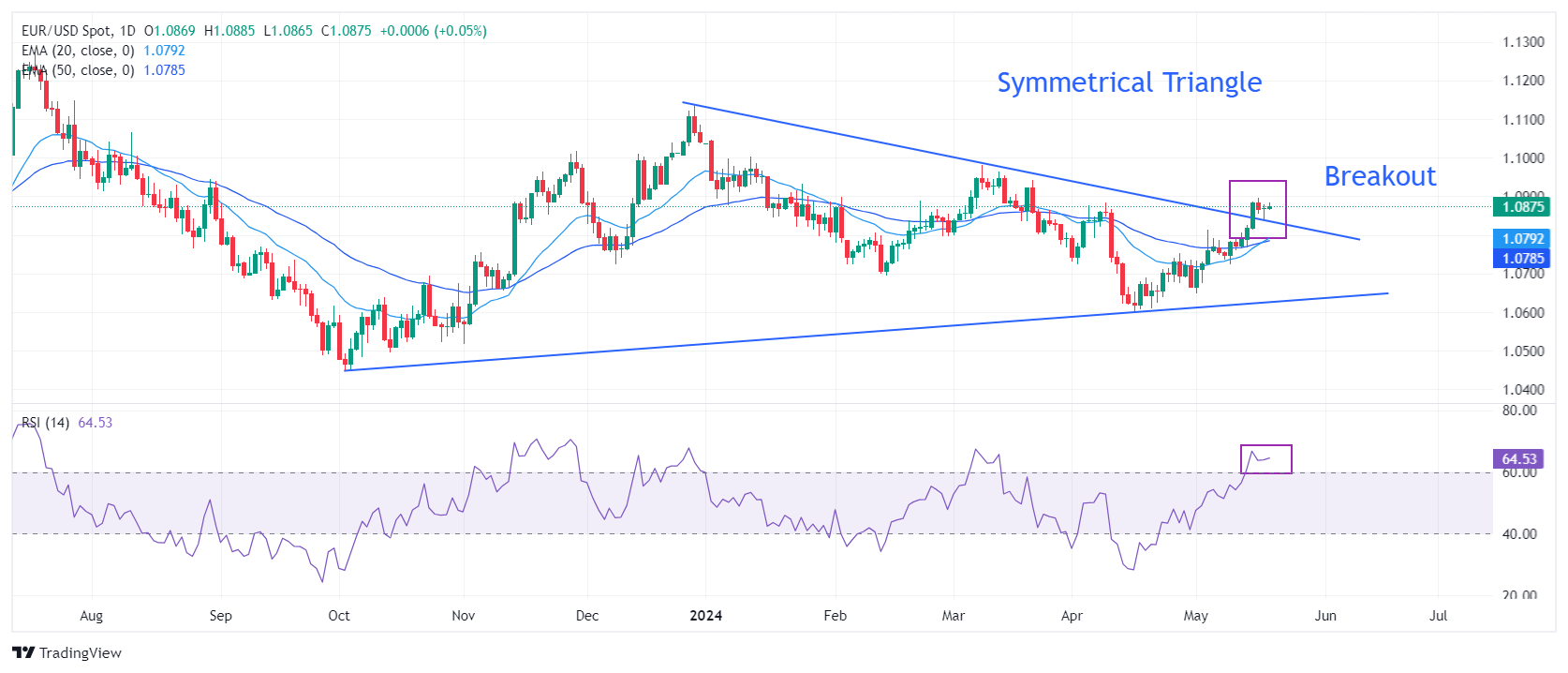
EUR/USD holds the breakout of the Symmetrical Triangle chart pattern seen on a daily timeframe. The stabilization of the major currency pair above the breakout region suggests that the asset is quite bullish. Also, a bullish crossover of the 20-day and 50-day Exponential Moving Averages (EMAs) around 1.0780 has improved the near-term outlook of the pair.
The 14-period Relative Strength Index (RSI) has shifted comfortably into the bullish range of 60.00-80.00, suggesting that the momentum has leaned toward the upside.
Fed FAQs
Monetary policy in the US is shaped by the Federal Reserve (Fed). The Fed has two mandates: to achieve price stability and foster full employment. Its primary tool to achieve these goals is by adjusting interest rates. When prices are rising too quickly and inflation is above the Fed’s 2% target, it raises interest rates, increasing borrowing costs throughout the economy. This results in a stronger US Dollar (USD) as it makes the US a more attractive place for international investors to park their money. When inflation falls below 2% or the Unemployment Rate is too high, the Fed may lower interest rates to encourage borrowing, which weighs on the Greenback.
The Federal Reserve (Fed) holds eight policy meetings a year, where the Federal Open Market Committee (FOMC) assesses economic conditions and makes monetary policy decisions. The FOMC is attended by twelve Fed officials – the seven members of the Board of Governors, the president of the Federal Reserve Bank of New York, and four of the remaining eleven regional Reserve Bank presidents, who serve one-year terms on a rotating basis.
In extreme situations, the Federal Reserve may resort to a policy named Quantitative Easing (QE). QE is the process by which the Fed substantially increases the flow of credit in a stuck financial system. It is a non-standard policy measure used during crises or when inflation is extremely low. It was the Fed’s weapon of choice during the Great Financial Crisis in 2008. It involves the Fed printing more Dollars and using them to buy high grade bonds from financial institutions. QE usually weakens the US Dollar.
Quantitative tightening (QT) is the reverse process of QE, whereby the Federal Reserve stops buying bonds from financial institutions and does not reinvest the principal from the bonds it holds maturing, to purchase new bonds. It is usually positive for the value of the US Dollar.
Author

Sagar Dua
FXStreet
Sagar Dua is associated with the financial markets from his college days. Along with pursuing post-graduation in Commerce in 2014, he started his markets training with chart analysis.

















