EUR/USD wavers within range ahead of US Consumer Sentiment data
- The Euro trims previous gains as the US Dollar bounces up on a choppy trading session.
- ECB's Rehn has warned about the downside risk for inflation stemming from low energy prices and a strong EUR.
- Initial claims for unemployment benefits in the US increased at their fastest pace in four years.

The EUR/USD pair gives away gains on the early European session and retreats to levels near 1.1700, amid choppy and volatile trading on Friday. Comments from ECB official Olly Rehn, warning about the downside risks to inflation, have failed to support the Euro (EUR), which remains weighed down under a firmer US Dollar.
On Thursday, the ECB left its Deposit Facility rate unchanged at 2% and President Christine Lagarde said that "risk to economic growth has become more balanced". These comments curbed market expectations of further interest rate cuts in the near term and provided a significant boost to the Euro.
In the US, data from the US Department of Labour revealed that Initial Jobless Claims increased at their fastest pace in the last four years last week, while August's Consumer Prices Index (CPI) advanced broadly in line with the market expectations, clearing the way for a quarter-point Fed rate cut next week and at least another one before the end of the year.
In Friday's calendar, the focus is on the University of Michigan's US Consumer Sentiment Survey, which is expected to show a further deterioration, adding pressure to the US central bank to ease its monetary policy. The risk for the US Dollar is skewed to the downside.
Euro Price Today
The table below shows the percentage change of Euro (EUR) against listed major currencies today. Euro was the strongest against the New Zealand Dollar.
| USD | EUR | GBP | JPY | CAD | AUD | NZD | CHF | |
|---|---|---|---|---|---|---|---|---|
| USD | 0.09% | 0.18% | 0.35% | 0.07% | 0.24% | 0.43% | 0.14% | |
| EUR | -0.09% | 0.08% | 0.28% | -0.01% | 0.16% | 0.35% | 0.06% | |
| GBP | -0.18% | -0.08% | 0.18% | -0.10% | 0.04% | 0.27% | -0.02% | |
| JPY | -0.35% | -0.28% | -0.18% | -0.30% | -0.14% | 0.01% | -0.27% | |
| CAD | -0.07% | 0.00% | 0.10% | 0.30% | 0.21% | 0.38% | 0.08% | |
| AUD | -0.24% | -0.16% | -0.04% | 0.14% | -0.21% | 0.23% | -0.10% | |
| NZD | -0.43% | -0.35% | -0.27% | -0.01% | -0.38% | -0.23% | -0.29% | |
| CHF | -0.14% | -0.06% | 0.02% | 0.27% | -0.08% | 0.10% | 0.29% |
The heat map shows percentage changes of major currencies against each other. The base currency is picked from the left column, while the quote currency is picked from the top row. For example, if you pick the Euro from the left column and move along the horizontal line to the US Dollar, the percentage change displayed in the box will represent EUR (base)/USD (quote).
Daily digest market movers: The Dollar loses footing following weak employment data
- US Initial Jobless Claims increased to 263K in the first week of September, from 236K in the previous week, against expectations of a slight decline to 235K. Even though the state of Texas accounted for most of this increase – suggesting that there were some temporary distortions in the data – these figures provide further evidence of the deterioration of the US labour market and set the conditions for the Fed to cut rates by at least 25 basis points next week.
- At the same time, US Consumer Price Index figures confirmed the moderate uptick in inflation forecasted by market analysts. Yearly inflation picked up to 2.9% from the 2.7% level seen in July, while the core CPI increased at a steady 3.1%, also in line with expectations. The monthly CPI accelerated 0.4% from July's 0.2% pace, beating market expectations of a 0.3% increase. These numbers did not alter Fed easing bets, but trimmed expectations of a larger-than-usual 50 bps cut next week.
- In Europe, the European Central Bank left the Rate on the Deposit Facility steady for the second consecutive meeting, and President Lagarde's comments at the ensuing press conference revealed that the bank is not planning to ease its monetary policy further in the near term. Lagarde sounded confident about the economy and warned about the uncertain inflation outlook. All in all, a balanced stance that poses a Euro-supportive monetary policy divergence with the Fed.
- German data released on Friday confirmed that consumer inflation stood at 0.1% in August with July and at 2.2% compared with August last year. The impact on the Euro has been minimal.
- At 14:00 GMT, the preliminary US University of Michigan Consumer Sentiment Index for September is expected to further decline to 58.0 from August's 58.2 reading. These figures are about 15% below the average levels of the second half of 2024, revealing a significant deterioration in consumers' confidence and adding bearish pressure on the US Dollar.
Technical Analysis: EUR/USD maintains its bullish bias intact
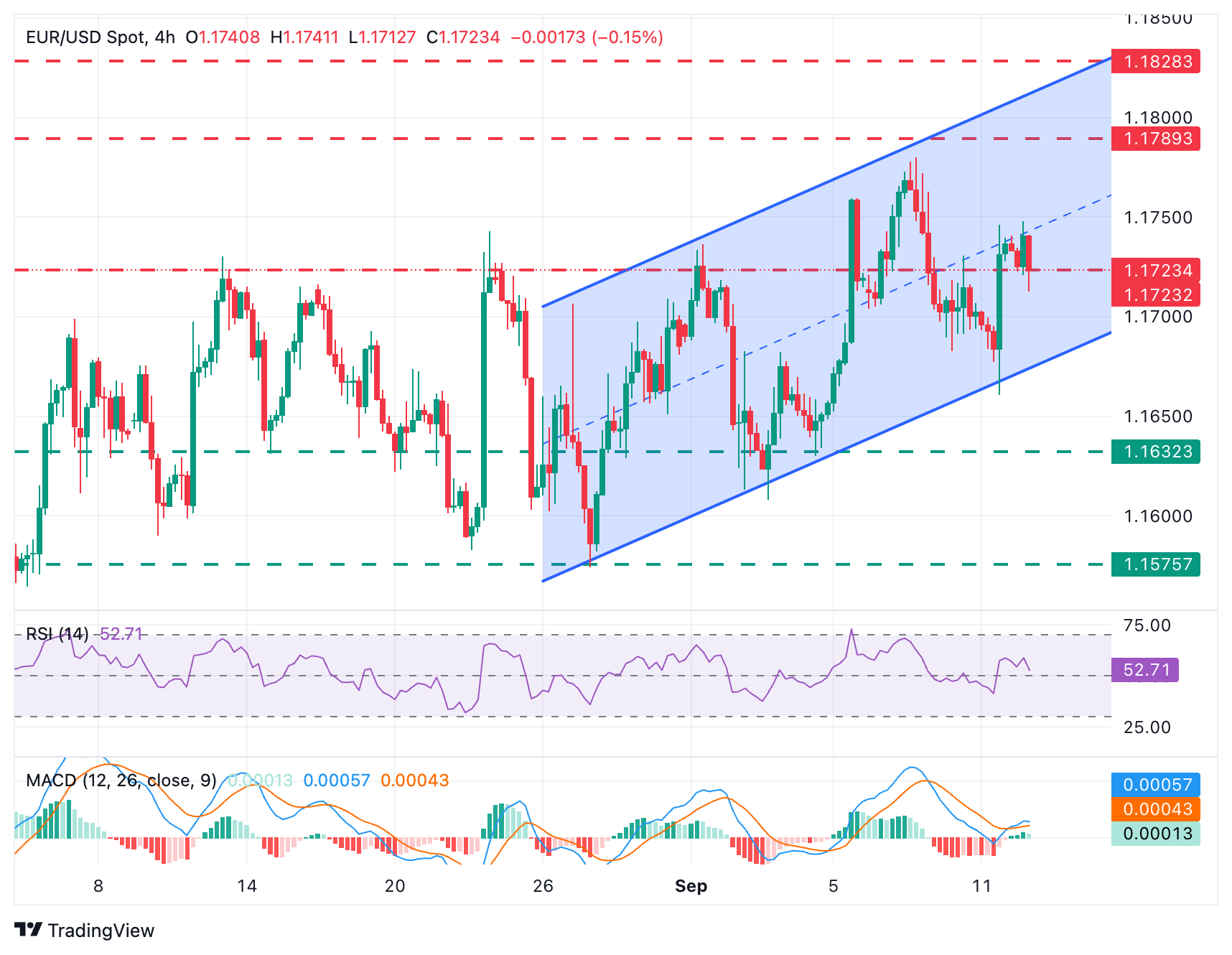
EUR/USD bounced up from the bottom of the last three weeks' ascending channel on Thursday, keeping the broader bullish bias intact. Technical indicators show a mild upside momentum on Friday, despite the recent reversal. The RSI has bounced back beyond the 50 level, and the MACD has crossed above the signal line, suggesting that further appreciation looks likely.
Immediate resistance is at the intra-day high of 1.1750. Further up, the 1.1780-1.1790 (September 8, July 24 highs) is likely to hold bulls ahead of the channel top, now at 1.1810.
To the downside, the intra-day low is now in the area of 1.1715. Below here, the channel bottom is at 1.1670, right above Thursday's low at 1.1660. A breach of that level would cancel the bullish view and increase pressure towards the September 2 and 3 lows in the area of 1.1610.
ECB FAQs
The European Central Bank (ECB) in Frankfurt, Germany, is the reserve bank for the Eurozone. The ECB sets interest rates and manages monetary policy for the region. The ECB primary mandate is to maintain price stability, which means keeping inflation at around 2%. Its primary tool for achieving this is by raising or lowering interest rates. Relatively high interest rates will usually result in a stronger Euro and vice versa. The ECB Governing Council makes monetary policy decisions at meetings held eight times a year. Decisions are made by heads of the Eurozone national banks and six permanent members, including the President of the ECB, Christine Lagarde.
In extreme situations, the European Central Bank can enact a policy tool called Quantitative Easing. QE is the process by which the ECB prints Euros and uses them to buy assets – usually government or corporate bonds – from banks and other financial institutions. QE usually results in a weaker Euro. QE is a last resort when simply lowering interest rates is unlikely to achieve the objective of price stability. The ECB used it during the Great Financial Crisis in 2009-11, in 2015 when inflation remained stubbornly low, as well as during the covid pandemic.
Quantitative tightening (QT) is the reverse of QE. It is undertaken after QE when an economic recovery is underway and inflation starts rising. Whilst in QE the European Central Bank (ECB) purchases government and corporate bonds from financial institutions to provide them with liquidity, in QT the ECB stops buying more bonds, and stops reinvesting the principal maturing on the bonds it already holds. It is usually positive (or bullish) for the Euro.
Author

Guillermo Alcala
FXStreet
Graduated in Communication Sciences at the Universidad del Pais Vasco and Universiteit van Amsterdam, Guillermo has been working as financial news editor and copywriter in diverse Forex-related firms, like FXStreet and Kantox.