EUR/USD rockets higher as Dollar fades on fiscal policy hopes
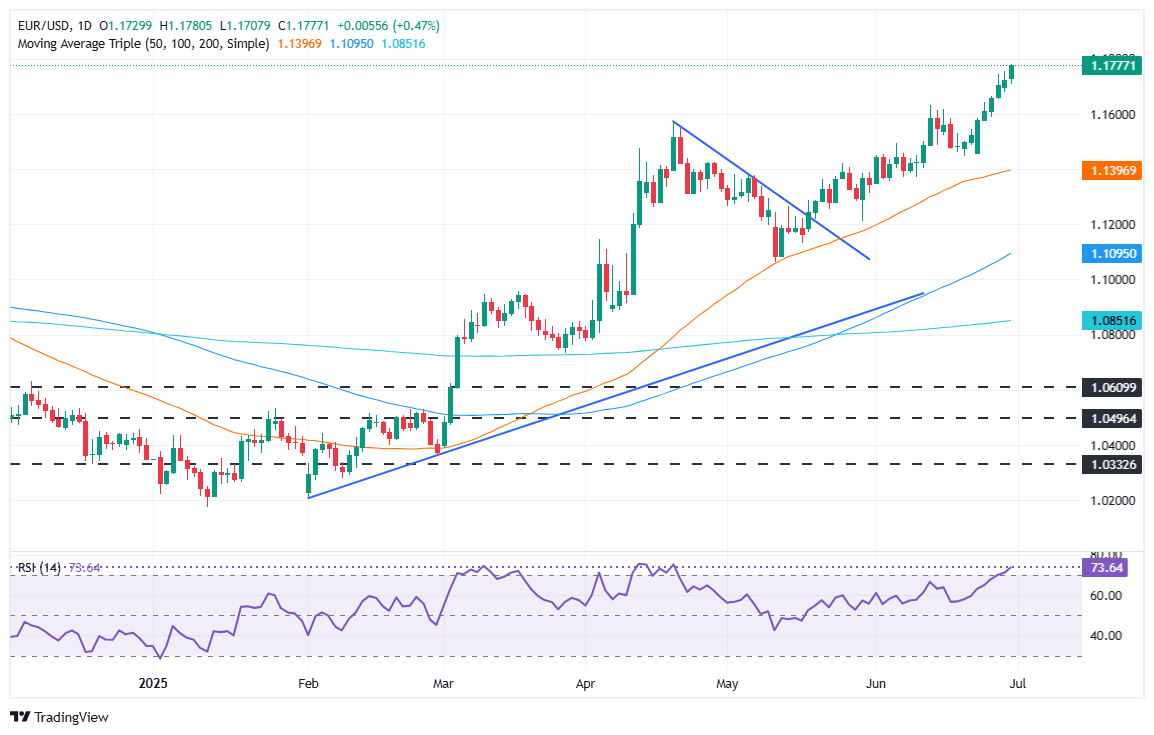
- EUR/USD trades at 1.1776 after hitting a multi-year high of 1.1780 amid USD weakness.
- US fiscal deficit concerns and Fed cut bets drive the US Dollar to multi-year lows.
- German Retail Sales slump intensifies ECB’s growth worries ahead of key central bank speeches.

EUR/USD climbs to fresh yearly highs of 1.1780 on Monday as the Greenback continues to remain battered by the prospects of the approval of the fiscal budget in the United States (US) and the expectation that the Trump administration continues to make progress on trade deals with major trading partners. At the time of writing, the pair trades at 1.1776, up 0.51%.
Sentiment remains positive as depicted by US equity indices posting a solid second quarter in 2025, trading at all-time highs. Hence, the US Dollar (USD) is near multi-year lows amid expectations that the fiscal deficit will increase substantially, and market participants pricing in more than 50 basis points (bps) of easing by the Federal Reserve (Fed), boosted the shared currency to near four-year highs.
News that the European Union (EU) would accept Trump’s universal tariffs pushed EUR/USD higher. Nevertheless, the EU wants the US to lower duties on key sectors, including pharmaceuticals, alcohol, semiconductors and commercial aircraft.
Data in Europe revealed that German Retail Sales plunged. European Central Bank (ECB) policymakers appear concerned about economic growth and will remain data-dependent in setting their rate policy.
On Tuesday, the Federal Reserve Chair Jerome Powell will share a panel with ECB’s President Christine Lagarde, Bank of England’s (BoE) Governor Andrew Bailey, and Bank of Japan (BoJ) Chief Kazuo Ueda.
Daily digest market movers: EUR/USD rally continues as the Greenback weakens
- EUR/USD seems poised to challenge 1.1800. The US Dollar Index (DXY), which tracks the performance of the buck’s value against a basket of rivals, edges down 0.41% at 96.85, near almost four-year lows.
- The US fiscal deficit is set to increase by $3.3 trillion if the US Congress approves Trump’s “One Big Beautiful Bil.” This could weaken the US Dollar and drive the Euro higher.
- The US economic docket is busy during this shortened week. The ISM Manufacturing PMI for June is forecast to improve from 48.5 to 48.8, while the ADP Employment Change is projected to improve from 37K private jobs added to the workforce to 85K.
- The crucial US Nonfarm Payrolls report in June is projected to show that the jobs market is softening, with estimates suggesting that the economy added just 110,000 people to the workforce, below last month’s 139,000. The Unemployment Rate is projected to rise from 4.2% to 4.3%.
- German Retail Sales in May plummeted by -1.6% MoM, below estimates of 0.5% expansion. Every year, it dipped from 2.3% to 1.6% YoY, and missed the forecast of a 3.3% increase.
- ECB’s de Guindos said the central bank faces “brutal uncertainty,” suggesting that Q2 and Q3 growth could be flat and must keep all options open. ECB’s Chief Economist, Philip Lane, said they may face larger deviations from the 2% inflation target on both sides. Simkus added that he is unsure if they have all the necessary data for the September meeting.
Euro technical outlook: EUR/USD set to test 1.1800 in the near-term
The EUR/USD trend remains up, with buyers gathering more momentum, as indicated by the Relative Strength Index (RSI). Although it is in overbought territory, as indicated by regular readings of the RSI, when the trend is strong, a reading between 70-80 suggests an acceleration of the move before reaching extreme readings. Therefore, further upside is seen.
The EUR/USD first supply zone would be 1.1800, followed by 1.1850 and 1.1900. On the flip side, if EUR/USD retreats below 1.1750, look for a dip to 1.1700. Further downside is seen if cleared, with the next demand zone at 1.1653, the June 26 daily low, ahead of 1.1600.
ECB FAQs
The European Central Bank (ECB) in Frankfurt, Germany, is the reserve bank for the Eurozone. The ECB sets interest rates and manages monetary policy for the region. The ECB primary mandate is to maintain price stability, which means keeping inflation at around 2%. Its primary tool for achieving this is by raising or lowering interest rates. Relatively high interest rates will usually result in a stronger Euro and vice versa. The ECB Governing Council makes monetary policy decisions at meetings held eight times a year. Decisions are made by heads of the Eurozone national banks and six permanent members, including the President of the ECB, Christine Lagarde.
In extreme situations, the European Central Bank can enact a policy tool called Quantitative Easing. QE is the process by which the ECB prints Euros and uses them to buy assets – usually government or corporate bonds – from banks and other financial institutions. QE usually results in a weaker Euro. QE is a last resort when simply lowering interest rates is unlikely to achieve the objective of price stability. The ECB used it during the Great Financial Crisis in 2009-11, in 2015 when inflation remained stubbornly low, as well as during the covid pandemic.
Quantitative tightening (QT) is the reverse of QE. It is undertaken after QE when an economic recovery is underway and inflation starts rising. Whilst in QE the European Central Bank (ECB) purchases government and corporate bonds from financial institutions to provide them with liquidity, in QT the ECB stops buying more bonds, and stops reinvesting the principal maturing on the bonds it already holds. It is usually positive (or bullish) for the Euro.
Author

Christian Borjon Valencia
FXStreet
Markets analyst, news editor, and trading instructor with over 14 years of experience across FX, commodities, US equity indices, and global macro markets.

















