EUR/USD soars as doubts over Fed independence hit Dollar sentiment
- EUR/USD jumps over 0.50% as traders price in rate cuts and political influence at the Fed.
- Trump to nominate Fed Governor Kugler’s replacement by week’s end.
- Fed’s Collins, Cook highlight economic uncertainty and weak jobs data, supporting a cautious stance.
- Minneapolis Fed’s Kashkari maintains forecast for two rate cuts in 2025.

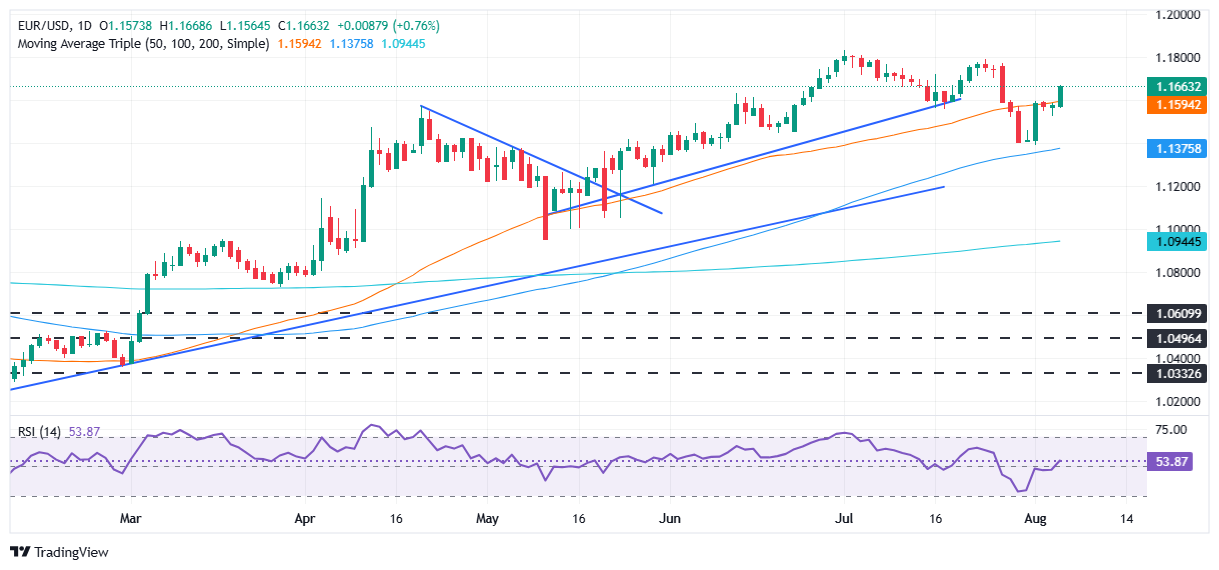
The EUR/USD rallied more than 0.50% on Wednesday, boosted by broad US Dollar weakness across the board as traders began to price in rate cuts by the Federal Reserve. In addition, fears of the Fed’s independence from the White House increased, as US President Trump said that he would nominate a replacement for the vacated seat by Fed Governor Adriana Kugler, who steps down on August 8. The pair trades at 1.1657 after bouncing off lows of 1.1564.
The economic docket in the US was empty on Wednesday, though a slew of Fed officials crossed the wires. Boston Fed President Susan Collins revealed that there’s a lot of uncertainty in the economy, suggesting a wait-and-see approach. Her colleague, Fed Governor Lisa Cook, said that the July jobs data was concerning and that big revisions usually can happen at economic turning points.
Collins and Cook's remarks maintain the “status quo” of keeping interest rates unchanged until data indicates an ongoing economic slowdown. Meanwhile, Minneapolis Fed President Neel Kashkari said on Tuesday that he still foresees two rate cuts towards the end of the year.
In the meantime, the US President Donald Trump expressed that he would nominate Kugler’s replacement towards the end of the week.
Across the pond, the Eurozone (EZ) economic docket revealed that Germany’s Factory Orders softened in June, while Retail Sales for the bloc improved in the twelve months to June data.
Ahead of the week, traders would eye the US Initial Jobless Claims data. Conversely, Germany’s Industrial Production print and the Trade Balance would dictate the current status of the European Union (EU)'s largest economy.
Euro PRICE This week
The table below shows the percentage change of Euro (EUR) against listed major currencies this week. Euro was the strongest against the Swiss Franc.
| USD | EUR | GBP | JPY | CAD | AUD | NZD | CHF | |
|---|---|---|---|---|---|---|---|---|
| USD | -0.59% | -0.55% | 0.01% | -0.30% | -0.37% | -0.33% | 0.11% | |
| EUR | 0.59% | 0.09% | 0.62% | 0.30% | 0.08% | 0.24% | 0.68% | |
| GBP | 0.55% | -0.09% | 0.55% | 0.21% | -0.00% | 0.16% | 0.59% | |
| JPY | -0.01% | -0.62% | -0.55% | -0.29% | -0.52% | -0.35% | 0.24% | |
| CAD | 0.30% | -0.30% | -0.21% | 0.29% | -0.23% | -0.04% | 0.38% | |
| AUD | 0.37% | -0.08% | 0.00% | 0.52% | 0.23% | 0.16% | 0.60% | |
| NZD | 0.33% | -0.24% | -0.16% | 0.35% | 0.04% | -0.16% | 0.42% | |
| CHF | -0.11% | -0.68% | -0.59% | -0.24% | -0.38% | -0.60% | -0.42% |
The heat map shows percentage changes of major currencies against each other. The base currency is picked from the left column, while the quote currency is picked from the top row. For example, if you pick the Euro from the left column and move along the horizontal line to the US Dollar, the percentage change displayed in the box will represent EUR (base)/USD (quote).
Daily digest market movers: Euro surges, underpinned by broad Dollar weakness
- The ISM Services PMI dropped to 50.1 in July from 50.8 in June, missing expectations for a rebound to 51.5. While the index remained in expansionary territory, the employment component contracted further, and prices paid surged to their highest level since October 2022. The report’s stagflationary tone pushed the US 10-year/3-month yield curve deeper into inversion, reflecting growing investor concerns over a potential economic slowdown.
- The Minneapolis Fed President Kashkari said that the economy is slowing, albeit it has held up quite well in the face of tariffs. He added that although the impact of tariffs on inflation is not clear, it still may be appropriate in the near term to begin adjusting the policy rate. He still sees two rate cuts, but warned that if inflation rises due to tariffs, the Fed could pause or even hike.
- EU’s docket revealed that Industrial Orders in Germany fell 1% MoM, missing estimates of 1%, but improved from a 1.4% contraction.
- In the EU, the HCOB Services PMI for the whole bloc showed some signs of softening, down from 51.2 as expected in July, to 51. Figures in France and Italy followed suit, with the former dropping to 48.5 from 49.7 in the previous month, and estimates, with the latter rising from 52.1 to 52.3, but below estimates.
Technical outlook: EUR/USD conquers 1.1650, eyes on 1.1700
During the session, the EUR/USD cleared key resistance at 1.1600, followed by a decisive breach of the 20-day Simple Moving Average (SMA) at 1.1625. Although the pair is showing a neutral bias, the Relative Strength Index (RSI) shows signs that buyers are gathering momentum. Nevertheless, they need to clear the latest cycle high seen at 1.1788, the July 24 peak, so that they can challenge 1.1800 and the year-to-date (YTD) high of 1.1829.
Conversely, a drop below 1.1600 will expose the 50-day SMA at 1.1598 ahead of subsequent dips toward the psychological 1.1500 level and August’s low of 1.1391.
Euro FAQs
The Euro is the currency for the 19 European Union countries that belong to the Eurozone. It is the second most heavily traded currency in the world behind the US Dollar. In 2022, it accounted for 31% of all foreign exchange transactions, with an average daily turnover of over $2.2 trillion a day. EUR/USD is the most heavily traded currency pair in the world, accounting for an estimated 30% off all transactions, followed by EUR/JPY (4%), EUR/GBP (3%) and EUR/AUD (2%).
The European Central Bank (ECB) in Frankfurt, Germany, is the reserve bank for the Eurozone. The ECB sets interest rates and manages monetary policy. The ECB’s primary mandate is to maintain price stability, which means either controlling inflation or stimulating growth. Its primary tool is the raising or lowering of interest rates. Relatively high interest rates – or the expectation of higher rates – will usually benefit the Euro and vice versa. The ECB Governing Council makes monetary policy decisions at meetings held eight times a year. Decisions are made by heads of the Eurozone national banks and six permanent members, including the President of the ECB, Christine Lagarde.
Eurozone inflation data, measured by the Harmonized Index of Consumer Prices (HICP), is an important econometric for the Euro. If inflation rises more than expected, especially if above the ECB’s 2% target, it obliges the ECB to raise interest rates to bring it back under control. Relatively high interest rates compared to its counterparts will usually benefit the Euro, as it makes the region more attractive as a place for global investors to park their money.
Data releases gauge the health of the economy and can impact on the Euro. Indicators such as GDP, Manufacturing and Services PMIs, employment, and consumer sentiment surveys can all influence the direction of the single currency. A strong economy is good for the Euro. Not only does it attract more foreign investment but it may encourage the ECB to put up interest rates, which will directly strengthen the Euro. Otherwise, if economic data is weak, the Euro is likely to fall. Economic data for the four largest economies in the euro area (Germany, France, Italy and Spain) are especially significant, as they account for 75% of the Eurozone’s economy.
Another significant data release for the Euro is the Trade Balance. This indicator measures the difference between what a country earns from its exports and what it spends on imports over a given period. If a country produces highly sought after exports then its currency will gain in value purely from the extra demand created from foreign buyers seeking to purchase these goods. Therefore, a positive net Trade Balance strengthens a currency and vice versa for a negative balance.
Author

Christian Borjon Valencia
FXStreet
Markets analyst, news editor, and trading instructor with over 14 years of experience across FX, commodities, US equity indices, and global macro markets.