EUR/USD slips below 1.1700 as Trump’s tariff barrage fuels USD demand
- EUR/USD drops 0.15%, extending losses amid tariff and data-driven volatility.
- Trump hits EU and Mexico with 30% tariffs, lifting haven flows into USD.
- EU pauses retaliatory tariffs until August to maintain diplomatic momentum.

The EUR/USD remains pressured during the North American session, below the 1.1700 figure as the Dollar got boosted by Trump unveiling new tariff letters on two of its largest trade partners, increasing appetite for haven assets. At the time of writing, the pair trades at 1.1667, down 0.15%.
US President Donald Trump revealed levies of 30% on the European Union (EU) and Mexico last weekend. Initially, investors' sentiment deteriorated, but traders seem to be fading from Trump’s decision, amid speculation that Washington could backpedal on trade decisions.
Analysts cited by Reuters revealed that “Markets are really not willing to play the ups and downs of Trump’s communications on tariffs.” Traders are waiting for the release of inflation figures for June in the United States, Federal Reserve speeches, and Retail Sales data.
Across the pond, the EU revealed that it will extend its suspension of retaliatory duties on the United States (US) until early August, to keep communication channels open. The docket in the week would feature Industrial Production and the ZEW Survey Economic Sentiment for May and July, respectively, alongside the release of the Harmonized Index of Consumer Prices (HICP) for June.
In response to the tariff threats, the EU announced on Sunday that it will extend its suspension of retaliatory tariffs against the United States until early August, aiming to keep diplomatic channels open.
Daily digest market movers: Euro pressured as Trump sent tariff letter to EU
- Economic data from the United States will be crucial. The release of June’s Consumer Price Index (CPI) is expected to rise from 2.4% to 2.7% YoY. Core CPI is projected to hit the 3% threshold, from 2.8% to 3% YoY. If the readings come as expected, it justifies the Federal Reserve’s current monetary policy stance, amid speculation that inflation could be persistent.
- Traders are awaiting the release of June’s Consumer Price Index (CPI) in the United States, with annual inflation expected to rise from 2.4% to 2.7%. Core CPI is projected to accelerate to 3.0% year-over-year, up from 2.8%, remaining well above the Federal Reserve’s 2% target. The data is likely to reinforce the Fed’s current cautious stance, especially as officials have warned that tariffs could fuel another wave of inflation.
- Cleveland Fed President Beth Hammack reinforced her hawkish stance, stating that she sees the economy as healthy and is open-minded about the July Fed meeting. She noted that inflation has made progress toward the 2% goal, but it remains too high.
- The EU May Industrial Production is expected to improve from -2.4% to 0.9%. The ZEW Survey of Economic Sentiment for July is projected at 37.8, up from 35.3. June Core HICP is expected at 2.3% YoY, unchanged compared to May. Headline HICP is expected to remain unchanged at 2%.
Euro technical outlook: EUR/USD clears 20-day SMA, further downside eyed
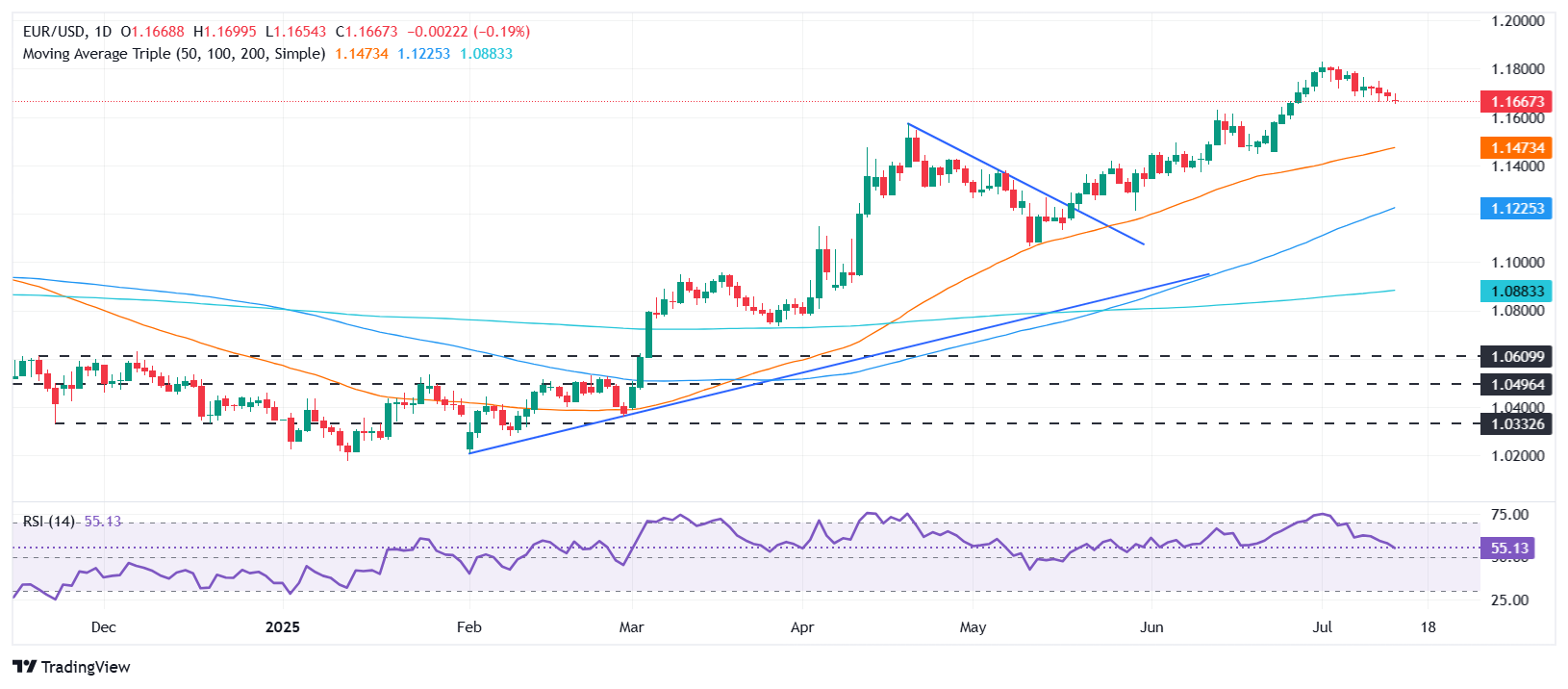
In the near term, the EUR/USD is neutral to bearishly biased, as the pair dipped below the 20-day Simple Moving Average (SMA) of 1.1677. As it achieves a daily close below the latter, sellers must clear the next support seen at 1.1650, before testing 1.1600. Up next lies the 50-day SMA at 1.1477.
From a momentum standpoint, the Relative Strength Index (RSI) is approaching its neutral line. Hence, a drop below its 50-neutral line could accelerate the pair’s drop.
For a bullish resumption, buyers must hurdle the 1.1700 figure before the July 10 high of 1.1749, followed by 1.1800 and the YTD high of 1.1829.
Euro FAQs
The Euro is the currency for the 19 European Union countries that belong to the Eurozone. It is the second most heavily traded currency in the world behind the US Dollar. In 2022, it accounted for 31% of all foreign exchange transactions, with an average daily turnover of over $2.2 trillion a day. EUR/USD is the most heavily traded currency pair in the world, accounting for an estimated 30% off all transactions, followed by EUR/JPY (4%), EUR/GBP (3%) and EUR/AUD (2%).
The European Central Bank (ECB) in Frankfurt, Germany, is the reserve bank for the Eurozone. The ECB sets interest rates and manages monetary policy. The ECB’s primary mandate is to maintain price stability, which means either controlling inflation or stimulating growth. Its primary tool is the raising or lowering of interest rates. Relatively high interest rates – or the expectation of higher rates – will usually benefit the Euro and vice versa. The ECB Governing Council makes monetary policy decisions at meetings held eight times a year. Decisions are made by heads of the Eurozone national banks and six permanent members, including the President of the ECB, Christine Lagarde.
Eurozone inflation data, measured by the Harmonized Index of Consumer Prices (HICP), is an important econometric for the Euro. If inflation rises more than expected, especially if above the ECB’s 2% target, it obliges the ECB to raise interest rates to bring it back under control. Relatively high interest rates compared to its counterparts will usually benefit the Euro, as it makes the region more attractive as a place for global investors to park their money.
Data releases gauge the health of the economy and can impact on the Euro. Indicators such as GDP, Manufacturing and Services PMIs, employment, and consumer sentiment surveys can all influence the direction of the single currency. A strong economy is good for the Euro. Not only does it attract more foreign investment but it may encourage the ECB to put up interest rates, which will directly strengthen the Euro. Otherwise, if economic data is weak, the Euro is likely to fall. Economic data for the four largest economies in the euro area (Germany, France, Italy and Spain) are especially significant, as they account for 75% of the Eurozone’s economy.
Another significant data release for the Euro is the Trade Balance. This indicator measures the difference between what a country earns from its exports and what it spends on imports over a given period. If a country produces highly sought after exports then its currency will gain in value purely from the extra demand created from foreign buyers seeking to purchase these goods. Therefore, a positive net Trade Balance strengthens a currency and vice versa for a negative balance.
Author

Christian Borjon Valencia
FXStreet
Markets analyst, news editor, and trading instructor with over 14 years of experience across FX, commodities, US equity indices, and global macro markets.