EUR/USD slips as Trump softens China tariff stance, US Dollar recovers
- Trump says high tariffs on China are “not sustainable,” boosting the Dollar and easing trade tensions.
- Fed officials Waller, Musalem, and Kashkari signal support for further cuts but warn inflation remains hot.
- Eurozone inflation data meets estimates; traders eye next week’s US CPI for fresh direction.

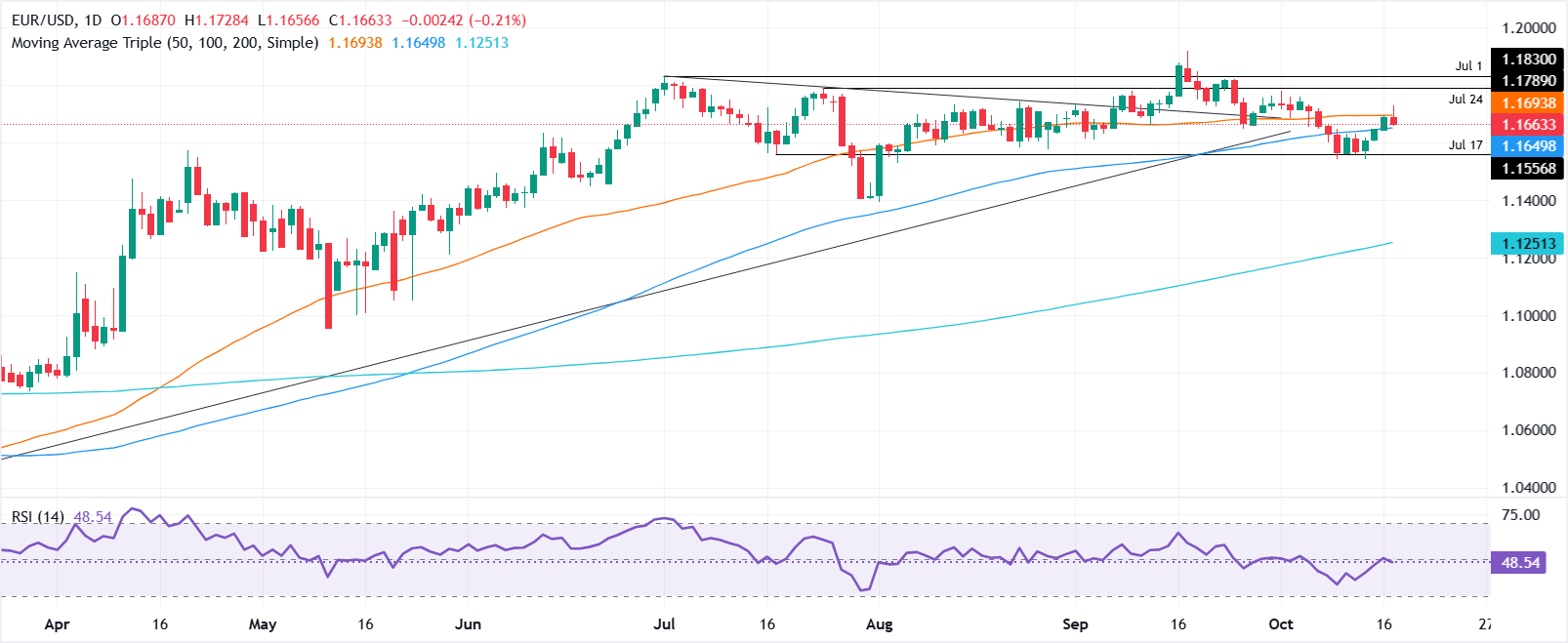
EUR/USD dives 0.17% during the North American session on Friday as the Greenback trims its earlier losses as US President Donald Trump tempered his trade rhetoric on China. The pair trades at around 1.1666 after hitting a daily high of 1.1728.
Euro retreats from daily highs as risk appetite improves and Fed remarks stay cautiously dovish
Risk appetite improved ahead of Wall Street open as US President Donald Trump said that high tariffs on China were not sustainable and most likely increase tensions between the two countries. He added that he plans to meet Xi Jinping at the Asian Pacific reunion in South Korea.
After the headlines, the Greenback erased its earlier losses and rose. The US Dollar Index (DXY), which tracks the performance of the buck’s value against a basket of peers, is up 0.09% at 98.42.
The lack of economic data keeps traders leaning on Federal Reserve (Fed) officials crossing the wires. Most of the remarks were slightly dovish, led by Governor Christopher Waller. Meanwhile, St. Louis Fed President Alberto Musalem and Minneapolis Fed Neel Kashkari, although favoring further cuts, stressed that inflation remains hot.
In Europe, the Harmonized Index of Consumer Prices (HICP) was broadly aligned with estimates in September.
Next week, the US economic docket remains empty, but the release of the Consumer Price Index (CPI) figures on Friday is widely awaited by market participants.
Euro Price This week
The table below shows the percentage change of Euro (EUR) against listed major currencies this week. Euro was the strongest against the Australian Dollar.
| USD | EUR | GBP | JPY | CAD | AUD | NZD | CHF | |
|---|---|---|---|---|---|---|---|---|
| USD | -0.38% | -0.57% | -0.92% | 0.14% | 0.20% | 0.10% | -1.03% | |
| EUR | 0.38% | -0.19% | -0.49% | 0.51% | 0.67% | 0.51% | -0.66% | |
| GBP | 0.57% | 0.19% | -0.26% | 0.70% | 0.85% | 0.70% | -0.50% | |
| JPY | 0.92% | 0.49% | 0.26% | 1.00% | 1.07% | 1.08% | -0.17% | |
| CAD | -0.14% | -0.51% | -0.70% | -1.00% | 0.03% | 0.00% | -1.19% | |
| AUD | -0.20% | -0.67% | -0.85% | -1.07% | -0.03% | -0.14% | -1.33% | |
| NZD | -0.10% | -0.51% | -0.70% | -1.08% | -0.00% | 0.14% | -1.19% | |
| CHF | 1.03% | 0.66% | 0.50% | 0.17% | 1.19% | 1.33% | 1.19% |
The heat map shows percentage changes of major currencies against each other. The base currency is picked from the left column, while the quote currency is picked from the top row. For example, if you pick the Euro from the left column and move along the horizontal line to the US Dollar, the percentage change displayed in the box will represent EUR (base)/USD (quote).
Daily market movers: The Dollar appreciates, despite Fed’s dovish comments
- Several Federal Reserve officials spoke on Friday, offering a cautiously dovish tone. St. Louis Fed President Alberto Musalem said he supports a rate cut at the October meeting but reaffirmed his full commitment to returning inflation to the 2% target.
- Fed Governor Christopher Waller echoed Musalem’s remarks, while Minneapolis Fed President Neel Kashkari noted that the economy “is not slowing as much as we think,” suggesting resilience despite recent data softening.
- Eurozone inflation data came broadly in line with expectations in September, signaling stable price dynamics. Core HICP rose 0.1% MoM and 2.4% YoY, slightly above the 2.3% forecast. Headline HICP also climbed 0.1% on the month and 2.2% on the year, matching both projections and August’s readings.
- European Central Bank (ECB) officials maintained a cautious tone on Friday. ECB’s Olaf Sleijpen said that policy being “in a good place” does not mean it will stay there, noting that the economy has been more resilient than expected. ECB’s Joachim Nagel added that there is no need to act on interest rates for now.
- On Tuesday, Fed Chair Jerome Powell was dovish, acknowledged the weakness of the labor market and added that the central bank should move to more “neutral” interest rates.
- Money markets are fully pricing in a 25-basis-point rate cut at the Fed’s October 29 meeting, with odds at 97%, according to the Prime Market Terminal probability tool.
Technical outlook: EUR/USD slips below 100-day SMA, further downside eyed
EUR/USD’s technical outlook remains bearishly biased, despite improving somewhat in the week. After reaching a weekly high of 1.1728, the shared currency tumbled below 1.1700, opening the door for further downside.
The EUR/USD first support would be the 100-day Simple Moving Average (SMA) at 1.1648. Once cleared, the next stop would be the 1.1600 figure, followed by 1.1550 and 1.1500.
On the flip side, resistance is seen at the 50-day SMA at 1.1691, 1.1700 and the daily high of 1.1728. A breach of the latter will expose 1.1800 and the July 1 high at 1.1830.
Euro FAQs
The Euro is the currency for the 19 European Union countries that belong to the Eurozone. It is the second most heavily traded currency in the world behind the US Dollar. In 2022, it accounted for 31% of all foreign exchange transactions, with an average daily turnover of over $2.2 trillion a day. EUR/USD is the most heavily traded currency pair in the world, accounting for an estimated 30% off all transactions, followed by EUR/JPY (4%), EUR/GBP (3%) and EUR/AUD (2%).
The European Central Bank (ECB) in Frankfurt, Germany, is the reserve bank for the Eurozone. The ECB sets interest rates and manages monetary policy. The ECB’s primary mandate is to maintain price stability, which means either controlling inflation or stimulating growth. Its primary tool is the raising or lowering of interest rates. Relatively high interest rates – or the expectation of higher rates – will usually benefit the Euro and vice versa. The ECB Governing Council makes monetary policy decisions at meetings held eight times a year. Decisions are made by heads of the Eurozone national banks and six permanent members, including the President of the ECB, Christine Lagarde.
Eurozone inflation data, measured by the Harmonized Index of Consumer Prices (HICP), is an important econometric for the Euro. If inflation rises more than expected, especially if above the ECB’s 2% target, it obliges the ECB to raise interest rates to bring it back under control. Relatively high interest rates compared to its counterparts will usually benefit the Euro, as it makes the region more attractive as a place for global investors to park their money.
Data releases gauge the health of the economy and can impact on the Euro. Indicators such as GDP, Manufacturing and Services PMIs, employment, and consumer sentiment surveys can all influence the direction of the single currency. A strong economy is good for the Euro. Not only does it attract more foreign investment but it may encourage the ECB to put up interest rates, which will directly strengthen the Euro. Otherwise, if economic data is weak, the Euro is likely to fall. Economic data for the four largest economies in the euro area (Germany, France, Italy and Spain) are especially significant, as they account for 75% of the Eurozone’s economy.
Another significant data release for the Euro is the Trade Balance. This indicator measures the difference between what a country earns from its exports and what it spends on imports over a given period. If a country produces highly sought after exports then its currency will gain in value purely from the extra demand created from foreign buyers seeking to purchase these goods. Therefore, a positive net Trade Balance strengthens a currency and vice versa for a negative balance.
Author

Christian Borjon Valencia
FXStreet
Markets analyst, news editor, and trading instructor with over 14 years of experience across FX, commodities, US equity indices, and global macro markets.