EUR/USD slips as Dollar rebounds, French protests weigh on sentiment
- US Dollar bounces from three-year lows after Fed cut, supported by rising US Treasury yields late in the week.
- Fed officials Daly and Kashkari offered cautious tones, while Miran reaffirmed his preference for deeper easing.
- French spending cut protests pressure Macron’s new PM, adding political headwinds for the Euro.

EUR/USD edges lower on Friday, late in the North American session, as the Greenback recovers after bouncing off three-year lows reached in the aftermath of the Federal Reserve’s (Fed) interest rate cut. Political turmoil in France amid higher US Treasury yields boosted the US Dollar, sending the pair lower.
EUR/USD falls as Fed speakers, higher yields, French unrest undermine Euro’s momentum
The EUR/USD trades at 1.1747, down 0.32% as the economic docket on both sides of the Atlantic was light. Comments from Fed officials after the central bank reduced rates by 25 bps last Wednesday suggest that the stance of the majority of the Federal Open Market Committee (FOMC) is neutral with the exception of Fed Governor Stephen Miran.
The US economic docket featured comments by San Francisco Fed President Mary Daly, Minneapolis Fed President Neel Kashkari and Governor Miran. Daly’s message was mildly dovish, while Kashkari sounded neutral, even opening the door for hikes if needed. Conversely, Governor Miran confirmed that the “dot plot” on the lowest range for the fed funds rate was him, saying that he does not think that a 50 bps cut “would worry markets.”
In France, protests are exerting downward pressure on the shared currency as hundreds of thousands of people met in France’s main cities on Thursday to pressure President Emmanuel Macron and newly appointed Prime Minister Sebastien Lecomu to scrap plans to cut spending proposed by the previous Prime Minister, François Bayrou.
Next week, the US economic docket will feature S&P Global Flash PMIs, Durable Goods, Jobless Claims, GDP data and the release of the Fed’s favorite inflation gauge, the Core PCE. Alongside this, a flurry of Fed officials will hit the media.
Daily market movers: EUR/USD capped by Fed neutral stance comments
- Mary Daly noted the Fed's move to cut rates was to try and bolster a weakening labor market, noting a pointed softening of the US economy over the past year.
- Minneapolis Minnesota Fed President Neel Kashkari said that he supported the rate cut this week as risks of an increase in unemployment warranted some action. He said that it is hard to see inflation climbing much higher than 3% from tariffs and added that if the jobs market improves and inflation rises, the Fed should hold rates.
- Fed Governor Stephen Miran said that the economy should have an interest rate not too far from the neutral rate. He added that he will announce a review of his views on Monday.
- The US Dollar Index (DXY) which tracks the buck’s value against a basket of six currencies, edges up 0.31% at 97.66.
- Last Thursday, weekly US Initial Jobless Claims fell to 231K in the week ending September 13, undershooting expectations of 240K and down sharply from the prior week’s upwardly revised 264K.
- Meanwhile, the Philadelphia Fed Manufacturing Index rebounded strongly in September, jumping to 23.2 from August’s -0.3, far surpassing the 2.3 forecast and signaling robust activity in the sector.
- Futures markets are pricing a 90% probability of a 25-basis-point Fed rate cut this month, along with nearly an 80% chance of another quarter-point reduction in December.
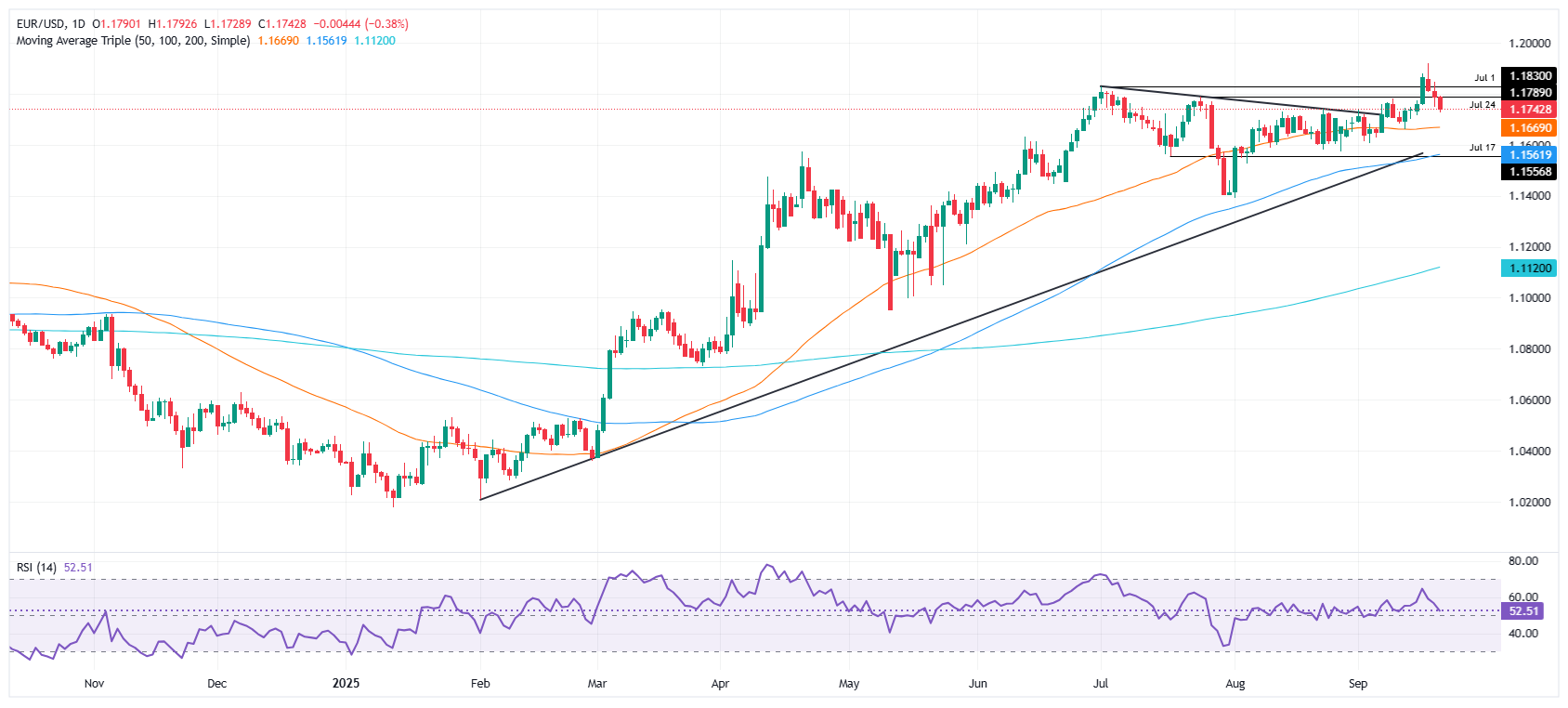
Technical outlook: EUR/USD pulls back below 1.1750, bias stays bullish
EUR/USD eased after recent gains, with an “evening star” formation confirming that the Euro weakened. Although bears have not cleared the September 11 low at 1.1659, they are gathering some steam. A breach of the 1.1700 level will expose the latter, as well as the confluence of the 100-day SMA and the August 27 swing low near 1.1560–1.1574.
The Relative Strength Index (RSI) remains supportive of the broader uptrend, staying clear of overbought territory. On the upside, a rebound above 1.1800 would open the door to 1.1850, with scope to retest the year-to-date high at 1.1918.
Euro FAQs
The Euro is the currency for the 19 European Union countries that belong to the Eurozone. It is the second most heavily traded currency in the world behind the US Dollar. In 2022, it accounted for 31% of all foreign exchange transactions, with an average daily turnover of over $2.2 trillion a day. EUR/USD is the most heavily traded currency pair in the world, accounting for an estimated 30% off all transactions, followed by EUR/JPY (4%), EUR/GBP (3%) and EUR/AUD (2%).
The European Central Bank (ECB) in Frankfurt, Germany, is the reserve bank for the Eurozone. The ECB sets interest rates and manages monetary policy. The ECB’s primary mandate is to maintain price stability, which means either controlling inflation or stimulating growth. Its primary tool is the raising or lowering of interest rates. Relatively high interest rates – or the expectation of higher rates – will usually benefit the Euro and vice versa. The ECB Governing Council makes monetary policy decisions at meetings held eight times a year. Decisions are made by heads of the Eurozone national banks and six permanent members, including the President of the ECB, Christine Lagarde.
Eurozone inflation data, measured by the Harmonized Index of Consumer Prices (HICP), is an important econometric for the Euro. If inflation rises more than expected, especially if above the ECB’s 2% target, it obliges the ECB to raise interest rates to bring it back under control. Relatively high interest rates compared to its counterparts will usually benefit the Euro, as it makes the region more attractive as a place for global investors to park their money.
Data releases gauge the health of the economy and can impact on the Euro. Indicators such as GDP, Manufacturing and Services PMIs, employment, and consumer sentiment surveys can all influence the direction of the single currency. A strong economy is good for the Euro. Not only does it attract more foreign investment but it may encourage the ECB to put up interest rates, which will directly strengthen the Euro. Otherwise, if economic data is weak, the Euro is likely to fall. Economic data for the four largest economies in the euro area (Germany, France, Italy and Spain) are especially significant, as they account for 75% of the Eurozone’s economy.
Another significant data release for the Euro is the Trade Balance. This indicator measures the difference between what a country earns from its exports and what it spends on imports over a given period. If a country produces highly sought after exports then its currency will gain in value purely from the extra demand created from foreign buyers seeking to purchase these goods. Therefore, a positive net Trade Balance strengthens a currency and vice versa for a negative balance.
Author

Christian Borjon Valencia
FXStreet
Markets analyst, news editor, and trading instructor with over 14 years of experience across FX, commodities, US equity indices, and global macro markets.
















