EUR/USD slides below 1.2000 as Fed hold, Powell stance lift Dollar
- EUR/USD drops over 0.6% after the Fed holds rates and Powell stresses data dependence.
- Bessent’s strong-Dollar remarks reverse Trump-led selling, lifting the Greenback broadly.
- ECB officials warn sustained Dollar weakness could undershoot Eurozone inflation targets.
EUR/USD sustained losses of over 0.60% on Wednesday below the 1.2000 figure as the Federal Reserve keeps interest rates steady, while the Fed Chair Jerome Powell refrained from answering questions regarding politics, striking a neutral stance regarding monetary policy. At the time of writing, the pair trades at 1.1955.
Euro weakens as the Fed signals patience, labor stability, and firmer Dollar fundamentals
At the press conference, Jerome Powell dodged questions related to politics and whether he would remain at the board of the Federal Reserve after his term expires. On monetary policy, Powell said there was broad support for the decision, emphasizing that policymakers will remain data-dependent and continue to assess conditions on a meeting-by-meeting basis.
Turning to the labor market, Powell said conditions have stabilized, while inflation remains somewhat elevated. He added that core PCE inflation is likely to run closer to 3%, and said he expects price pressures to peak around mid-year.
In an interview with CNBC, Scott Bessent commented that they do not intervene in the markets to propel the Japanese Yen. He added that the “US always has a strong dollar policy, but a strong dollar policy means setting the right fundamentals.”
Bessent comments outweighed US President Donald Trump remarks on Tuesday, in which he said the Dollar was doing “great,” when asked about the depreciation of the Greenback. His answer gave the green light to traders, who drove the US Dollar Index (DXY) to four-year lows.
In the Eurozone, GfK Consumer Confidence in Germany for February, improved. Meanwhile, members of the European Central Bank (ECB) expressed worries in regard to a weaker US Dollar, warning that it could drive down inflation past the ECB’s 2% goal.
Daily market movers: Euro treads water amid US Dollar strength
- The Euro drops as the buck recovers ahead of the Fed’s meeting. The US Dollar Index (DXY) which tracks the strength of the American currency against other six, is up 0.55% at 96.34.
- The Federal Reserve kept interest rates unchanged at 3.50%–3.75% at its latest policy meeting, following a split vote. Stephen Miran and Christopher Waller—one of President Trump’s nominees to succeed Jerome Powell—opted in favor of a 25-basis-point rate cut.
- Fed policymaker reiterated that inflation remains “somewhat elevated,” while noting that the unemployment rate has shown signs of stabilizing. Officials added that the economic outlook remains uncertain and stressed that decisions going forward will remain guided by both sides of the dual mandate.
- German GfK Consumer Confidence rose to -24.1 from -26.9 in January. The survey showed that the desire to buy improved and to save was mostly stable in January. Economic and income expectations improved as well.
- ECB’s Francois Villeroy de Galhau said “We are closely monitoring this appreciation of the euro and its possible implications for lower inflation.” He added that the weaker US Dollar against the euro reflected lower confidence amid unpredictable US economic policy.
- ECB Vice President Luis de Guindos said last summer that an EUR/USD exchange rate around 1.20 would be acceptable but warned that levels above that threshold could pose challenges.
- Prime Market Terminal data shows that traders are expecting 44 basis points of easing by the Federal Reserve towards the end of the year.
Technical outlook: EUR/USD consolidates around 1.1950
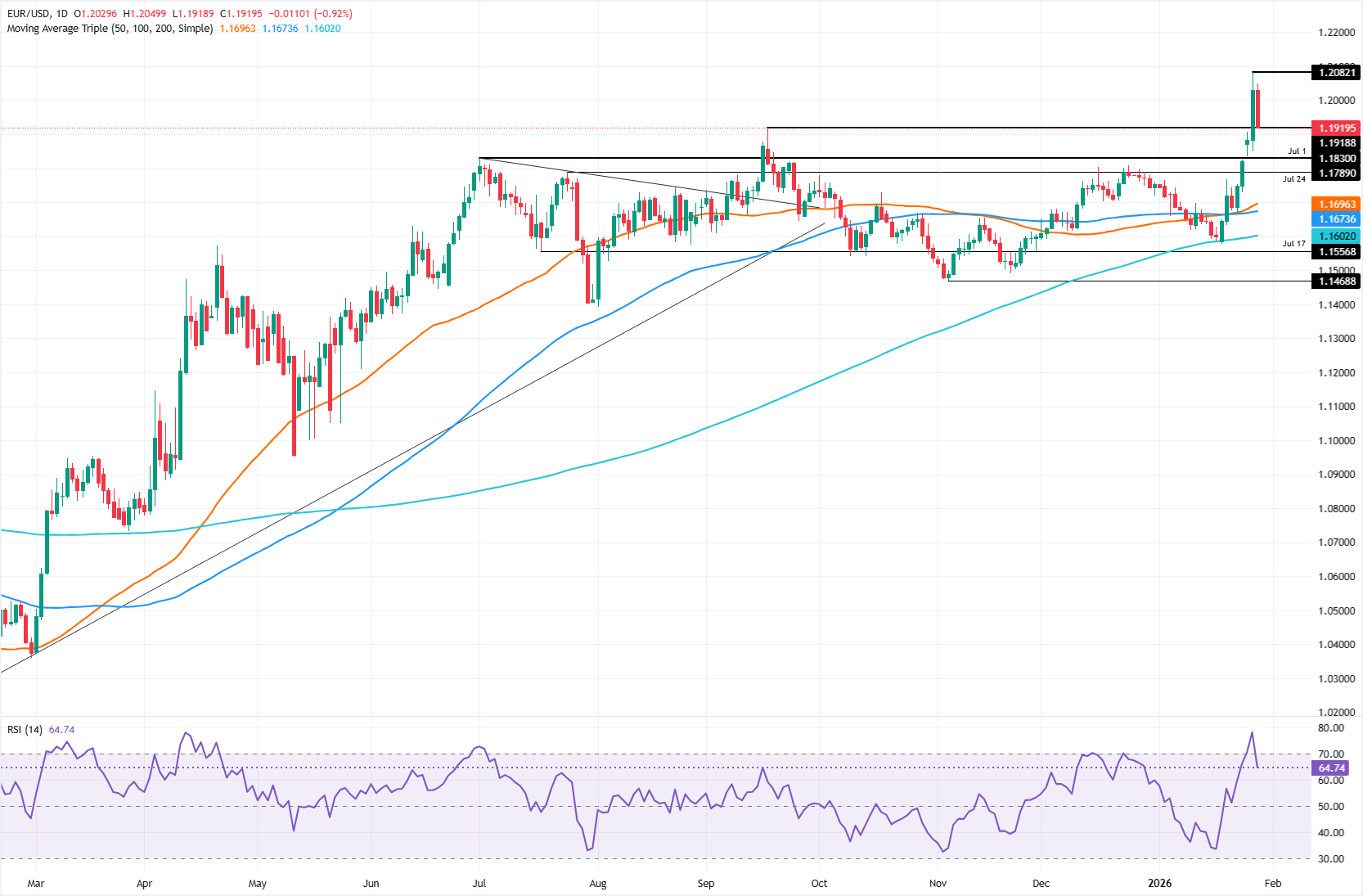
EUR/USD is retreating from yearly highs of 1.2082, with the shared currency seeming poised to bottom at around 1.1900 to remain sideways, waiting for the Fed’s decision. The Relative Strength Index (RSI) confirms the previously mentioned, as the RSI exited overbought territory, aiming towards its neutral level.
A Fed’s hawkish outcome could send EUR/USD tumbling below 1.1900, opening the door to test the July 1 daily high at 1.1830, ahead of 1.1800. Conversely, if policymakers are still seeing weakness in the labor market, the EUR/USD could rally towards 1.2000 and challenge the yearly high.
Fed FAQs
Monetary policy in the US is shaped by the Federal Reserve (Fed). The Fed has two mandates: to achieve price stability and foster full employment. Its primary tool to achieve these goals is by adjusting interest rates. When prices are rising too quickly and inflation is above the Fed’s 2% target, it raises interest rates, increasing borrowing costs throughout the economy. This results in a stronger US Dollar (USD) as it makes the US a more attractive place for international investors to park their money. When inflation falls below 2% or the Unemployment Rate is too high, the Fed may lower interest rates to encourage borrowing, which weighs on the Greenback.
The Federal Reserve (Fed) holds eight policy meetings a year, where the Federal Open Market Committee (FOMC) assesses economic conditions and makes monetary policy decisions. The FOMC is attended by twelve Fed officials – the seven members of the Board of Governors, the president of the Federal Reserve Bank of New York, and four of the remaining eleven regional Reserve Bank presidents, who serve one-year terms on a rotating basis.
In extreme situations, the Federal Reserve may resort to a policy named Quantitative Easing (QE). QE is the process by which the Fed substantially increases the flow of credit in a stuck financial system. It is a non-standard policy measure used during crises or when inflation is extremely low. It was the Fed’s weapon of choice during the Great Financial Crisis in 2008. It involves the Fed printing more Dollars and using them to buy high grade bonds from financial institutions. QE usually weakens the US Dollar.
Quantitative tightening (QT) is the reverse process of QE, whereby the Federal Reserve stops buying bonds from financial institutions and does not reinvest the principal from the bonds it holds maturing, to purchase new bonds. It is usually positive for the value of the US Dollar.
Author

Christian Borjon Valencia
FXStreet
Markets analyst, news editor, and trading instructor with over 14 years of experience across FX, commodities, US equity indices, and global macro markets.


![How Wall Street rigs the game [Video]](https://editorial.fxsstatic.com/images/i/market-chaos-01.jpg)