|

EUR/USD risk reversals contradict bearish pinbar, still gunning for 1.20?

  • EUR/USD - bullish sentiment strengthens in the options market.
  • Bearish pin bar needs a negative follow-through.

Euro's drop from the previous day's high of 1.1975 to 1.1898 cannot be attributed to specific factor(s) but could be considered as a sign of bull market exhaustion. Kathy Lien from BK Asset Management writes, "the technical structure of the pair signals a deeper correction to 1.1850."

However, as per textbook rules, only a negative follow-through (bearish price action) today would add credence to the bearish pin bar candle and open doors for a deeper pullback.

But, the EUR/USD risk reversals gauge suggests the bearish pin bar could be a bear trap.

Risk reversals
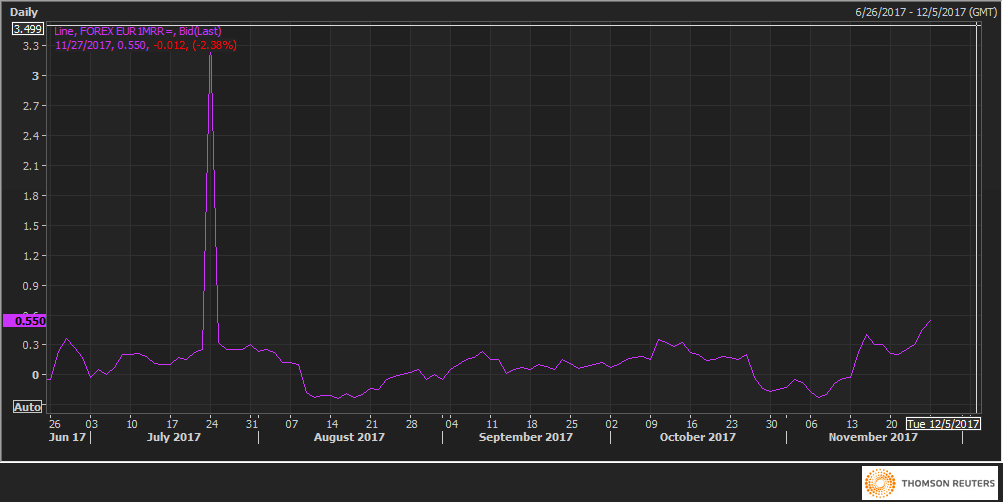
The one-month 25 delta risk reversals gauge rose to 0.55 yesterday; the highest level since July 25. The uptick in the gauge indicates increasing demand for the EUR calls. Clearly, the options market sees yesterday's dip as a temporary one.

Still, a move above 1.20 is easier said than done as the memories of ECB jawboning the currency back in September could keep the bulls at bay.

EUR/USD Technical Levels

FXStreet Chief Analyst Valeria Bednarik writes, "technically and for the upcoming sessions, the pair retains the bullish stance despite the modest daily pullback, as in the 4 hours chart, technical indicators have managed to correct extreme overbought conditions, but remain well into positive territory, with the RSI around 62 indicating a limited downward strength. In the same chart, the 20 SMA maintains its bullish slope around 1.1870, reinforcing the view. The 1.1890 region is the immediate support, en route to 1.1860, while only below 1.1820 bulls will lose hope, handing the grip to bears.

Support levels: 1.1890 1.1860 1.1825

Resistance levels: 1.1960 1.2000 1.2045

 TREND INDEXOB/OS INDEXVOLATILY INDEX
15MBearishNeutral Shrinking
1HBearishOversold Expanding
4HBearishNeutral Low
1DBearishOverbought High
1WBullishNeutral Low

Author

Omkar Godbole

Omkar Godbole

FXStreet Contributor

Omkar Godbole, editor and analyst, joined FXStreet after four years as a research analyst at several Indian brokerage companies.


More from Omkar Godbole
Share:

Editor's Picks

GBP/USD bounces off lows, back above 1.3200

After bottoming out near 1.3160, GBP/USD manages to regain a bit of shine and reclaim the 1.3200 mark and beyond at the end of the week. Stronger-than-expected UK Retail Sales data seem to be helping the British Pound limit its losses, while the chaotic UK political environment keeps the bulls at bay for now.

EUR/USD looks consolidative around 1.1460

EUR/USD stages a modest rebound after slipping to a three-month low below 1.1420 at the end of the week. That said, the pair now looks to consolidate humble gains just above 1.1460 despite growing uncertainty surrounding the next round of US-Iran negotiations, which keeps the US Dollar’s downside contained.

Gold slips back to six-day lows, targets $4,100

Gold retreats for the third consecutive day on Friday, eroding gains seen in the first half of the week and approaching the key $4,100 mark per troy ounce. Indeed, the precious metal continues to face headwinds from the Fed's hawkish stance and renewed uncertainty surrounding the next round of US-Iran negotiations.

Breaking: Iran closes the Strait of Hormuz amid ceasefire deal violation
Iran says it is closing the Strait of Hormuz after accusing the United States (US) and Israel of violating the ceasefire. According to Iran, the decision came over the continued Israeli strikes in Lebanon. The Iranian Revolutionary Guard Corps Navy issued a warning to all vessels: "Do not approach the Strait of Hormuz; otherwise, your security will be jeopardized."
The Iran war didn't break the US economy, but what happens next?

Nearly four months after the start of the Iran war, the US economy remains remarkably resilient. While the conflict initially triggered a severe disruption to global energy markets and a sharp rise in Oil prices, recent diplomatic progress between Washington and Tehran has eased concerns about a prolonged supply shock.

Regime change: Inside Kevin Warsh's first move to make the Fed unreadable on purpose

The rate did not move. That was the least interesting thing about Kevin Warsh's first meeting in charge of the Fed. The FOMC held its benchmark at 3.50%-3.75% for the fourth straight meeting, exactly as priced, and then the new chair used his first press conference to dismantle the machinery the market has leaned on for a decade.















