EUR/USD rises as US Dollar weakens on extended shutdown and market uncertainty
- EUR/USD rises 0.16% as markets digest extended US shutdown and weak sentiment data.
- US Dollar Index slips to 99.53 as investors favor Euro despite Wall Street’s AI-led selloff.
- German trade surplus narrows to €15.3B, while steady US inflation expectations signal cautious outlook ahead.

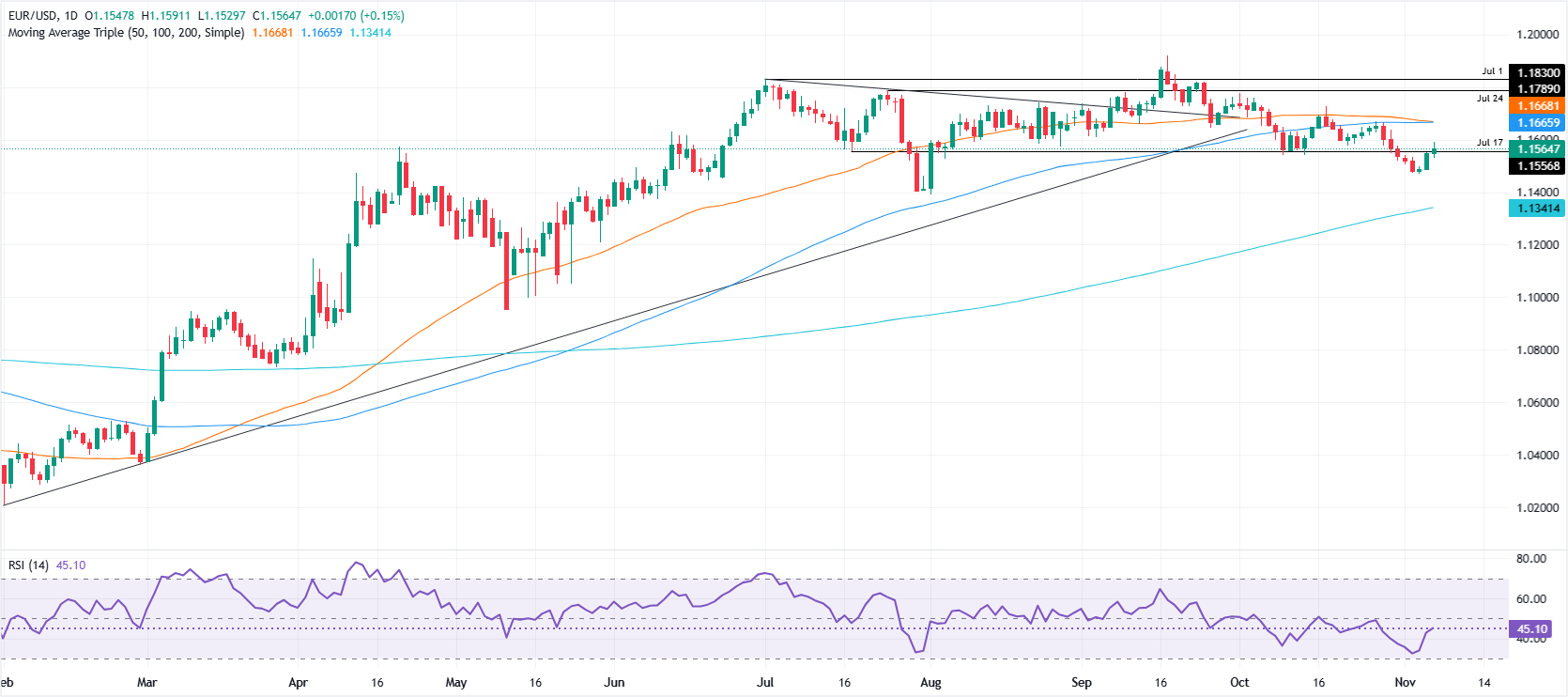
EUR/USD trimmed some of its previous losses and rises 0.16% on Friday’s late in the North American session, amid a scarce economic docket in both sides of the Atlantic. The US government shutdown extension to its 38th day and the light docket in Europe, keeps the pair trading within familiar levels around 1.1560.
Euro gains modestly as traders shun the Dollar amid US government shutdown
That lack of data in the US increased uncertainty in the financial markets, as seen by Wall Street indices, plunging due to different reasons. Alongside the government shutdown, investors seem anxious about AI related companies being overvalued, triggering a sell-off in the four major US indices.
As investors became risk averse, one should expect Greenback to being the haven, but traders opted to buy the Euro instead of the Dollar. The US Dollar Index (DXY), which tracks the performance of six currencies, dives 0.16% at 99.53.
Economic data in the US showed that consumers had grown pessimistic about the economy, revealed the University of Michigan (UoM) Consumer Sentiment poll for November. At the same time, the New York Fed revealed that inflation expectations for one year dipped, while for a medium term stood steady, revealed the October’s survey.
In Europe, the German Trade Balance showed the surplus narrowed to €15.3 billion in September, beneath the €16.8 expected, following August’s downward revised surplus of €16.9 billion.
Euro Price This week
The table below shows the percentage change of Euro (EUR) against listed major currencies this week. Euro was the strongest against the New Zealand Dollar.
| USD | EUR | GBP | JPY | CAD | AUD | NZD | CHF | |
|---|---|---|---|---|---|---|---|---|
| USD | -0.29% | -0.22% | -0.41% | 0.11% | 0.76% | 1.70% | 0.05% | |
| EUR | 0.29% | 0.07% | -0.05% | 0.40% | 1.04% | 1.99% | 0.34% | |
| GBP | 0.22% | -0.07% | -0.28% | 0.33% | 0.97% | 1.92% | 0.27% | |
| JPY | 0.41% | 0.05% | 0.28% | 0.48% | 1.15% | 2.09% | 0.58% | |
| CAD | -0.11% | -0.40% | -0.33% | -0.48% | 0.59% | 1.57% | -0.06% | |
| AUD | -0.76% | -1.04% | -0.97% | -1.15% | -0.59% | 0.95% | -0.70% | |
| NZD | -1.70% | -1.99% | -1.92% | -2.09% | -1.57% | -0.95% | -1.62% | |
| CHF | -0.05% | -0.34% | -0.27% | -0.58% | 0.06% | 0.70% | 1.62% |
The heat map shows percentage changes of major currencies against each other. The base currency is picked from the left column, while the quote currency is picked from the top row. For example, if you pick the Euro from the left column and move along the horizontal line to the US Dollar, the percentage change displayed in the box will represent EUR (base)/USD (quote).
Daily digest market movers: EUR/USD to remain trapped within 1.15-1.16
- US Consumer Sentiment fell sharply to 50.3 in November from 53.6 in October, reflecting weaker household confidence said the UoM. The survey showed inflation expectations for the year ahead edged higher to 4.7% from 4.6%, while the five-year outlook eased to 3.6% from 3.9%.
- The New York Fed’s Consumer Expectations Survey showed that one-year inflation expectations slipped to 3.2% in October from 3.4% in September. Expectations for both the three-year and five-year horizons were unchanged at 3.0%.
- Federal Reserve Vice Chair Philip Jefferson said the central bank should move cautiously with additional rate cuts as monetary policy approaches a neutral stance. He added that decisions will be made on a meeting-by-meeting basis and noted the “potential lack of government data due to the shutdown” as a factor warranting prudence.
- In Europe, an unexpected decline in September retail sales dampened optimism following earlier upbeat services sector data, acting as a headwind to the euro’s recovery.
EUR/USD technical outlook: To remain subdued, tilted to the downside
The EUR/USD seems poised to remain downward biased, despite sellers lacking the strength of pushing the exchange rate towards the 200-day Simple Moving Average (SMA) at 1.1344. Nevertheless, in the short term if buyers regain the 20-day SMA at 1.1592 and 1.1600, then look for a recovery towards 1.1700.
Although buyers are gathering momentum as shown by the RSI, as long as the index is bearish, sellers have the upper hand. Hence, if EUR/USD drops below 1.1500, expect a test of the August 1 cycle low of 1.1391.
Euro FAQs
The Euro is the currency for the 20 European Union countries that belong to the Eurozone. It is the second most heavily traded currency in the world behind the US Dollar. In 2022, it accounted for 31% of all foreign exchange transactions, with an average daily turnover of over $2.2 trillion a day. EUR/USD is the most heavily traded currency pair in the world, accounting for an estimated 30% off all transactions, followed by EUR/JPY (4%), EUR/GBP (3%) and EUR/AUD (2%).
The European Central Bank (ECB) in Frankfurt, Germany, is the reserve bank for the Eurozone. The ECB sets interest rates and manages monetary policy. The ECB’s primary mandate is to maintain price stability, which means either controlling inflation or stimulating growth. Its primary tool is the raising or lowering of interest rates. Relatively high interest rates – or the expectation of higher rates – will usually benefit the Euro and vice versa. The ECB Governing Council makes monetary policy decisions at meetings held eight times a year. Decisions are made by heads of the Eurozone national banks and six permanent members, including the President of the ECB, Christine Lagarde.
Eurozone inflation data, measured by the Harmonized Index of Consumer Prices (HICP), is an important econometric for the Euro. If inflation rises more than expected, especially if above the ECB’s 2% target, it obliges the ECB to raise interest rates to bring it back under control. Relatively high interest rates compared to its counterparts will usually benefit the Euro, as it makes the region more attractive as a place for global investors to park their money.
Data releases gauge the health of the economy and can impact on the Euro. Indicators such as GDP, Manufacturing and Services PMIs, employment, and consumer sentiment surveys can all influence the direction of the single currency. A strong economy is good for the Euro. Not only does it attract more foreign investment but it may encourage the ECB to put up interest rates, which will directly strengthen the Euro. Otherwise, if economic data is weak, the Euro is likely to fall. Economic data for the four largest economies in the euro area (Germany, France, Italy and Spain) are especially significant, as they account for 75% of the Eurozone’s economy.
Another significant data release for the Euro is the Trade Balance. This indicator measures the difference between what a country earns from its exports and what it spends on imports over a given period. If a country produces highly sought after exports then its currency will gain in value purely from the extra demand created from foreign buyers seeking to purchase these goods. Therefore, a positive net Trade Balance strengthens a currency and vice versa for a negative balance.
Author

Christian Borjon Valencia
FXStreet
Markets analyst, news editor, and trading instructor with over 14 years of experience across FX, commodities, US equity indices, and global macro markets.