EUR/USD rises as US-China trade war eases ahead of Fed decision
- EUR/USD trades at 1.1643, supported by improved risk sentiment after US–China talks in Malaysia.
- Negotiators outlined a framework for a trade truce covering tariffs, rare earths, and fentanyl.
- US Dollar softens as traders price in 97% odds of a 25 bps Fed rate cut at this week's meeting.

EUR/USD edges up late in the North American session on Monday as the Greenback retreats from last week's highs, while the US-China trade war de-escalates ahead of the Donald Trump-Xi Jinping summit in South Korea. The pair trades at 1.1643, up by 0.15%.
Euro climbs as Dollar retreats from weekly highs; focus turns to Trump–Xi summit and FOMC
Negotiations in Malaysia between US and Chinese officials set the stage for the Trump–Xi Jinping meeting on Thursday, after trade negotiators talked about tariffs, shipping fees, fentanyl and export controls on rare earths.
Risk appetite improved on the news, a tailwind for the shared currency, which had been pressured as the US Dollar regained strength. Despite this, the EUR/USD remains at familiar levels as traders wait for the Federal Reserve’s (Fed) monetary policy decision in the next two days.
Traders’ expectations that the Federal Reserve will cut rates by 25 basis points at the next meeting are at 97%, as revealed by the Prime Market Terminal Interest rate probability tool.
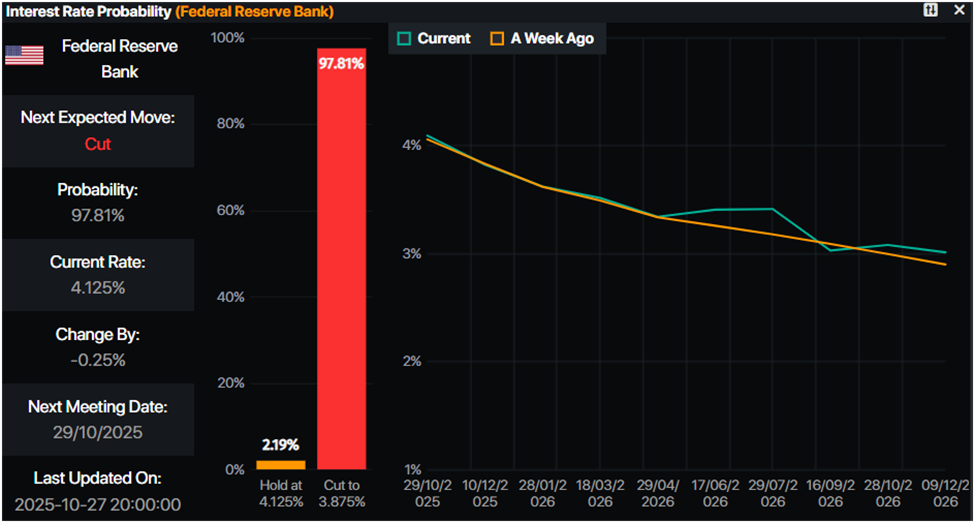
Source: Prime Market Terminal
Data in the Eurozone revealed that companies expect an economic improvement next year, but the current situation ix “assessed as slightly worse,” revealed the IFO Business Survey.
Euro Price This Month
The table below shows the percentage change of Euro (EUR) against listed major currencies this month. Euro was the strongest against the Japanese Yen.
| USD | EUR | GBP | JPY | CAD | AUD | NZD | CHF | |
|---|---|---|---|---|---|---|---|---|
| USD | 0.75% | 0.79% | 3.35% | 0.51% | 0.86% | 0.36% | -0.13% | |
| EUR | -0.75% | 0.05% | 2.56% | -0.24% | 0.13% | -0.35% | -0.88% | |
| GBP | -0.79% | -0.05% | 2.55% | -0.29% | 0.08% | -0.39% | -0.92% | |
| JPY | -3.35% | -2.56% | -2.55% | -2.74% | -2.43% | -2.65% | -3.29% | |
| CAD | -0.51% | 0.24% | 0.29% | 2.74% | 0.36% | -0.11% | -0.64% | |
| AUD | -0.86% | -0.13% | -0.08% | 2.43% | -0.36% | -0.48% | -1.01% | |
| NZD | -0.36% | 0.35% | 0.39% | 2.65% | 0.11% | 0.48% | -0.53% | |
| CHF | 0.13% | 0.88% | 0.92% | 3.29% | 0.64% | 1.01% | 0.53% |
The heat map shows percentage changes of major currencies against each other. The base currency is picked from the left column, while the quote currency is picked from the top row. For example, if you pick the Euro from the left column and move along the horizontal line to the US Dollar, the percentage change displayed in the box will represent EUR (base)/USD (quote).
Daily market movers: EUR/USD floats around 1.1640 as the Greenback weakens
- The US Dollar Index (DXY), which tracks the performance of the buck’s value against a basket of its rivals, is up 0.03% at 98.94, capping the EUR/USD’s advance.
- US President Donald Trump arrived in Asia and said that the US and China are set to “come away” with a trade deal. He is expected to meet his counterpart Xi Jinping this week in South Korea.
- US Treasury Secretary Scott Bessent said on Sunday that US and Chinese officials have reached a “positive framework” for the upcoming Trump–Xi summit later this week. He also suggested that President Trump’s threat to impose 100% tariffs on Chinese goods is no longer under consideration.
- The German Ifo Business Climate Index in October rose from 87.7 to 88.4, exceeding forecasts of 87.8. Expectations advanced to 91.6 from the previous 89.8, while Current Conditions fell to 85.3 from 85.7, beneath projections for a dip to 85.5. The survey revealed that “Companies remain hopeful that the economy will pick up in the coming year. However, the current business situation was assessed as slightly worse.”
Technical outlook: EUR/USD remains subdued, traders eye 100-day SMA
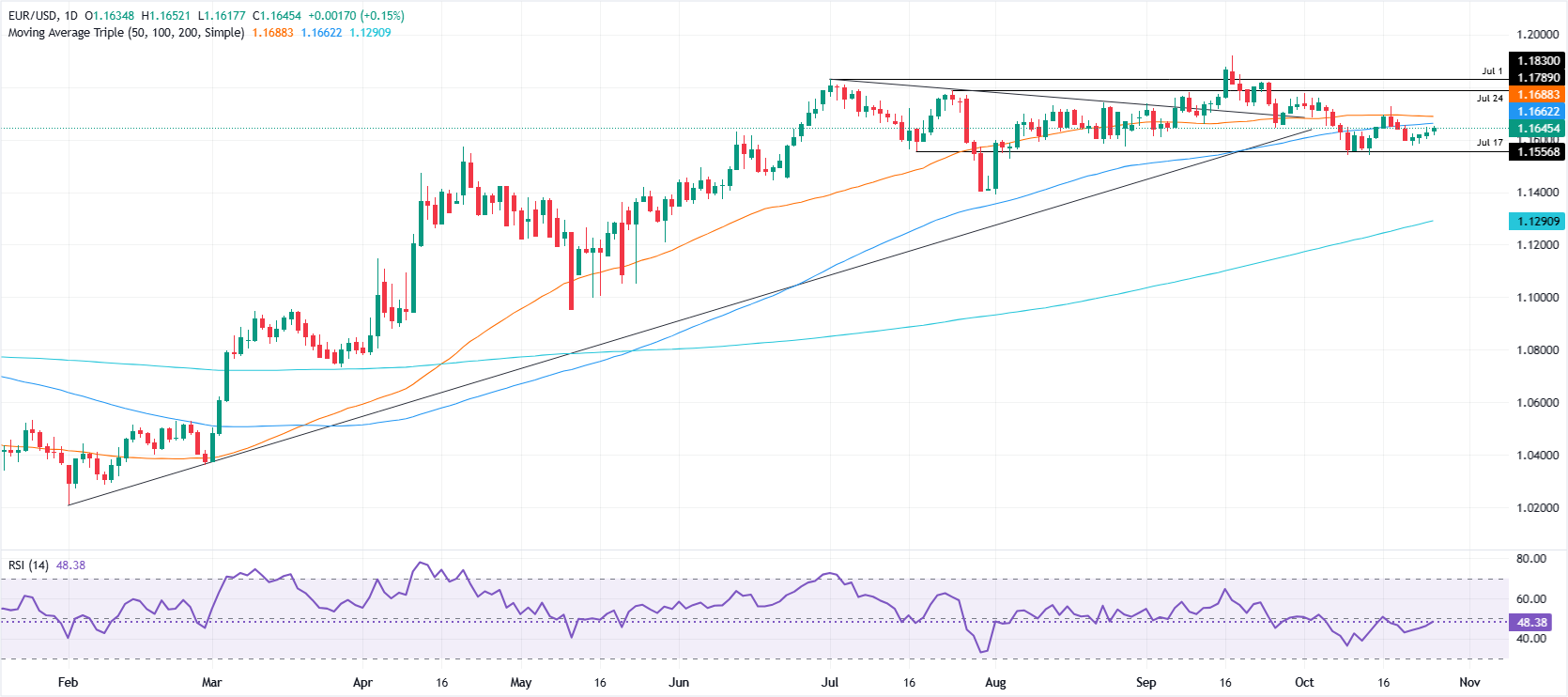
The EUR/USD technical picture shows that further upside could be capped by key resistance levels lying overhead. First, traders must clear the 100-day Simple Moving Average (SMA) at 1.1659, followed by the 50-day SMA at 1.1686. A breach of the latter will expose the 1.1700 milestone.
Immediate support is located at 1.1600, followed by 1.1550 and 1.1500. A decisive break below this area would expose the August 1 cycle low near 1.1391.
Euro FAQs
The Euro is the currency for the 19 European Union countries that belong to the Eurozone. It is the second most heavily traded currency in the world behind the US Dollar. In 2022, it accounted for 31% of all foreign exchange transactions, with an average daily turnover of over $2.2 trillion a day. EUR/USD is the most heavily traded currency pair in the world, accounting for an estimated 30% off all transactions, followed by EUR/JPY (4%), EUR/GBP (3%) and EUR/AUD (2%).
The European Central Bank (ECB) in Frankfurt, Germany, is the reserve bank for the Eurozone. The ECB sets interest rates and manages monetary policy. The ECB’s primary mandate is to maintain price stability, which means either controlling inflation or stimulating growth. Its primary tool is the raising or lowering of interest rates. Relatively high interest rates – or the expectation of higher rates – will usually benefit the Euro and vice versa. The ECB Governing Council makes monetary policy decisions at meetings held eight times a year. Decisions are made by heads of the Eurozone national banks and six permanent members, including the President of the ECB, Christine Lagarde.
Eurozone inflation data, measured by the Harmonized Index of Consumer Prices (HICP), is an important econometric for the Euro. If inflation rises more than expected, especially if above the ECB’s 2% target, it obliges the ECB to raise interest rates to bring it back under control. Relatively high interest rates compared to its counterparts will usually benefit the Euro, as it makes the region more attractive as a place for global investors to park their money.
Data releases gauge the health of the economy and can impact on the Euro. Indicators such as GDP, Manufacturing and Services PMIs, employment, and consumer sentiment surveys can all influence the direction of the single currency. A strong economy is good for the Euro. Not only does it attract more foreign investment but it may encourage the ECB to put up interest rates, which will directly strengthen the Euro. Otherwise, if economic data is weak, the Euro is likely to fall. Economic data for the four largest economies in the euro area (Germany, France, Italy and Spain) are especially significant, as they account for 75% of the Eurozone’s economy.
Another significant data release for the Euro is the Trade Balance. This indicator measures the difference between what a country earns from its exports and what it spends on imports over a given period. If a country produces highly sought after exports then its currency will gain in value purely from the extra demand created from foreign buyers seeking to purchase these goods. Therefore, a positive net Trade Balance strengthens a currency and vice versa for a negative balance.
Author

Christian Borjon Valencia
FXStreet
Markets analyst, news editor, and trading instructor with over 14 years of experience across FX, commodities, US equity indices, and global macro markets.