EUR/USD retreats as solid US employment data lifts the US Dollar
- EUR/USD weakens after the June Nonfarm Payrolls report highlights a resilient US labour market, easing pressure on the Fed to cut rates in July.
- US yields provided support for the Greenback ahead of Independence Day on Friday, which could impact liquidity and volatility.
- EUR/USD faces near-term resistance at the psychologically significant 1.1800 level.

The Euro (EUR) is weakening against the US Dollar (USD) on Thursday during the American session after a slew of US economic data provided some relief for the Greenback.
After rising to a multi-year high of 1.1830 on Tuesday, the upside rally is facing resistance with EUR/USD trading below 1.1800 at the time of writing.
Thursday’s market focus was on the release of employment data from the United States. As investors continued to search for clues on when the Federal Reserve (Fed) might begin to cut rates, the focus shifted to the Nonfarm Payrolls (NFP) report for June.
The headline NFP number revealed that 147,000 jobs were added to the US economy in June, above analyst expectations of a 110,000 increase and the 144,000 jobs created in May. The unemployment rate fell to 4.1% from 4.2% and wage growth remained steady.
Additional metrics such as the unemployment rate, labor force participation, and wage growth indicators, which are key indicators that the Federal Reserve closely watches to assess inflation trends, are also included in the report.
A resilient labour market eases pressure on the Fed to cut interest rates, which has resulted in a modest recovery in US yields, supporting the Dollar.
EUR/USD faces near-term resistance at 1.1800
The EUR/USD pair has been exhibiting strong bullish momentum, recently climbing to a high of 1.1830. A test of this level has prompted some profit-taking, pushing the pair back below the current psychological resistance zone at 1.1800.
Despite this retracement, the price remains above both the 10-day and 20-day Simple Moving Average (SMA), currently providing support around 1.1695 and 1.1592, respectively. Both averages are trending upward, reflecting continued short- and medium-term strength and reinforcing the broader bullish structure.
EUR/USD daily chart
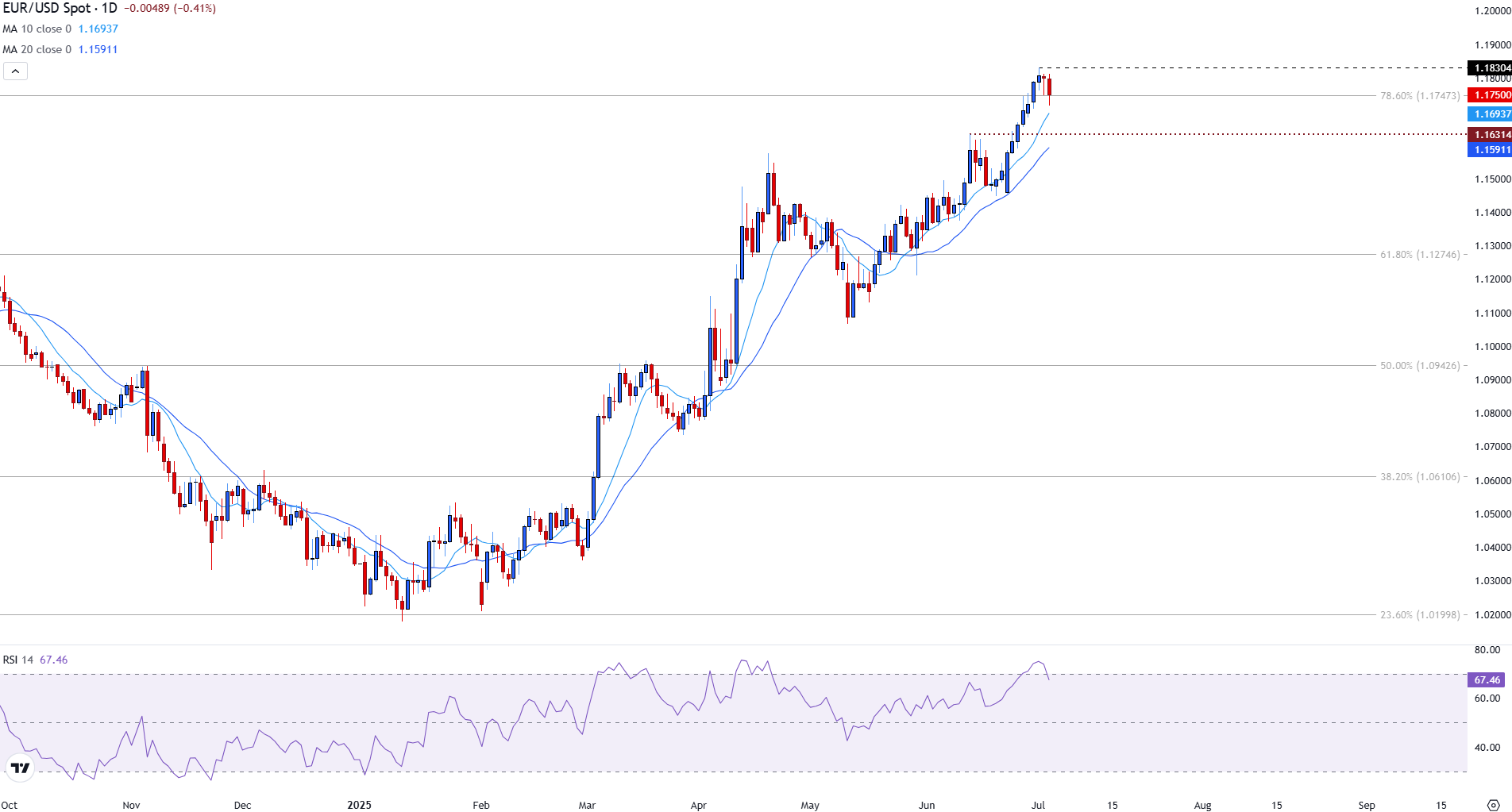
The Relative Strength Index (RSI) is currently near 68, just below overbought territory, indicating strong momentum but also suggesting the potential for a brief consolidation or dip.
In a bullish scenario, if the pair holds above the 1.1695 support level and regains upward traction, a retest and potential breakout above 1.1830 could follow.
Employment FAQs
Labor market conditions are a key element to assess the health of an economy and thus a key driver for currency valuation. High employment, or low unemployment, has positive implications for consumer spending and thus economic growth, boosting the value of the local currency. Moreover, a very tight labor market – a situation in which there is a shortage of workers to fill open positions – can also have implications on inflation levels and thus monetary policy as low labor supply and high demand leads to higher wages.
The pace at which salaries are growing in an economy is key for policymakers. High wage growth means that households have more money to spend, usually leading to price increases in consumer goods. In contrast to more volatile sources of inflation such as energy prices, wage growth is seen as a key component of underlying and persisting inflation as salary increases are unlikely to be undone. Central banks around the world pay close attention to wage growth data when deciding on monetary policy.
The weight that each central bank assigns to labor market conditions depends on its objectives. Some central banks explicitly have mandates related to the labor market beyond controlling inflation levels. The US Federal Reserve (Fed), for example, has the dual mandate of promoting maximum employment and stable prices. Meanwhile, the European Central Bank’s (ECB) sole mandate is to keep inflation under control. Still, and despite whatever mandates they have, labor market conditions are an important factor for policymakers given its significance as a gauge of the health of the economy and their direct relationship to inflation.
Author

Tammy Da Costa, CFTe®
FXStreet
Tammy is an economist and market analyst with a deep passion for financial markets, particularly commodities and geopolitics.