EUR/USD languishes near lows ahead of the US PCE Price Index release
- The Euro remains pinned near three-week lows, with upside attempts capped below 1.1690.
- Strong US GDP and jobless claims data eased concerns about the US economy and boosted the US Dollar.
- Investors will be looking at the US PCE Price Index report for more clues about the Fed's forward guidance.

EUR/USD is posting moderate gains on Friday, trading near 1.1675 at the time of writing on Friday from 1.1645 daily lows, but remains on track for a 0.55% weekly decline. In the United States (US), a batch of upbeat macroeconomic figures eased concerns about an economic downturn on Thursday, while in Europe, data have been uninspiring this week. To make matters worse, US President Donald Trump rattled markets with a new round of tariffs.
Data from the US Bureau of Economic Analysis revealed that the Gross Domestic Product (GDP) grew at a stronger pace than previously estimated in the second quarter. The good news came alongside a solid increase in Durable Goods Orders in August and an unexpected decline in US weekly Initial Jobless Claims, which prompted investors to scale back the Federal Reserve's (Fed) interest rate cut bets and provided a fresh boost to the US Dollar (USD).
Apart from that, President Trump announced new tariffs on heavy trucks, branded drugs, and kitchen cabinets, which resurfaced fears about global trade uncertainty and hammered risk appetite during the Asian session.
On Friday, the main focus is on the Personal Consumption Expenditures (PCE) Price Index for further clues about the Fed's next monetary policy decisions. The market is bracing for a moderate increase in headline PCE inflation. Anything below the 3% line is likely to keep hopes of Fed easing alive and allow for some recovery in risk appetite.
Euro Price Today
The table below shows the percentage change of Euro (EUR) against listed major currencies today. Euro was the strongest against the New Zealand Dollar.
| USD | EUR | GBP | JPY | CAD | AUD | NZD | CHF | |
|---|---|---|---|---|---|---|---|---|
| USD | -0.09% | -0.12% | -0.12% | 0.10% | 0.04% | 0.09% | -0.05% | |
| EUR | 0.09% | 0.00% | 0.07% | 0.24% | 0.20% | 0.25% | 0.06% | |
| GBP | 0.12% | -0.00% | 0.12% | 0.24% | 0.29% | 0.25% | 0.03% | |
| JPY | 0.12% | -0.07% | -0.12% | 0.16% | 0.11% | 0.17% | -0.09% | |
| CAD | -0.10% | -0.24% | -0.24% | -0.16% | -0.06% | 0.01% | -0.21% | |
| AUD | -0.04% | -0.20% | -0.29% | -0.11% | 0.06% | 0.04% | -0.17% | |
| NZD | -0.09% | -0.25% | -0.25% | -0.17% | -0.01% | -0.04% | -0.10% | |
| CHF | 0.05% | -0.06% | -0.03% | 0.09% | 0.21% | 0.17% | 0.10% |
The heat map shows percentage changes of major currencies against each other. The base currency is picked from the left column, while the quote currency is picked from the top row. For example, if you pick the Euro from the left column and move along the horizontal line to the US Dollar, the percentage change displayed in the box will represent EUR (base)/USD (quote).
Daily digest market movers: The USD appreciates following bright US data
- On Thursday, a raft of better-than-expected US economic data eased concerns about the country's soft momentum and endorsed the views of Fed hawks, who are calling for a slow monetary easing cycle. US Treasury yields stretched higher, and the US Dollar jumped. In this context, Euro rallies are expected to remain limited.
- The final US Q2 GDP was revised to a 3.8% annualized growth, up from the 3.3% reported in previous estimations. The upward revision was related to the strong performance of consumer spending, which, however, was partially offset by weaker export activity.
- At the same time, US weekly Initial Jobless Claims fell to 218K on the week ending September 20, their lowest level since late July, from the 232K claims reported in the previous week and against market expectations of a slight increase to 235K.
- Finally, the US Census Bureau reported that orders for durable goods manufactured in the US increased 2.9% in August, driven by a sharp increase in transportation. Durable Goods had been contracting for two consecutive months in June and July. They fell 2.7% in July and were expected to decline by another 0.5% in August.
- Investors trimmed bets of Fed easing following the data. The CME Fed Watch Tool shows an 87% chance of a rate cut in October, from above 90% earlier this week. The chances for a half-point rate cut in the two remaining meetings this year have dropped to 62% from nearly 80% last week.
- Early in the Asian session on Friday, US President Donald Trump brought trade tariffs back to the table, announcing 100% levies for branded medicines, 25% for heavy-duty trucks, and 50% on imports of kitchen cabinets. The decision triggered a wave of risk aversion, underpinning support for the safe-haven US Dollar.
- The highlight today is the US PCE Prices Index report, which will be analysed carefully for more clues about the Fed's next moves. Headline PCE inflation is expected to have edged up to a 2.7% yearly pace in August, from 2.6% in July, although the core inflation, more relevant for monetary policy purposes, is expected to have remained steady at 2.9%.
Technical Analysis: EUR/USD under pressure, with 1.1650 support holding bears
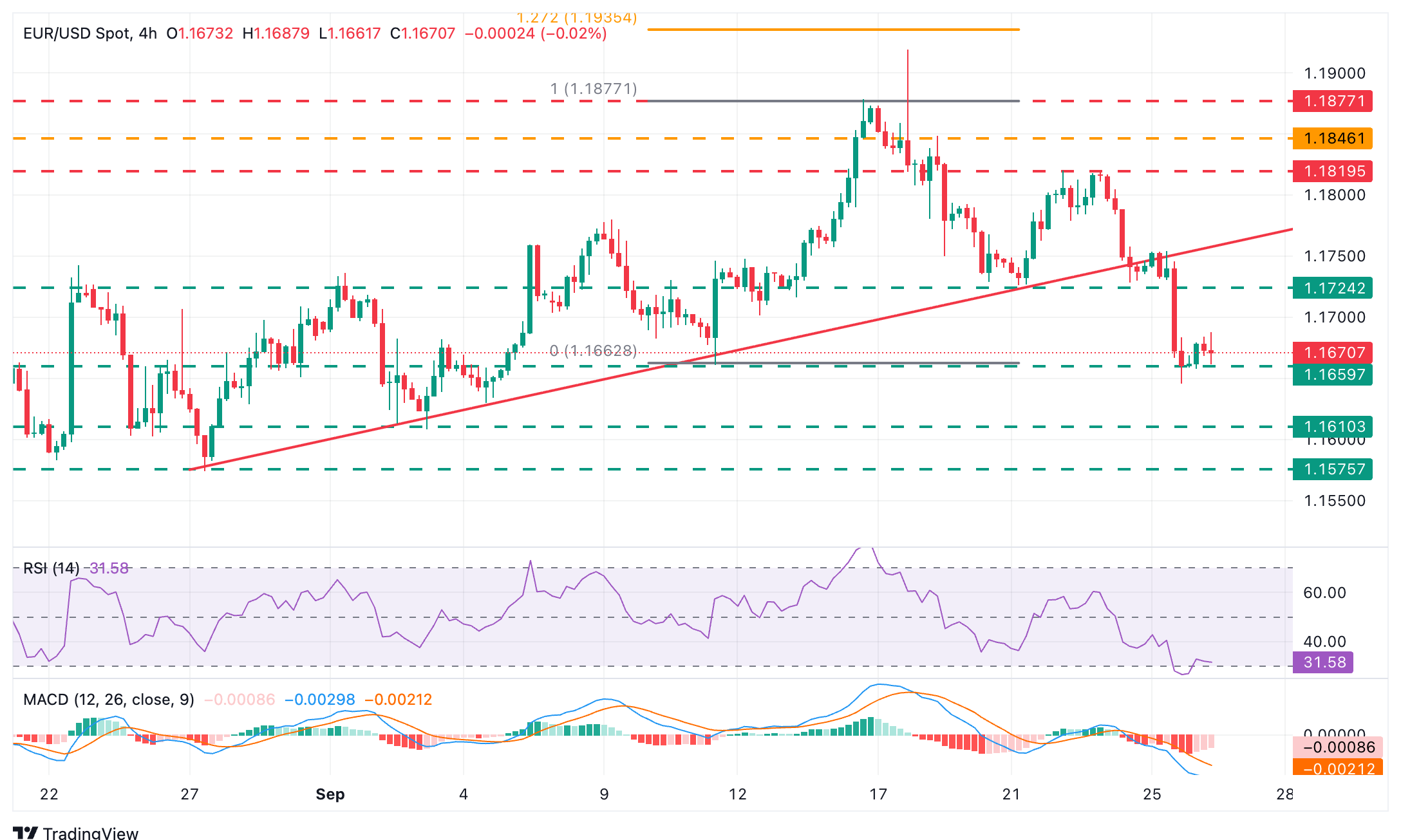
EUR/USD validated its bearish shift on Thursday after confirming the break of the trendline support. The pair is managing to trim some losses on Friday, but momentum indicators remain within bearish territory. Unless US PCE inflation data surprises on the soft side, the pair is likely to remain vulnerable.
Immediate support is located around 1.1650, which held the pair on Thursday and also on September 11. Further down, the September 2 and 3 lows, near 1.1610 and the August 27 low, at 1.1575, would be the next targets. To the upside, support at the September 19 and 20 lows, near 1.1725, is likely to act as resistance, ahead of the reverse trendline, now at 1.1755, and the September 24 and 25 highs, at 1.1820.
Economic Indicator
Personal Consumption Expenditures - Price Index (YoY)
The Personal Consumption Expenditures (PCE), released by the US Bureau of Economic Analysis on a monthly basis, measures the changes in the prices of goods and services purchased by consumers in the United States (US). The YoY reading compares prices in the reference month to a year earlier. Price changes may cause consumers to switch from buying one good to another and the PCE Deflator can account for such substitutions. This makes it the preferred measure of inflation for the Federal Reserve. Generally, a high reading is bullish for the US Dollar (USD), while a low reading is bearish.
Read more.Next release: Fri Sep 26, 2025 12:30
Frequency: Monthly
Consensus: 2.7%
Previous: 2.6%
Source: US Bureau of Economic Analysis
Economic Indicator
Core Personal Consumption Expenditures - Price Index (YoY)
The Core Personal Consumption Expenditures (PCE), released by the US Bureau of Economic Analysis on a monthly basis, measures the changes in the prices of goods and services purchased by consumers in the United States (US). The PCE Price Index is also the Federal Reserve’s (Fed) preferred gauge of inflation. The YoY reading compares the prices of goods in the reference month to the same month a year earlier. The core reading excludes the so-called more volatile food and energy components to give a more accurate measurement of price pressures." Generally, a high reading is bullish for the US Dollar (USD), while a low reading is bearish.
Read more.Next release: Fri Sep 26, 2025 12:30
Frequency: Monthly
Consensus: 2.9%
Previous: 2.9%
Source: US Bureau of Economic Analysis
After publishing the GDP report, the US Bureau of Economic Analysis releases the Personal Consumption Expenditures (PCE) Price Index data alongside the monthly changes in Personal Spending and Personal Income. FOMC policymakers use the annual Core PCE Price Index, which excludes volatile food and energy prices, as their primary gauge of inflation. A stronger-than-expected reading could help the USD outperform its rivals as it would hint at a possible hawkish shift in the Fed’s forward guidance and vice versa.
Author

Guillermo Alcala
FXStreet
Graduated in Communication Sciences at the Universidad del Pais Vasco and Universiteit van Amsterdam, Guillermo has been working as financial news editor and copywriter in diverse Forex-related firms, like FXStreet and Kantox.