EUR/USD rallies towards 1.1450 as trade turmoil hurts the Greenback
- EUR/USD climbs 0.68% as ISM data shows US manufacturing remains in contraction.
- Trump’s renewed tariff threats on China and metals drive investors away from the Greenback.
- EU’s Sefcovic to meet USTR Greer in Paris amid escalating transatlantic trade tensions.

EUR/USD edges up during the North American session to hit a six-week high of 1.1449, poised to stay above 1.1400 as the US Dollar drops to levels last seen in April as the “Sell America” trade continues. Arising trade tensions between the United States (US) and China, as well as the Eurozone (EU), prompted investors to favor the Greenback with the Euro posting gains of over 0.68%.
Recently, economic data in the US revealed that business activities in the manufacturing sector remained in contractionary territory, according to the Institute for Supply Management (ISM).
Last week, US President Donald Trump revealed that China had violated its agreement with Switzerland. Consequently, he threatens to impose 50% tariffs on aluminum and steel imports, effective on June 4, sparking a flight to safe-haven assets, except the US Dollar.
Beijing responded to Washington’s accusations as “groundless and threatened to respond with forceful measures.”
In other trade news, EU Trade Commissioner Sefcovic is to meet USTR Greer in Paris on Wednesday, according to a spokesperson.
The EU’s economic schedule featured the release of the HCOB Manufacturing Purchasing Managers Index (PMI) for May, with most readings coming mixed, with only Spain showing signs of expansion.
EUR/USD daily market movers: Euro extended rally past 1.1400, eyes on 1.1450
- ISM Manufacturing PMI edged down to 48.5 in May from 48.7, marking the lowest reading since November. The Prices Index remained in expansion at 69.4%, while the Employment Index continued in contraction, improving slightly from 46.5 to 46.8.
- S&P Global Manufacturing PMI stayed in expansion but slipped to 52.0 from 52.3 in April.
- Fed Governor Christopher Waller has shifted to a more dovish stance. He stated that rate cuts remain possible later this year but warned that policymakers are mainly focused on controlling inflation.
- Eurozone May’s HCOB Manufacturing PMI remained in recessionary territory, down at 49.4, though it’s the fifth straight monthly gain and the highest in almost three years. Germany’s Manufacturing PMI revised down to 48.3 from 48.8, underscoring continued weakness in the region’s largest economy.
- EUR/USD traders would have to digest a busy economic schedule in the upcoming week. In the EU, the docket will feature inflation figures, the European Central Bank (ECB) monetary policy, and ECB’s President Christine Lagarde’s press conference. In the US, investors are eyeing the release of Nonfarm Payroll figures, the ISM Services PMI, and the Federal Reserve’s (Fed) speakers.
- Financial market players had fully priced in the expectation that the ECB would reduce its Deposit Facility Rate by 25 basis points (bps) to 2% at the upcoming monetary policy meeting.
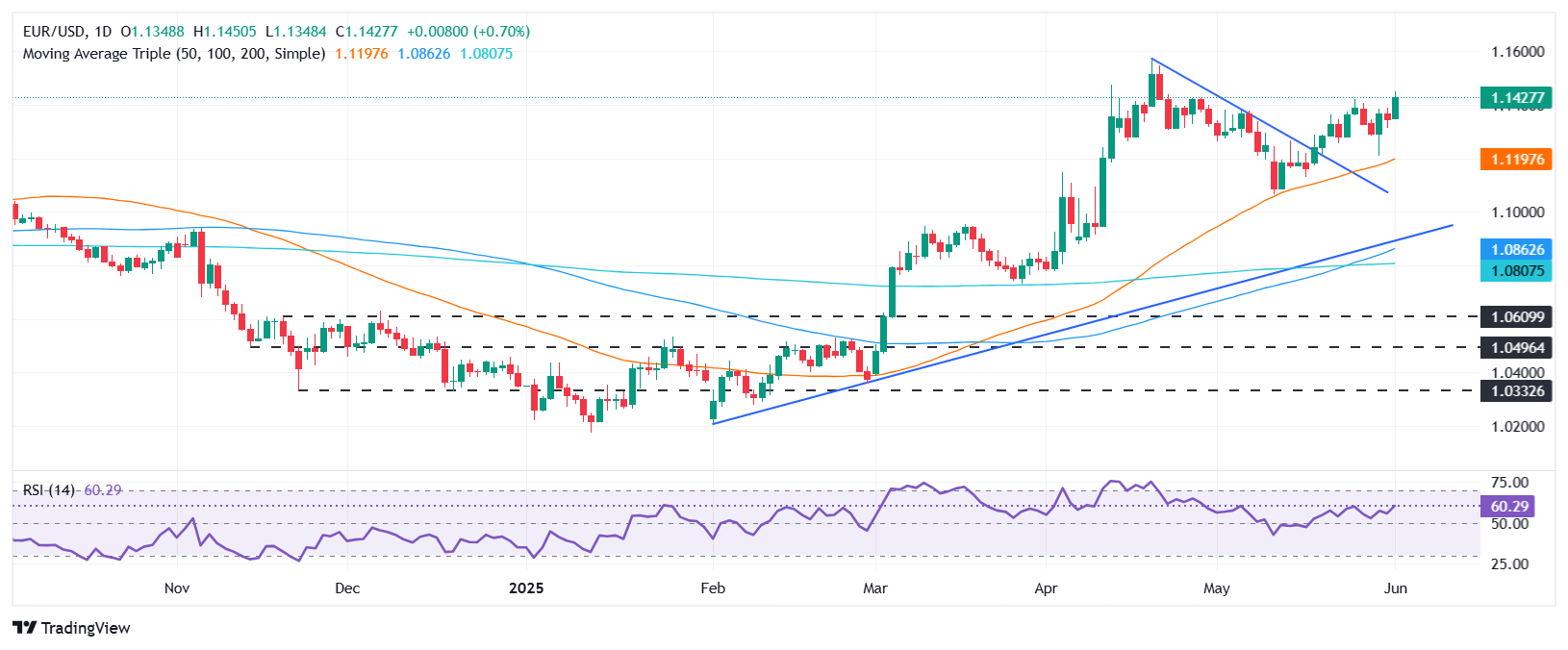
Euro technical outlook: EUR/USD surpasses key resistance levels, buyers target 1.1500
EUR/USD uptrend remains intact, as indicated by the daily chart; however, the trend appears overextended unless buyers reclaim higher prices. The Relative Strength Index (RSI) is bullish, indicating that buyers are in control. However, the ECB’s looming monetary policy decision, with expectations for a rate cut, could pave the way for a retracement.
If EUR/USD climbs past 1.1450, this could open the door to challenge the year-to-date (YTD) peak hit on April 21 at 1.1573. Instead, if the shared currency weakens and falls below 1.1400, the first support would be 1.1350. A breach of it, will expose 1.13 and the 20-day Simple Moving Average (SMA) at 1.1277.
Risk sentiment FAQs
In the world of financial jargon the two widely used terms “risk-on” and “risk off'' refer to the level of risk that investors are willing to stomach during the period referenced. In a “risk-on” market, investors are optimistic about the future and more willing to buy risky assets. In a “risk-off” market investors start to ‘play it safe’ because they are worried about the future, and therefore buy less risky assets that are more certain of bringing a return, even if it is relatively modest.
Typically, during periods of “risk-on”, stock markets will rise, most commodities – except Gold – will also gain in value, since they benefit from a positive growth outlook. The currencies of nations that are heavy commodity exporters strengthen because of increased demand, and Cryptocurrencies rise. In a “risk-off” market, Bonds go up – especially major government Bonds – Gold shines, and safe-haven currencies such as the Japanese Yen, Swiss Franc and US Dollar all benefit.
The Australian Dollar (AUD), the Canadian Dollar (CAD), the New Zealand Dollar (NZD) and minor FX like the Ruble (RUB) and the South African Rand (ZAR), all tend to rise in markets that are “risk-on”. This is because the economies of these currencies are heavily reliant on commodity exports for growth, and commodities tend to rise in price during risk-on periods. This is because investors foresee greater demand for raw materials in the future due to heightened economic activity.
The major currencies that tend to rise during periods of “risk-off” are the US Dollar (USD), the Japanese Yen (JPY) and the Swiss Franc (CHF). The US Dollar, because it is the world’s reserve currency, and because in times of crisis investors buy US government debt, which is seen as safe because the largest economy in the world is unlikely to default. The Yen, from increased demand for Japanese government bonds, because a high proportion are held by domestic investors who are unlikely to dump them – even in a crisis. The Swiss Franc, because strict Swiss banking laws offer investors enhanced capital protection.
Author

Christian Borjon Valencia
FXStreet
Markets analyst, news editor, and trading instructor with over 14 years of experience across FX, commodities, US equity indices, and global macro markets.