EUR/USD pares gains with US Industrial Production on focus
- The Euro retreated to 1.1585 after peaking at 1.1730 earlier in the day.
- Data from Eurostat revealed that inflation increased beyond expectations in September.
- The US Dollar remains depressed due to concerns of a Sino-US trade war and Fed easing expectations.

EUR/USD has given away daily gains and trades at 1.1685 ahead of the US session opening, on retreat from 1.1730 highs reached earlier on the day. The pair, however, remains on track to a 0.6% weekly gain against a softer US Dollar (USD) while the focus now turns to the release of the US Industrial Production report and a conference from St. Louis Fed President, Alberto Musalem, due later on the day.
The US Dollar (USD) is still facing serious headwinds from concerns about a Sino-US trade war and hopes of further Federal Reserve (Fed) interest rate cuts. Fed Governor Christopher Waller said on Thursday that he favours another interest rate cut in October, while Stephen Miran, Trump's recent pick to the board, reiterated the need for more aggressive cuts.
Eurozone data released on Friday has confirmed that consumer prices grew at a 0.1% monthly pace in September, unchanged from August, and the yearly inflation accelerated to a 2.2% pace from 2% in the previous month. The core HICP, however, has been revised up to a 2.4% year-on-year growth, the highest level since April, from previous estimations of a 2.3% inflation.
These figures back comments by ECB officials Wunsch and Kocher, who suggested on Thursday that the European Central Bank might be at the end of its rate-cutting cycle, or very close to it.
Euro Price Today
The table below shows the percentage change of Euro (EUR) against listed major currencies today. Euro was the strongest against the US Dollar.
| USD | EUR | GBP | JPY | CAD | AUD | NZD | CHF | |
|---|---|---|---|---|---|---|---|---|
| USD | 0.00% | -0.01% | -0.15% | -0.14% | -0.06% | -0.13% | -0.20% | |
| EUR | -0.01% | -0.03% | -0.14% | -0.12% | -0.08% | -0.15% | -0.20% | |
| GBP | 0.00% | 0.03% | -0.14% | -0.14% | -0.05% | -0.12% | -0.18% | |
| JPY | 0.15% | 0.14% | 0.14% | -0.01% | 0.07% | -0.01% | -0.06% | |
| CAD | 0.14% | 0.12% | 0.14% | 0.00% | 0.07% | 0.03% | -0.04% | |
| AUD | 0.06% | 0.08% | 0.05% | -0.07% | -0.07% | -0.07% | -0.13% | |
| NZD | 0.13% | 0.15% | 0.12% | 0.00% | -0.03% | 0.07% | -0.06% | |
| CHF | 0.20% | 0.20% | 0.18% | 0.06% | 0.04% | 0.13% | 0.06% |
The heat map shows percentage changes of major currencies against each other. The base currency is picked from the left column, while the quote currency is picked from the top row. For example, if you pick the Euro from the left column and move along the horizontal line to the US Dollar, the percentage change displayed in the box will represent EUR (base)/USD (quote).
Daily digest market movers: Trade tensions, Fed cut hopes, and US shutdown hit the US Dollar
- The US Dollar is on track for its worst week in months, weighed by a combination of simmering trade tensions between the US and China, increasing signals that the Federal Reserve will cut rates several times over the coming months, and the lack of progress on government funding, which suggests that the US shutdown will drag out long.
- The Fed's Beige book added pressure on the US Dollar earlier this week, warning about an economic slowdown as consumer spending starts to show signs of weakening and the labour market has stalled, with businesses concerned about the uncertain economic scenario and the impact of higher tariffs.
- On Thursday, European Central Bank (ECB) Governor Pierre Wunsch said that probabilities for a further rate cut are receding, while Governor Martin Kocher affirmed that the central bank is " at the end of the rate-cutting cycle or very close to it".
- In France, Prime Minister Sébastien Lecornu survived two no-confidence votes on Thursday, which eased some concerns about the country's uncertain political scenario and provided additional support to the Euro. Nevertheless, he still faces the challenge of passing a tightening budget through a divided parliament before the year's end.
Technical Analysis: EUR/USD hit the Double Bottom's target, at 1.1730
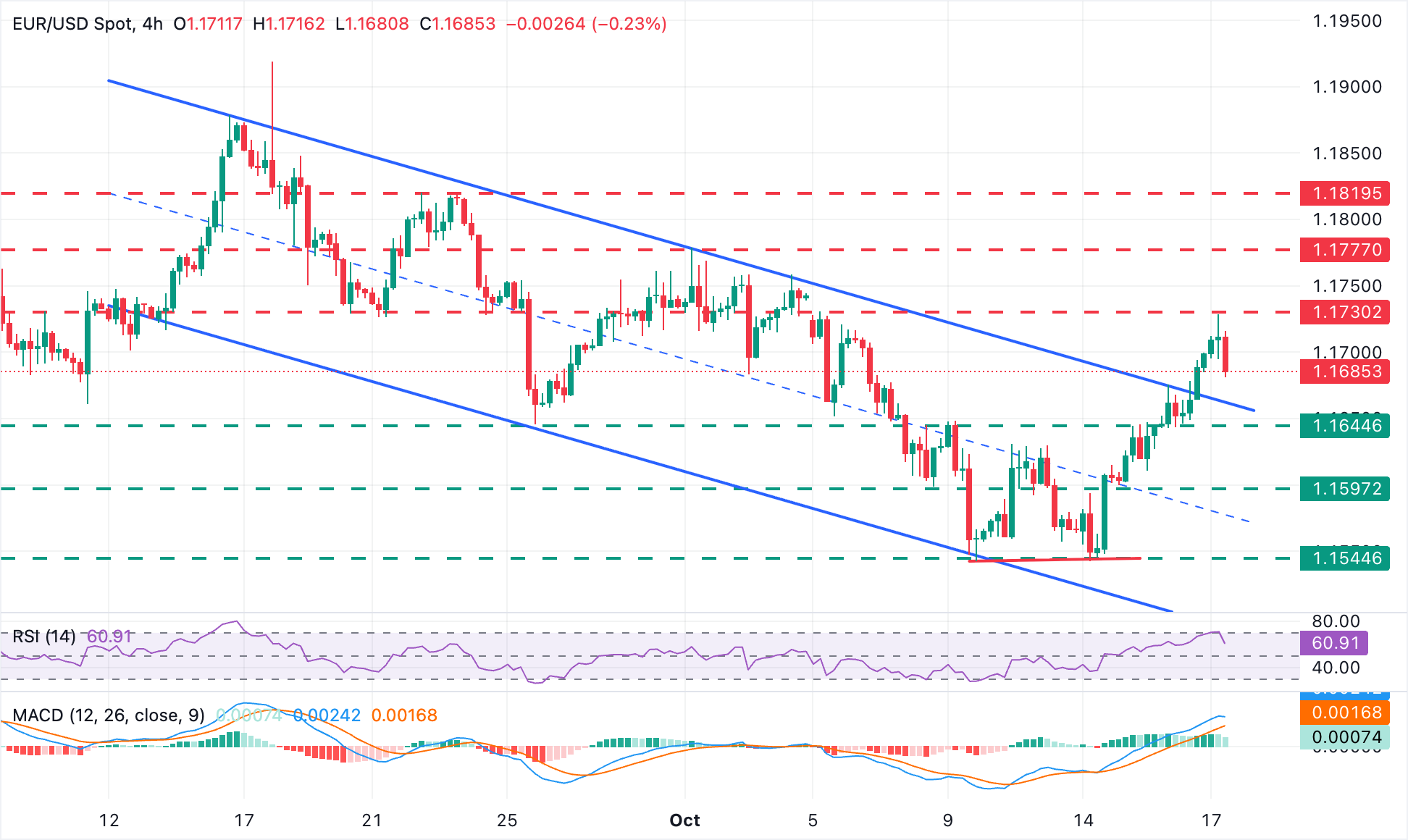
EUR/USD pulled lower earlier on Friday, after reaching the target of a Double Bottom pattern at 1.1730. The pair is still on track for its best weekly performance in months, but the 4-hour Relative Strength Index (RSI) has reached overbought levels, before trimming gains on profit-taking.
Intraday lows are right above 1.1690, although a potential correction might pull price action to confirm support at the reverse trendline, now around 1.1665. Below, Thursday's low, near 1.1640, the round 1.1600 level, and the October 14 low in the area of 1.1545 would emerge as the next support levels.
A confirmation beyond daily highs at 1.1730, on the contrary, would clear the path towards the October 1 high, near 1.1780. Further up, the next target would be the September 23 highs, at 1.1820.
Economic Indicator
Industrial Production (MoM)
The Industrial Production released by the Board of Governors of the Federal Reserve shows the volume of production of US industries such as factories and manufacturing. Up trend is regarded as inflationary which may anticipate interest rates to rise. If High industrial production growth comes out, this may generate a positive sentiment (or bullish) for the USD.
Read more.Next release: Fri Oct 17, 2025 13:15
Frequency: Monthly
Consensus: 0.1%
Previous: 0.1%
Source: Federal Reserve
Economic Indicator
Fed's Musalem speech
Alberto G. Musalem is the President and CEO of the Federal Reserve Bank of St. Louis since April 2, 2024. Musalem – with almost three decades of public and private sector experience in economic policy, finance and markets – represents the Eighth Federal Reserve District in national monetary policymaking on the Federal Open Market Committee (FOMC). Musalem rotates with other regional Reserve bank presidents as a voting member on the FOMC.
Read more.Next release: Fri Oct 17, 2025 16:25
Frequency: Irregular
Consensus: -
Previous: -
Author

Guillermo Alcala
FXStreet
Graduated in Communication Sciences at the Universidad del Pais Vasco and Universiteit van Amsterdam, Guillermo has been working as financial news editor and copywriter in diverse Forex-related firms, like FXStreet and Kantox.