EUR/USD wavers near highs with US PMIs, Fed Powell on the spotlight
- The Euro treads water near 1.1800, with downside attempts contained at 1.1785.
- Eurozone's manufacturing sector contracted unexpectedly in September while services activity accelerated.
- Later on the day, the US preliminary PMIs and Fed's Powell will provide fundamental guidance to the USD.

EUR/USD has been trying to return above the 1.1800 level for most of the European trading session. The pair is trading at1.1795 ar the time of writing, up from 1.1785 lows earlier on the day. Mixed business activity data in the Eurozone has provided some support to the Euro yet with traders cautious, awaiting the release of US preliminary Purchasing Managers Index (PMI) figures, and Fed Chairman Jerome Powell's speech.
Eurozone's preliminary PMIs revealed that manufacturing activity contracted against expectations in September, while the services sector accelerated beyond forecasts. Data from Germany showed a similar performance, with the manufacturing sector's reversal offset by a strong performance in services, while in France, both the manufacturing and services sectors contracted, increasing concerns about the region's second-largest economy.
The Focus is now on the US Flash PMIs, which will be the main data points until Friday's Personal Consumption Expenditures (PCE) Price Index release. Markets will want to test the resilience of the US economy to the higher trade tariffs ahead of a speech from Fed's Powell, which might give further insight into the bank's forward guidance.
Euro Price Today
The table below shows the percentage change of Euro (EUR) against listed major currencies today. Euro was the strongest against the Canadian Dollar.
| USD | EUR | GBP | JPY | CAD | AUD | NZD | CHF | |
|---|---|---|---|---|---|---|---|---|
| USD | 0.09% | -0.07% | 0.00% | 0.09% | -0.13% | 0.00% | -0.08% | |
| EUR | -0.09% | -0.02% | -0.09% | 0.05% | -0.14% | -0.03% | -0.12% | |
| GBP | 0.07% | 0.02% | 0.00% | 0.08% | -0.12% | -0.01% | -0.09% | |
| JPY | 0.00% | 0.09% | 0.00% | 0.07% | -0.10% | -0.00% | 0.00% | |
| CAD | -0.09% | -0.05% | -0.08% | -0.07% | -0.21% | -0.08% | -0.17% | |
| AUD | 0.13% | 0.14% | 0.12% | 0.10% | 0.21% | 0.11% | 0.11% | |
| NZD | -0.00% | 0.03% | 0.00% | 0.00% | 0.08% | -0.11% | -0.08% | |
| CHF | 0.08% | 0.12% | 0.09% | -0.00% | 0.17% | -0.11% | 0.08% |
The heat map shows percentage changes of major currencies against each other. The base currency is picked from the left column, while the quote currency is picked from the top row. For example, if you pick the Euro from the left column and move along the horizontal line to the US Dollar, the percentage change displayed in the box will represent EUR (base)/USD (quote).
Daily digest market movers: Eurozone PMIs provide mild support to the Euro
- Eurozone's preliminary business activity figures have been mixed. The Services PMI improved to 51.4 against expectations of a steady 50.5 reading, while the manufacturing index fell to 49.5 from 50.7 instead of improving to 50.9 as market analysts had forecasted.
- Likewise, German Manufacturing PMI fell to 48.5 from 498 against expectations of an improvement to the 50.0 level. Services activity, on the other hand, accelerated to 52.5 from 49.3, beating expectations of a weaker improvement, to 49.5.
- In France, the Manufacturing PMI has dropped to a three-month low of 48.1, from 50.4 in August, well below the 50.2 anticipated by the market's consensus, while the services sector's activity accelerated its contraction, to 48.9 from 49.8 in the previous month, well below the 49.6 reading expected by the market.
- In the US, at 13:45 GMT, the Flash Manufacturing S&P Global Manufacturing PMI is seen down to 52 in September from 53 in August, and the Services Index easing to 53.9 from last month's 54.5 reading.
- The US Dollar lost ground on Monday, as a slew of Fed officials provided a range of monetary policy views. Governor Stephen Miran, recently appointed by US President Donald Trump, offered the most dovish one, stating that interest rates should be close to 2% as changes in immigration, lower taxes, and the revenue from trade tariffs will drive down underlying interest rates, making current monetary policy too restrictive.
- On the other side of the spectrum, St. Louis and Cleveland Fed Presidents, Alberto Mussalem and Beth Hammack, showed ongoing concerns about inflation and remained more cautious about further interest rate cuts. The US Dollar, however, maintained its bearish tone against its main peers.
Technical Analysis: EUR/USD bulls have found resistance at the 1.1800 area
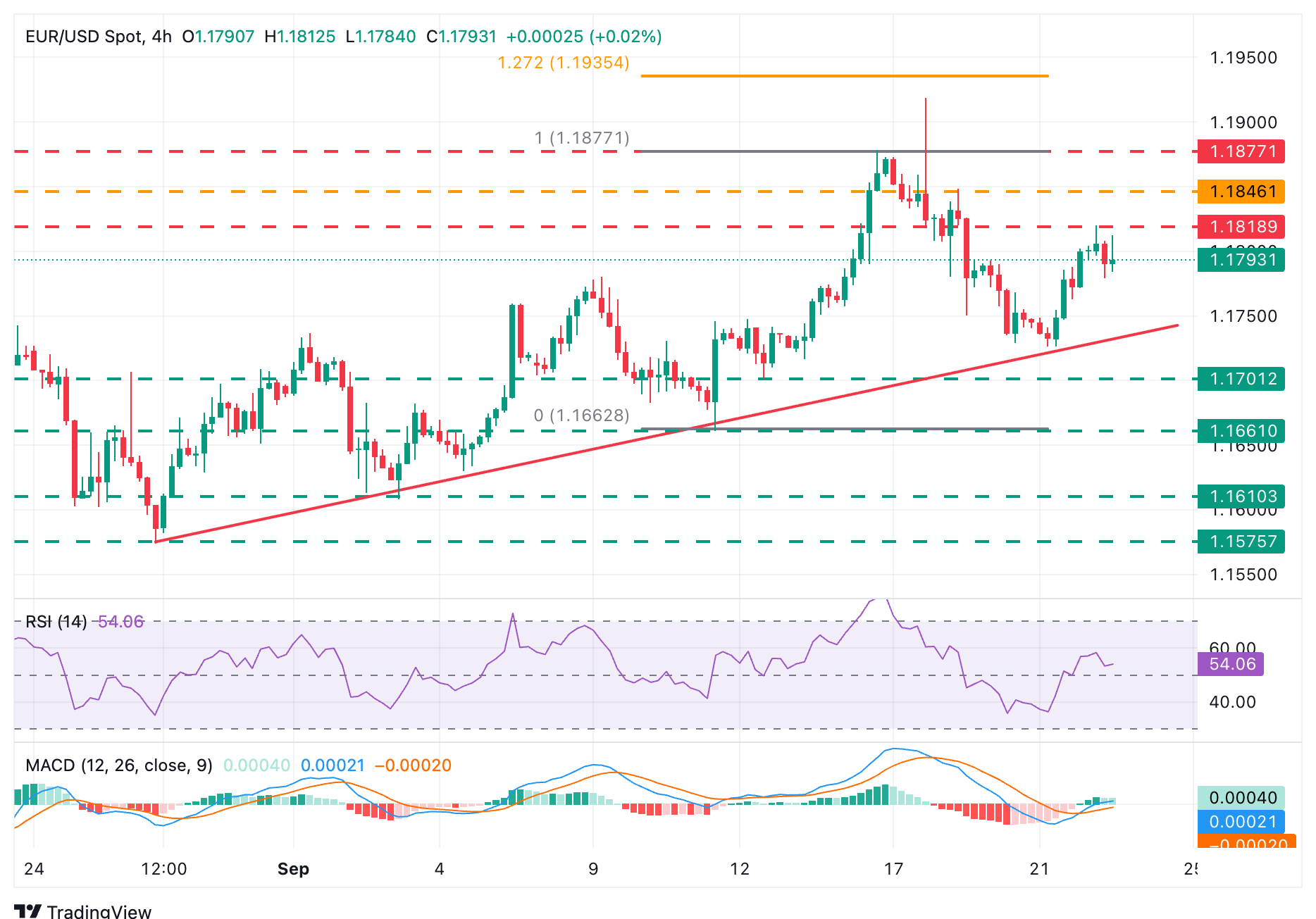
EUR/USD's rebound from the 1.1725 area on Monday has been capped at the 1.1800 area, with investors wary of risk ahead of business activity figures from Europe and the US, as well as Fed Powell's speech. Technical indicators suggest that the pair's recovery has lost momentum, although the Relative Strength Index (RSI) remains within positive territory above the 50 level.
Immediate support lies at the trendline from the September 2 lows, now in the area of 1.1730. A confirmation below here would increase bearish pressure towards the September 12 and 11 lows at the 1.1700 area and 1.1660, respectively. To the upside, the intra-day high, at 1.1820, and the September 18 high, near 1.1850, are likely to challenge a potential bullish reaction ahead of the September 16 high at 1.1878.
Economic Indicator
S&P Global Manufacturing PMI
The S&P Global Manufacturing Purchasing Managers Index (PMI), released on a monthly basis, is a leading indicator gauging business activity in the US manufacturing sector. The data is derived from surveys of senior executives at private-sector companies from the manufacturing sector. Survey responses reflect the change, if any, in the current month compared to the previous month and can anticipate changing trends in official data series such as Gross Domestic Product (GDP), industrial production, employment and inflation. A reading above 50 indicates that the manufacturing economy is generally expanding, a bullish sign for the US Dollar (USD). Meanwhile, a reading below 50 signals that activity in the manufacturing sector is generally declining, which is seen as bearish for USD.
Read more.Next release: Tue Sep 23, 2025 13:45 (Prel)
Frequency: Monthly
Consensus: 52
Previous: 53
Source: S&P Global
Economic Indicator
S&P Global Services PMI
The S&P Global Services Purchasing Managers Index (PMI), released on a monthly basis, is a leading indicator gauging business activity in the US services sector. As the services sector dominates a large part of the economy, the Services PMI is an important indicator gauging the state of overall economic conditions. The data is derived from surveys of senior executives at private-sector companies from the services sector. Survey responses reflect the change, if any, in the current month compared to the previous month and can anticipate changing trends in official data series such as Gross Domestic Product (GDP), industrial production, employment and inflation. A reading above 50 indicates that the services economy is generally expanding, a bullish sign for the US Dollar (USD). Meanwhile, a reading below 50 signals that activity among service providers is generally declining, which is seen as bearish for USD.
Read more.Next release: Tue Sep 23, 2025 13:45 (Prel)
Frequency: Monthly
Consensus: 53.9
Previous: 54.5
Source: S&P Global
Author

Guillermo Alcala
FXStreet
Graduated in Communication Sciences at the Universidad del Pais Vasco and Universiteit van Amsterdam, Guillermo has been working as financial news editor and copywriter in diverse Forex-related firms, like FXStreet and Kantox.