EUR/USD Price Forecast: Retakes 1.0800 mark; seems vulnerable while below 23.6% Fibo.
- EUR/USD stages a modest recovery from over a two-week low touched the previous day.
- The technical setup seems tilted in favor of bears and supports prospects for deeper losses.
- A sustained move beyond the overnight swing high is needed to negate the negative bias.

The EUR/USD pair attracts some buyers during the Asian session on Tuesday and for now, seems to have snapped a four-day losing streak to over a two-week low, around the 1.0770 area touched the previous day. Spot prices reclaim the 1.0800 mark amid subdued US Dollar (USD) price action, though the uptick lacks bullish conviction.
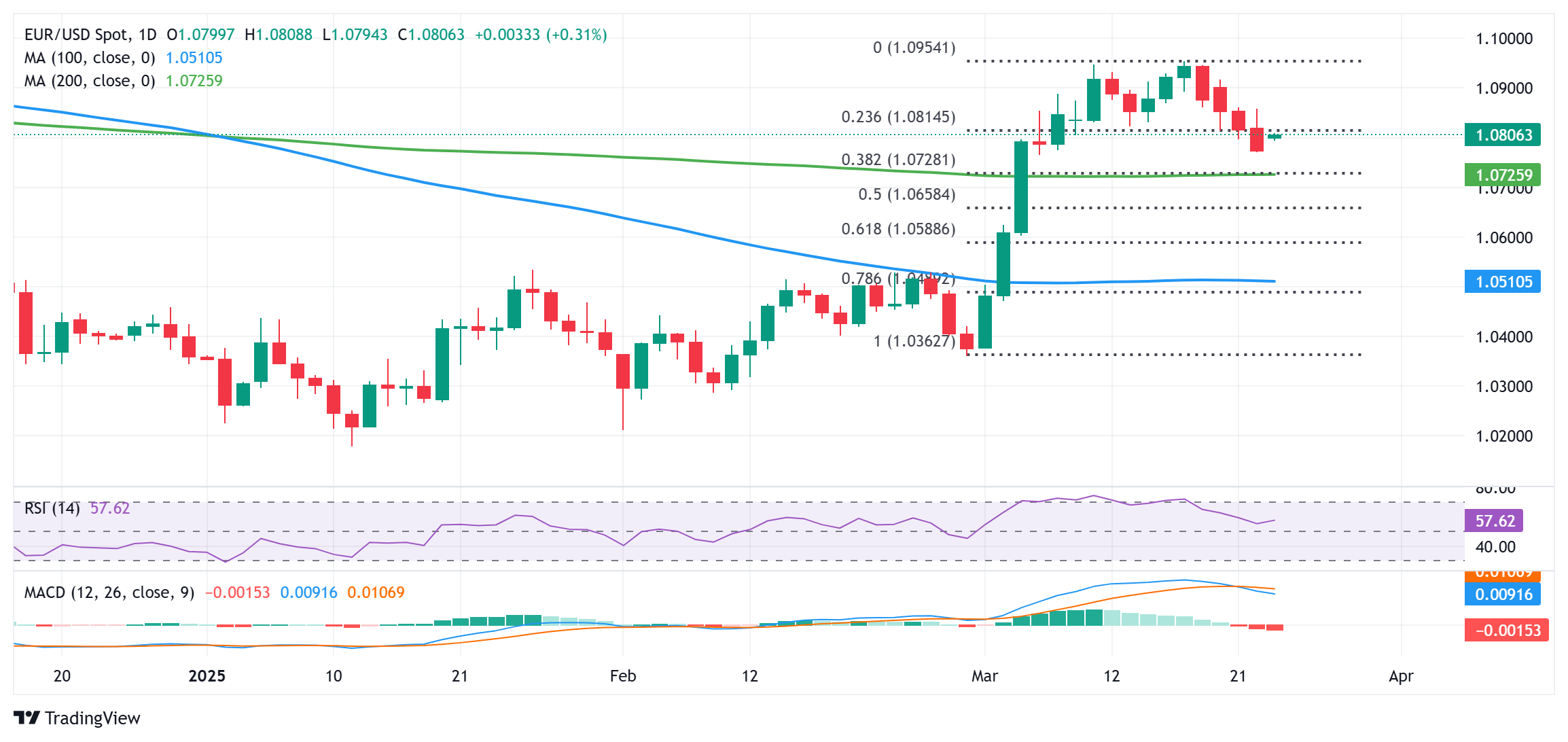
From a technical perspective, the overnight breakdown and close below the 23.6% Fibonacci retracement level of the recent move up from the late February low was seen as a key trigger for bearish traders. This, in turn, supports prospects for an extension of the recent pullback from the year-to-date top touched earlier this week and a further downfall toward the 1.0725 confluence. The latter comprises the 38.2% Fibo. level and the very important 200-day Simple Moving Average (SMA), which, in turn, should act as a strong base for the EUR/USD pair amid mixed oscillators on the daily chart.
A convincing break below, however, will suggest that spot prices have topped out near the 1.0955 region and pave the way for deeper losses. The subsequent downfall could drag the EUR/USD pair below the 1.0700 round figure, towards the next relevant support near the 1.0655 area (50% Fibo.) en route to the sub-1.0600 levels, or the 61.8% Fibo. Some follow-through selling might then shift the bias in favor of bearish traders and expose the 100-day SMA, around the 1.0500 psychological mark, which also nears the 78.6% Fibo. level.
On the flip side, the overnight swing high, around the 1.0855 region, now seems to act as an immediate hurdle, above which a bout of a short-covering move could allow the EUR/USD pair to reclaim the 1.0900 round figure. The momentum could extend further towards retesting the multi-month peak, around the 1.0955 region, before spot prices eventually climb to the 1.1000 psychological mark for the first time since early October 2024.
EUR/USD daily chart
Euro FAQs
The Euro is the currency for the 19 European Union countries that belong to the Eurozone. It is the second most heavily traded currency in the world behind the US Dollar. In 2022, it accounted for 31% of all foreign exchange transactions, with an average daily turnover of over $2.2 trillion a day. EUR/USD is the most heavily traded currency pair in the world, accounting for an estimated 30% off all transactions, followed by EUR/JPY (4%), EUR/GBP (3%) and EUR/AUD (2%).
The European Central Bank (ECB) in Frankfurt, Germany, is the reserve bank for the Eurozone. The ECB sets interest rates and manages monetary policy. The ECB’s primary mandate is to maintain price stability, which means either controlling inflation or stimulating growth. Its primary tool is the raising or lowering of interest rates. Relatively high interest rates – or the expectation of higher rates – will usually benefit the Euro and vice versa. The ECB Governing Council makes monetary policy decisions at meetings held eight times a year. Decisions are made by heads of the Eurozone national banks and six permanent members, including the President of the ECB, Christine Lagarde.
Eurozone inflation data, measured by the Harmonized Index of Consumer Prices (HICP), is an important econometric for the Euro. If inflation rises more than expected, especially if above the ECB’s 2% target, it obliges the ECB to raise interest rates to bring it back under control. Relatively high interest rates compared to its counterparts will usually benefit the Euro, as it makes the region more attractive as a place for global investors to park their money.
Data releases gauge the health of the economy and can impact on the Euro. Indicators such as GDP, Manufacturing and Services PMIs, employment, and consumer sentiment surveys can all influence the direction of the single currency. A strong economy is good for the Euro. Not only does it attract more foreign investment but it may encourage the ECB to put up interest rates, which will directly strengthen the Euro. Otherwise, if economic data is weak, the Euro is likely to fall. Economic data for the four largest economies in the euro area (Germany, France, Italy and Spain) are especially significant, as they account for 75% of the Eurozone’s economy.
Another significant data release for the Euro is the Trade Balance. This indicator measures the difference between what a country earns from its exports and what it spends on imports over a given period. If a country produces highly sought after exports then its currency will gain in value purely from the extra demand created from foreign buyers seeking to purchase these goods. Therefore, a positive net Trade Balance strengthens a currency and vice versa for a negative balance.
BRANDED CONTENT
Finding the right broker for trading EUR/USD is crucial, and we've identified the top choices for this major currency pair. Read about their unique features to make an informed decision.
Author

Haresh Menghani
FXStreet
Haresh Menghani is a detail-oriented professional with 10+ years of extensive experience in analysing the global financial markets.