EUR/USD Price Forecast: Holds retracement near 1.1600 from immediate highs
- EUR/USD trades almost flat around 1.1600 after correcting from the two-week high of 1.1656.
- The US Dollar struggles to attract more bids as the US NFP takes centre stage.
- Traders lose confidence that the Fed will cut interest rates in December.

The EUR/USD pair trades calmly near 1.1600 during the late Asian trading session on Tuesday, following the corrective move from an over two-week high of 1.1656. The major currency pair strives to regain strength as the US Dollar (USD) struggles to extend two-day recovery move, with investors turning cautious ahead of the United States (US) Nonfarm Payrolls (NFP) data for September, releasing on Thursday.
At the time of writing, the US Dollar Index (DXY), which tracks the Greenback’s value against six major currencies, trades marginally lower to near 99.45 The USD Index rebounded in last two trading days on receding expectations that the Federal Reserve (Fed) will cut interest rates again this year.
According to the CME FedWatch tool, the probability of the Fed cutting interest rates by 25 basis points (bps) to 3.50%-3.75% in the December meeting has diminished to 43% from 62.4% seen a week ago.
In the Eurozone, a majority of European Central Bank (ECB) officials have been expressing that interest rates should remain where they are as risks to inflation and economic growth are balanced.
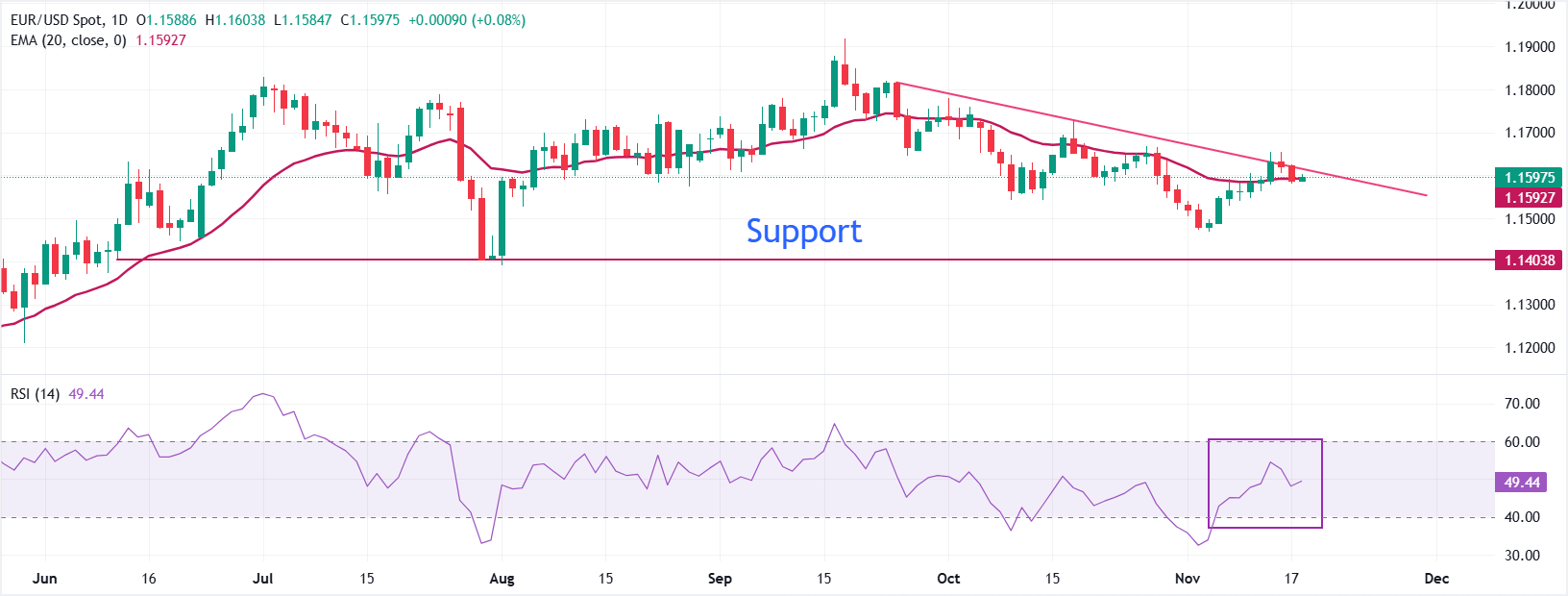
EUR/USD continues to face selling pressure near the downward-sloping trendline plotted from the September 22 high of 1.1818. The major currency pair corrects to near the 20-day Exponential Moving Average (EMA), which is around 88.70.
The 14-day Relative Strength Index (RSI) wobbles inside the 40.00-60.00 range, indicating a sideways trend.
Looking down, the August low around 1.1400 and the June low of 1.1347 will be key support zones for the pair in case the pair slides below the October 9 low of 1.1542.
On the upside, the pair could rise towards the round-level figure of 1.1700 and the October 17 high of 1.1728 if its breaks above the two-week high of 1.1656.
EUR/USD daily chart
Economic Indicator
Nonfarm Payrolls
The Nonfarm Payrolls release presents the number of new jobs created in the US during the previous month in all non-agricultural businesses; it is released by the US Bureau of Labor Statistics (BLS). The monthly changes in payrolls can be extremely volatile. The number is also subject to strong reviews, which can also trigger volatility in the Forex board. Generally speaking, a high reading is seen as bullish for the US Dollar (USD), while a low reading is seen as bearish, although previous months' reviews and the Unemployment Rate are as relevant as the headline figure. The market's reaction, therefore, depends on how the market assesses all the data contained in the BLS report as a whole.
Read more.Next release: Thu Nov 20, 2025 13:30
Frequency: Monthly
Consensus: 50K
Previous: 22K
Source: US Bureau of Labor Statistics
America’s monthly jobs report is considered the most important economic indicator for forex traders. Released on the first Friday following the reported month, the change in the number of positions is closely correlated with the overall performance of the economy and is monitored by policymakers. Full employment is one of the Federal Reserve’s mandates and it considers developments in the labor market when setting its policies, thus impacting currencies. Despite several leading indicators shaping estimates, Nonfarm Payrolls tend to surprise markets and trigger substantial volatility. Actual figures beating the consensus tend to be USD bullish.
Author

Sagar Dua
FXStreet
Sagar Dua is associated with the financial markets from his college days. Along with pursuing post-graduation in Commerce in 2014, he started his markets training with chart analysis.