|

EUR/USD Price Analysis: Hovers near 1.0780 followed by 23.6% Fibonacci retracement

  • EUR/USD extends gains towards the psychological barrier of 1.0800.
  • Technical analysis indicates a potential confirmation of bearish momentum for the pair.
  • The key support appears around March’s low of 1.0767 and the major level of 1.0750.

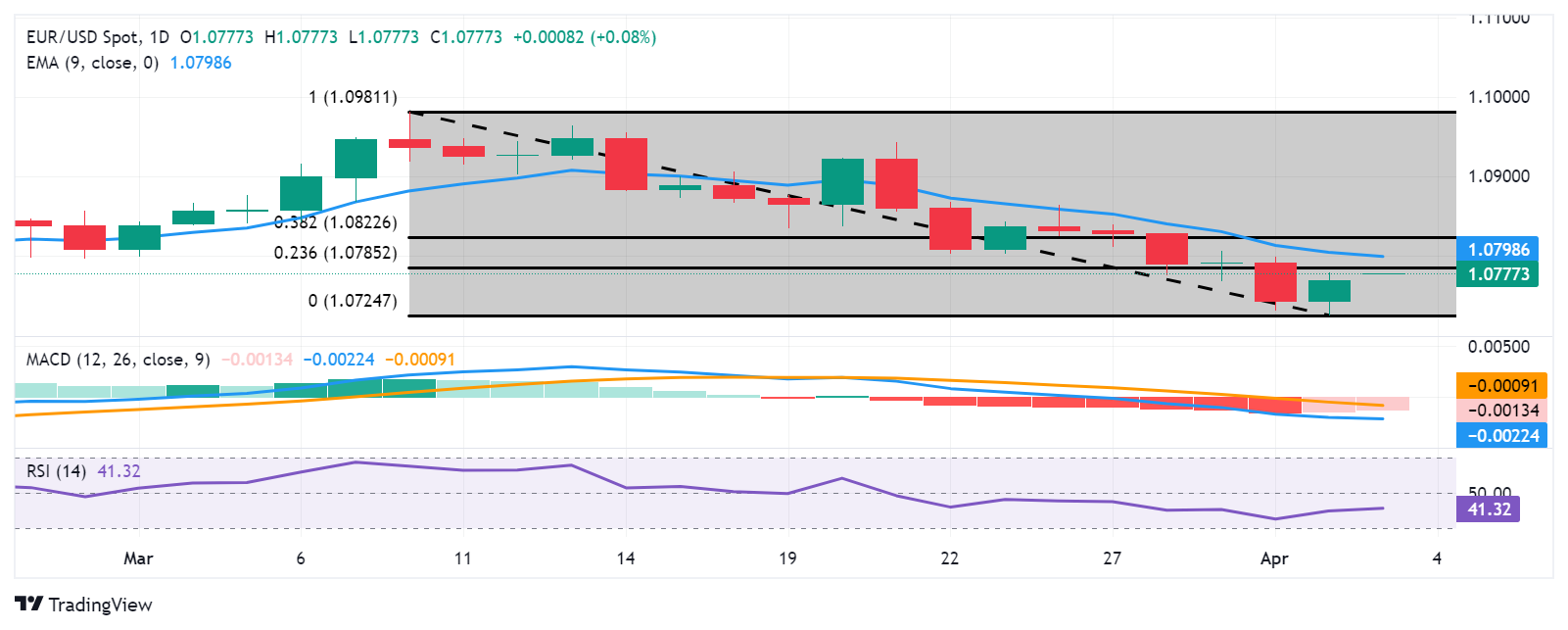
EUR/USD continues its winning streak for the second consecutive session on Wednesday, inching higher to near 1.0780 during the Asian hours. The immediate resistance appears at the 23.6% Fibonacci retracement level of 1.0785.

A breakthrough above this level could exert upward support for the EUR/USD pair to explore the region around the nine-day Exponential Moving Average (EMA) at 1.0798, aligned with the psychological resistance of 1.0800. Further resistance lies at the major level of 1.0850, following the psychological resistance at 1.0900.

Technical analysis suggests a bearish sentiment for the EUR/USD pair. The 14-day Relative Strength Index (RSI) is positioned below the 50 mark, indicating weakness in buying momentum. Additionally, the Moving Average Convergence Divergence (MACD) shows a divergence below the signal line and remains below the centerline. Although a lagging indicator, this alignment indicates a confirmation of the bearish momentum for the EUR/USD pair.

On the downside, immediate support appears at March’s low of 1.0767, followed by the major support at 1.0750. A break below this level could lead the EUR/USD pair to revisit the weekly low of 1.0724, followed by psychological support at the 1.0700 level.

EUR/USD: Daily Chart
Author

Akhtar Faruqui

Akhtar Faruqui is a Forex Analyst based in New Delhi, India. With a keen eye for market trends and a passion for dissecting complex financial dynamics, he is dedicated to delivering accurate and insightful Forex news and analysis.


More from Akhtar Faruqui
Share:

Editor's Picks

AUD/USD sits at two-month lows near 0.6950 after Australian CPI data

AUD/USD is sitting at two-month lows near 0.6950 in the Asian session on Wednesday, as below-expectations August Australian underlying CPI data pours cold water on expectations for further RBA interest rate hikes. Chinese PMI data also fail to inspire the Australian Dollar, despite a pause in the US Dollar advance.

USD/JPY stays weak below 157.00 amid Japanese intervention risks

USD/JPY keeps losses below 157.00 in the Asian session on Wednesday, as hawkish BoJ expectations, along with intervention risks, underpin the Japanese Yen, countering dismal domestic factory output and retail sales data. Meanwhile, a broad US Dollar retreat also collaborates to the pair's downside.

Gold flat lines below $4,200, ahead of US inflation data

Gold extends its consolidative price move in the European session, trading near the $4,200 mark. Falling US bond yields drag the US Dollar away from the two-month high, touched on Tuesday, and act as a tailwind for the commodity. However, hawkish US Federal Reserve expectations cap the upside as traders await important US macro data before placing fresh directional bets on the non-yielding bullion.

Crypto Today: Bitcoin holds $83K as Ethereum remains below $2,700 and XRP consolidates

Bitcoin trades lethargically on Wednesday, with bulls battling to defend the immediate $83,000 level as immediate support. Ethereum trades in tandem with Bitcoin, holding below key levels of $2,700 on the upside and $2,600 on the downside. Ripple, meanwhile, hovers near $1.50,

Germany annual CPI inflation rises to 3.3% in September

Inflation in Germany, as measured by the change in the Consumer Price Index, climbed to 3.3% (preliminary) in September from 2.9% in August, Germany's Destatis reported on Wednesday.

Silver is more volatile than Gold ahead of PCE and NFP. This chart shows the positioning gap
The market’s attention is focused on American data this week, but there’s something only those with a trained eye may be looking at: Gold and Silver positioning gap. Financial markets are moving on fears, mostly related to persistently high energy prices driven by the Middle East war. Sure, the US Dollar (USD) is strong, but at what cost?