|

EUR/USD Price Analysis: Euro steadies near 1.1300 with bullish bias intact

  • EUR/USD trades around the 1.1300 zone after modest gains in Tuesday’s post-European session.
  • Bullish structure holds, though short-term indicators point to mixed momentum.
  • Key support levels cluster just below, while trend-based indicators continue to favor buyers.

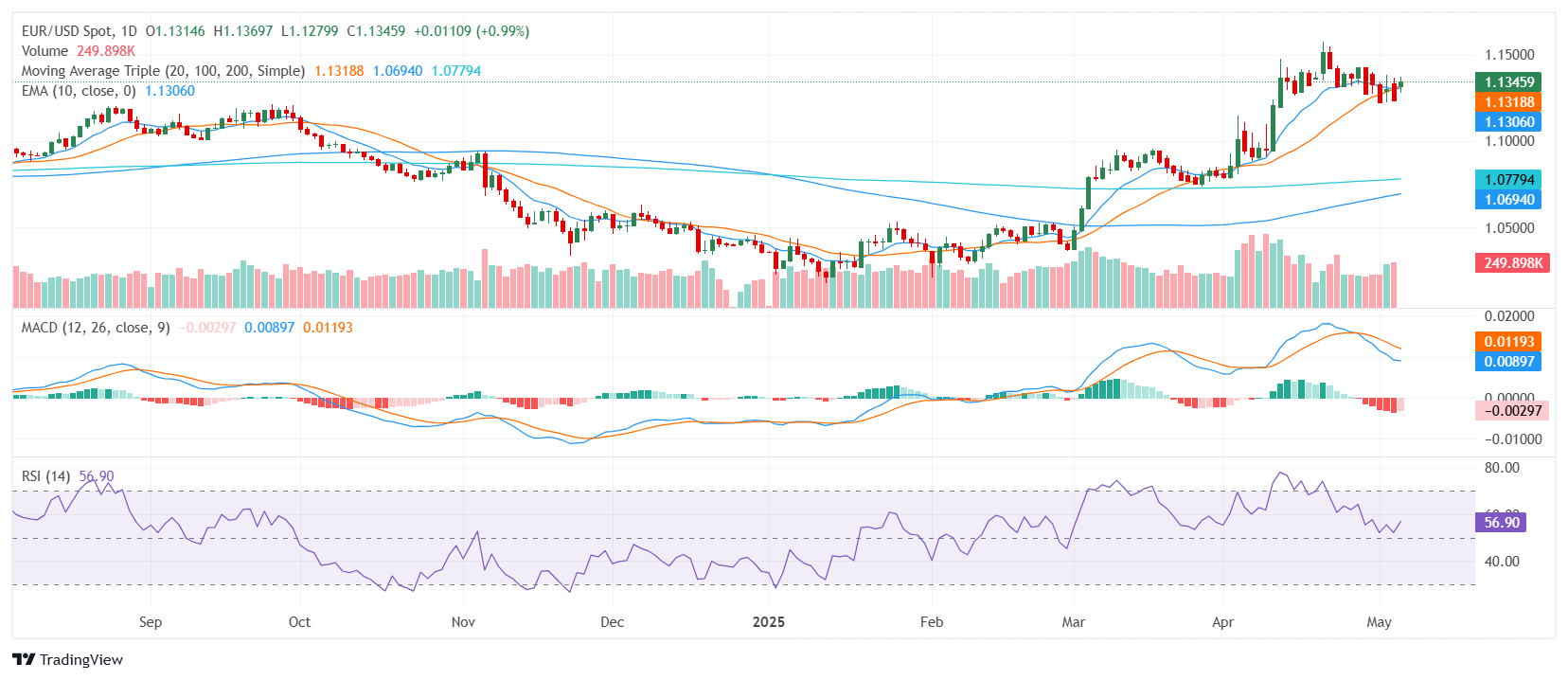
The EUR/USD pair moved slightly higher on Tuesday, trading near the 1.1300 zone after the European session as buyers remained in control despite a lack of strong momentum. The pair sits mid-range within today’s movement and is holding above key trend indicators, maintaining a bullish posture even as intraday signals suggest temporary indecision.

Technically, EUR/USD is flashing a bullish overall bias. The Moving Average Convergence Divergence currently prints a sell signal, while the Relative Strength Index stays neutral just under 60, reflecting steady—but not aggressive—momentum. The Awesome Oscillator and Stochastic %K are also neutral, pointing to limited short-term directional strength as the pair consolidates recent gains.

Beneath the surface, the bullish structure is well supported. The 20-day, 100-day, and 200-day Simple Moving Averages are all sloping upward and positioned below current price action. Reinforcing this trend are the 10-day EMA and SMA, which also point higher and sit just underneath the current zone, providing dynamic support on minor pullbacks.

Support is located at 1.1344, 1.1332, and 1.1331. Resistance remains limited at the upper end of today’s range near 1.1370. A decisive push above that zone could reactivate bullish momentum, while failure to hold support may lead to a brief pause in the uptrend without yet threatening the overall structure.

Daily Chart
Author

Patricio Martín

Patricio is an economist from Argentina passionate about global finance and understanding the daily movements of the markets.


More from Patricio Martín
Share:

Editor's Picks

AUD/USD looks weaker, focus is back to 0.7100

AUD/USD reverses Tuesday’s gains and retreats markedly toward four-day troughs in the low 0.7100s ahead of the opening bell in Asia. The firmer tone in the Greenback weighs on the risk complex amid unabated tensions on the US-Iran front, prompting the Aussie to shed part of recent gains and refocus on the downside. Moving forward, Australian trade balance results should entertain investors early on Thursday.

Japanese Yen bounces up from lows after Japan PM Takaichi’s intervention warnings

The Japanese Yen bounced up from five-week lows against the US Dollar, turning positive on the daily chart, as Japan’s Prime Minister Sanae Takaichi warned that Tokyo is ready to take action against Yen weakness. The USD/JPY pair has pulled back from the 160.00 level, considered a line in the sand for Japanese authorities, to hit session lows at 159.55.

Gold remains under bearish pressure, looks at $4,400

Gold keeps the offered stance well in place, retreating toward the $4,430 region per troy ounce, or four-day lows, on Wednesday. The yellow metal’s retracement comes in response to escalating tensions in the Middle East, which in turn continue to drive oil prices higher while reinforcing the idea of a tighter-for-longer Fed.


XRP eyes rebound despite muted ETF demand
Ripple (XRP) rebounds above $1.23 from support at $1.20 at the time of writing on Wednesday, as the broader cryptocurrency market pares losses triggered by escalating tensions in the Middle East. Appetite for risk assets remains generally low as the United States (US) and Iran exchange fire amid a fragile ceasefire and peace negotiations.
The upside-down math of debt
In 2010, Professors Carmen Reinhart and Kenneth Rogoff published a paper, Growth in a Time of Debt, which instantly went viral. The main thesis of the paper was that once a government's debt-to-GDP ratio crosses above 90%, a financial crisis and default are around the corner.
Recession on paper: What really moves the Canadian Loonie now?

Statistics Canada handed the headline writers a gift and the analysts a headache. Real GDP shrank 0.1% on an annualized basis in the first quarter, and with the fourth quarter of 2025 revised down to a 1.0% contraction, that is two negative quarters in a row, the textbook definition of a technical recession and Canada's first since the pandemic.