|

EUR/USD Price Analysis: Bulls take control as pair climbs to fresh highs

  • EUR/USD extends gains, rising to 1.0500 on Friday, hitting its highest level since late January.
  • The pair strengthens above the 20-day SMA, reinforcing a shift in sentiment toward the upside.
  • Momentum indicators remain firmly bullish, with RSI climbing deep in positive terrain.

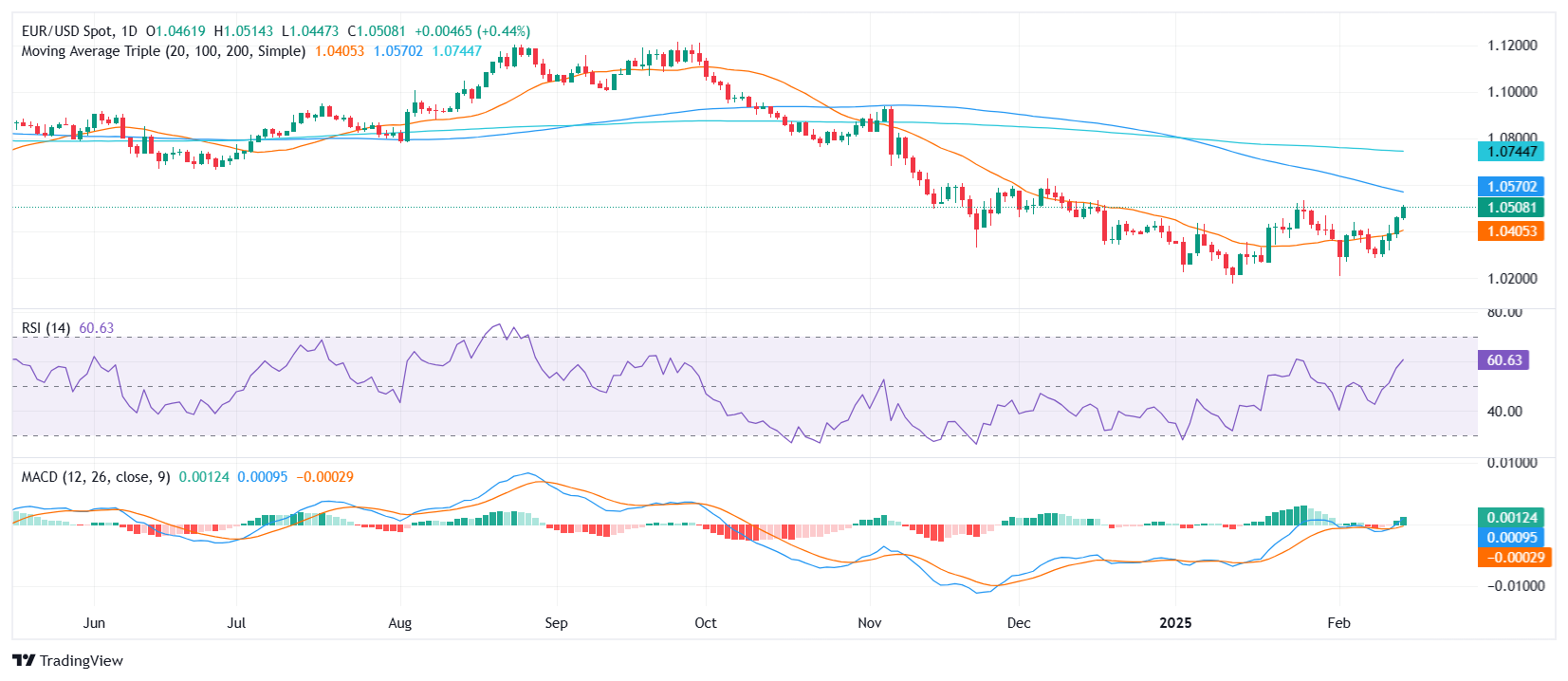
EUR/USD continued its upward trajectory on Friday, climbing to 1.0500 and marking its highest level in weeks. The pair's steady ascent above the 20-day Simple Moving Average (SMA) suggests that buyers are regaining control, potentially shifting the short-term outlook to a more constructive stance. This break above resistance levels could set the stage for further upside if momentum remains intact.

Technical indicators signal growing bullish momentum. The Relative Strength Index (RSI) has surged to 61, confirming strong buying interest, while the Moving Average Convergence Divergence (MACD) histogram prints rising green bars, reinforcing the ongoing upward push. The pair's ability to hold above the 20-day SMA suggests that dips may be viewed as buying opportunities rather than signs of renewed weakness.

Looking ahead, the next test for bulls will be the 1.0525-1.0550 zone, which could act as the next resistance area. If buyers maintain control, a move toward 1.0600, around the 100-day SMA, is not out of the question. On the flip side, should the pair slip back below the 20-day SMA, initial support emerges at 1.0450, with a deeper retracement potentially targeting 1.0420.

EUR/USD daily chart
Author

Patricio Martín

Patricio is an economist from Argentina passionate about global finance and understanding the daily movements of the markets.


More from Patricio Martín
Share:

Editor's Picks

AUD/USD bulls seem hesitant below 0.7050 ahead of RBA on Tuesday

AUD/USD reverses an Asian session dip on Monday as renewed optimism over Iran diplomacy boosts investor confidence, keeping a lid on the safe-haven US Dollar and supporting the risk-sensitive Aussie. Spot prices, however, remain below the one-month high, touched last Thursday, as bulls wait for the crucial RBA decision before taking fresh positions.


USD/JPY climbs to 158.00 neighborhood as BoJ uncertainty weighs on the JPY

The USD/JPY pair gains some positive traction at the start of a new week, recovering further from Friday's post-Bank of Japan (BoJ) swing low to sub-157.00 levels. The momentum lifts spot prices to the 158.00 neighborhood during the Asian session and seems unaffected by fresh intervention warning from Japan's Finance Minister Satsuki Katayama.

Gold recovers on positive US-Iran headlines

Gold extends its recovery during American trading hours on Monday, supported by falling Oil prices following positive headlines on US-Iran talks. The metal regains ground after hitting a fresh yearly low of $3,870 on Friday and ending October down 6.87%. However, the rebound lacks conviction as the fundamental backdrop continues to raise doubts over a sustained recovery.

Bitcoin braces for US midterm elections as historical sell-offs revive downside concerns
Bitcoin (BTC) braces for the impact of the US midterm elections, just a week after the $6 billion hack from Binance. Historically, congressional elections have negatively affected not just the president’s party but also Bitcoin. In the last 22 midterms, the ruling party has gained House seats only twice, while the three most recent elections coincided with Bitcoin’s bear market bottoms.
Why strong US growth could not stop the bond rally and AI selloff

The US economy grew at a 3.4% annual rate, yet Treasury yields fell and the Nasdaq ended October with its worst monthly performance since March 2025. The market is no longer rewarding capital expenditure simply because it supports growth. Investors are testing whether that expenditure can produce cash flow and returns above the cost of capital.


The 2% inflation target came from a throwaway remark. It now moves trillions
The Federal Reserve's 2% inflation goal grew out of an off-the-cuff remark by a New Zealand politician in 1988. Bond investors still price long-term US debt as if 2% holds, so a change in how the Fed measures inflation would move markets.















