EUR/USD plunges on risk-aversion as safe-haven flows bolstered the US dollar
- The shared currency struggled near 1.0300 and tumbled below 1.0200 before regaining the price level.
- Risk aversion keeps traders’ flows into safe-haven peers, like the greenback.
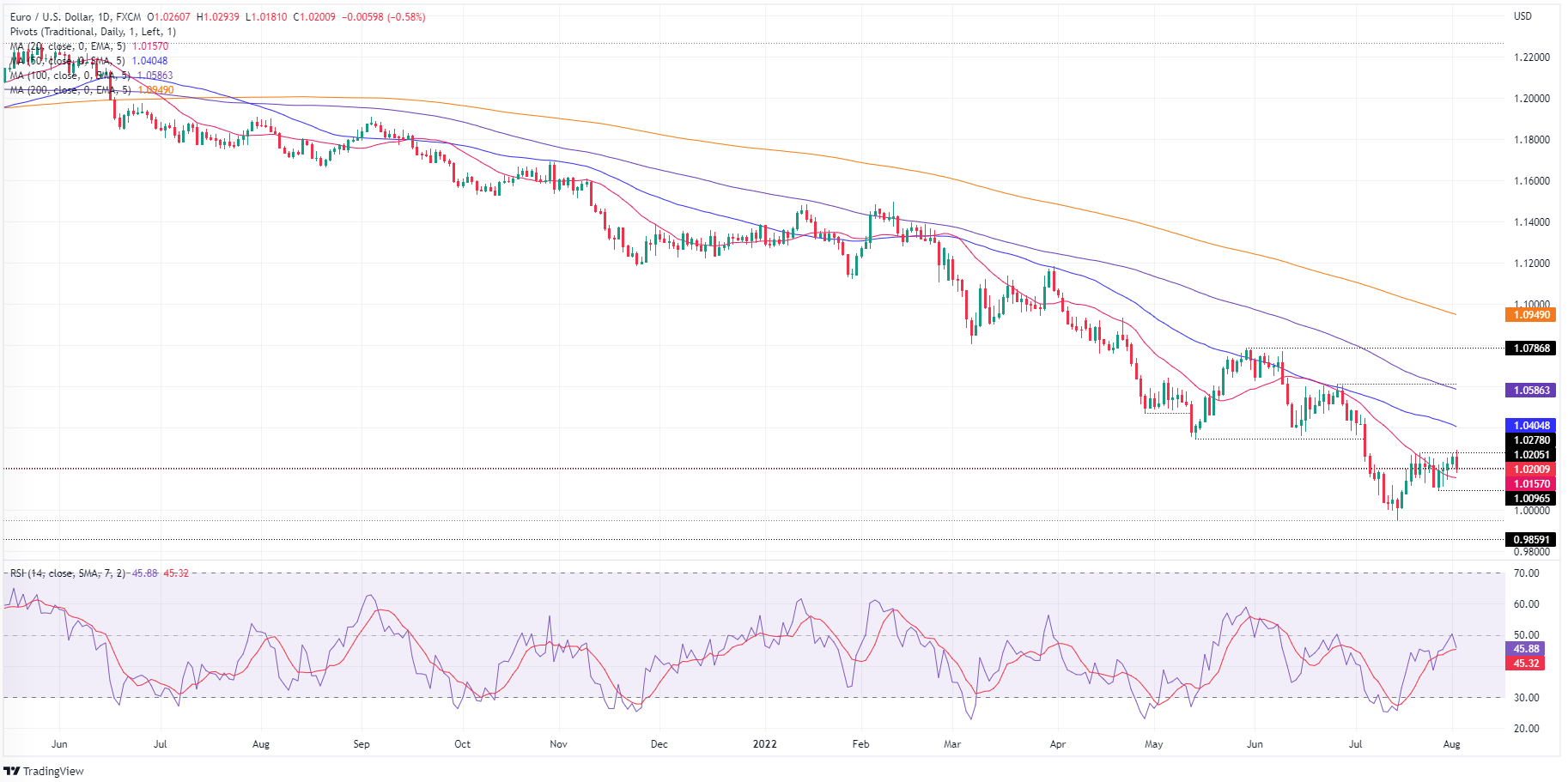
- EUR/USD Price Analysis: Failure to hold above 1.0200, the EUR/USD could dive towards 1.0100; otherwise, a rally to 1.0300 is on the cards.

The common currency remains heavy and falls on Tuesday, as risk-aversion dominates traders’ mood. Geopolitical tensions are arising from the visit of US House’s Nancy Pelosi to Taiwan, as news flows emerging from China condemned the visit. Besides that, Fed speaking commentary, saying that the US central bank is “nowhere near” to be done fighting inflation, keeps investors uneasy.
The EUR/USD is trading at 1.0200, after hitting a daily high at 1.0293, but flows to safety, augmented demand for the greenback.
EUR/USD creeps lower on haven flows
Newswires from China signaling increasing military drills around Taiwan would likely keep the sentiment sour. Aside from this, US labor market data, namely JOLTs Job Openings for June, rose to 10.7 million, less than 11 million estimated by the streets. That suggests the labor market is easing amid growing economic pressures.
Fed speakers have begun to cross wires led by San Francisco Fed President Mary Daly, saying that the Fed is “nowhere near” done in fighting inflation and added that “it would be premature to unwind all of that (Fed tightening) and say the job is done.”
Late, the Chicago Fed President Charles Evans said that going 50 bps “is a reasonable assessment, but 75 bps could also be okay.”
Whereas in the Eurozone, Spain reported data, with the July Consumer Confidence slowing to 55.5, less than estimates at 60.1, and lower than June’s 65.8. Though data was mainly ignored, the euro is feeling the pain from falling German bunds yields, with the 10-year bund rate down from 0.885% to 0.820%, higher than its daily low at 0.678%.
The US Dollar Index, a gauge of the greenback’s value vs. a basket of peers, rises 0.05% and sits at 105.882, underpinned by haven flows, as geopolitical tensions uprise, weighing on the Loonie.
What to watch
The EU economic docket will feature Germany’s Trade Balance and a tranche of S&P Global Services and Composite PMIs from Eurozone countries and the bloc. That, alongside EU, France, and Italy’s Retail Sales, would be some data to digest for EUR/USD traders.
On the US front, further Fed speakers will shed light on the future of further Fed tightening. On Wednesday, the docket will unveil S&P Global PMIs, ISM Non-Mfg. PMIs, and Factory Orders for June.
EUR/USD Price Analysis: Technical outlook
The EUR/USD is downward biased, even though it bounced off YTD lows, reached on July 14. Nevertheless, EUR/USD buyers could not crack above the 1.0300 mark, exposing the pair to selling pressure. Therefore, the EUR/USD first support would be the 20-day EMA at 1.0157. Once cleared, it would open the door for a dive towards 1.0100. Otherwise, if the EUR/USD breaks above 1.0300, it could send the pair towards the 50-day EMA at 1.0405.
Author

Christian Borjon Valencia
FXStreet
Markets analyst, news editor, and trading instructor with over 14 years of experience across FX, commodities, US equity indices, and global macro markets.
















