|

EUR/USD needs to hold onto support at 1.0972 to weather the dollar storm – Confluence Detector

EUR/USD has been on the back foot as a turbulent quarter is drawing to an end. How is the world's most popular currency pair positioned on the charts?   

The Technical Confluences Indicator is showing that euro/dollar has robust support at 1.0972, which is the convergence of the Fibonacci 61.8% one-month, the Simp[le Moving Average 5-one-day, and the Fibonacci 38.2% one-week.

Further down, the next significant cushion is at 1.0880, where the previous yearly, the SMA 50-4h, the SMA 200-1h, and the SMA 10-one-day meet up.

Resistance levels are spread out, with one hurdle awaiting at 1.1046, which is the confluence of the Fibonacci 23.6% one-day, the previous 4h-high, and the 100-day SMA. 

Further up, 1.1091, is where the Fibonacci 61.8% one-day and the previous monthly high converge. 

Here is how it looks on the tool:
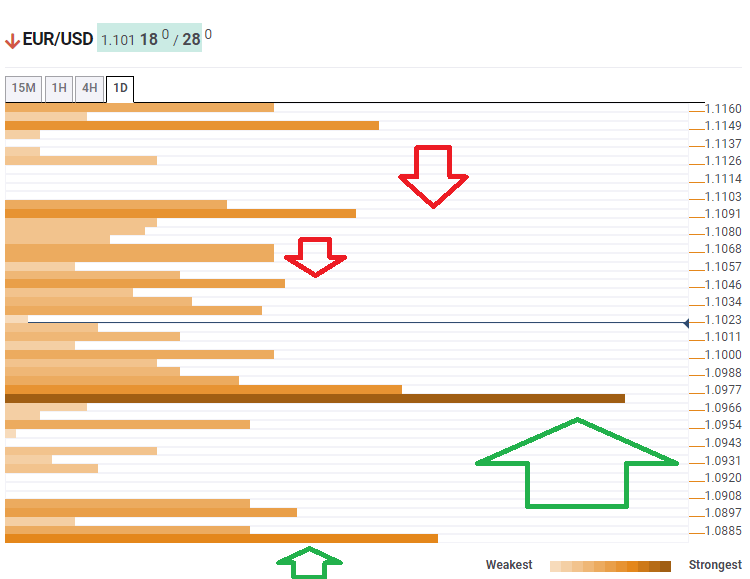
EUR USD Technical Confluence March 31 2020

Confluence Detector

The Confluence Detector finds exciting opportunities using Technical Confluences. The TC is a tool to locate and point out those price levels where there is a congestion of indicators, moving averages, Fibonacci levels, Pivot Points, etc. Knowing where these congestion points are located is very useful for the trader, and can be used as a basis for different strategies.

This tool assigns a certain amount of “weight” to each indicator, and this “weight” can influence adjacents price levels. These weightings mean that one price level without any indicator or moving average but under the influence of two “strongly weighted” levels accumulate more resistance than their neighbors. In these cases, the tool signals resistance in apparently empty areas.

Learn more about Technical Confluence

Author

Yohay Elam

Yohay Elam

FXStreet

Yohay is in Forex since 2008 when he founded Forex Crunch, a blog crafted in his free time that turned into a fully-fledged currency website later sold to Finixio.


More from Yohay Elam
Share:

Editor's Picks

AUD/USD meets support near 0.7020 ahead of key jobs data

AUD/USD’s decline has gathered extra pace on Wednesday, with the pair slipping back to levels last seen in early August in the low 0.7000s. The continuation of the bearish tone in the pair has come on the back of the strong upward trend in the Greenback, underpinned by rising bets for extra tightening by the Fed. Moving forward, the jobs report will gather all the attention on the domestic calendar.

USD/JPY stands firm near mid-157.00s, close to two-week high

USD/JPY hovers around mid-157.00s in the Asian session on Wednesday, near two-week highs touched last Friday as the BoJ's dovish rate hike continues to undermine the Japanese Yen. Meanwhile, the US Dollar remains firm amid the Fed's hawkish stance, adding support to the pair, though JPY intervention fears cap further gains. Markets pay little heed to the completion of the round of US-Iran indirect talks ahead of Trump-Xi meeting.

Gold falls to weekly troughs below $4,300

Gold rapidly leaves behind two daily upticks in a row and comes under heightened downside pressure midweek. Indeed, the precious metal breaches below the $4,300 mark per troy ounce to reach weekly lows amid the marked recovery in the US Dollar and the generalised upbeat tone in the US money market.

Australia unemployment rate expected to remain unchanged at 4.5% in August
Australia will release the August monthly employment report on Thursday at 01:30 GMT. Ahead of the announcement, analysts expect the country to have added 20K new jobs in the month, while the Unemployment Rate is expected to remain steady at 4.5%. The Australian Bureau of Statistics (ABS) report is also expected to show that the Participation Rate stood at 66.9%, unchanged from the previous month.
Freight costs may reach US shelves after the Fed plans to stop hiking

The Federal Reserve has forecast its main reference rate unchanged through 2027, a year when higher shipping costs are likely still reaching US store prices. Shipping a container from Asia to the US costs more than four times what it did before the war with Iran began in late February. International Monetary Fund research puts the peak effect on shop prices roughly a year out, in 2027.

BoJ Recap: Not as hawkish as expected

The Bank of Japan (BoJ) raised its short-term interest-rate target to 1.25% from 1.00% in a 7-2 vote, marking another step in the normalisation of monetary policy and widely matching what everyone has been expecting for weeks.